Skip to content

ELCA Blogs

Annexation will undermine peace in Middle East

Ecumenical organizations warn Israel’s planned action would further damage hopes for justice and lasting peace

(LWI) – Leading ecumenical organizations are urging the international community to oppose Israel’s planned annexation of parts of the occupied West Bank.

The Lutheran World Federation (LWF), together with the World Council of Churches (WCC), the World Communion of Reformed Churches (WCRC) and the Action by Churches Together (ACT) Alliance issued a statement on 29 June calling for an end to the occupation and for a resumption of dialogue to build lasting peace between Palestinians and Israelis.

The Israeli government has said it plans to effectively annex parts of the West Bank by extending its sovereignty to areas that contain Jewish settlements, as well as parts of the Jordan valley. The settlements are considered illegal under international law and an obstacle to a proposed ‘two state solution’ in the region.

The ecumenical organizations say the planned annexation “is in direct violation of international law” and would further threaten hopes for justice and peace in the region.They warn it would “undermine even more the rights of Palestinians, reducing their mobility, their access to land and livelihoods, to adequate infrastructure and basic services,” as well as increasing forced displacement and putting at risk access by humanitarian organizations.

The organizations pledge to continue working for peace in the Holy Land, insisting that “peace can never be unilaterally imposed or achieved by violent means.”

(This text is from the LWF website and can be found here)

READ the Full Statement here

Share

5 Ways to Support Refugees and Migrants


At the end of 2019, there were 79.5 million displaced people around the world. That’s 1% of the world’s population.

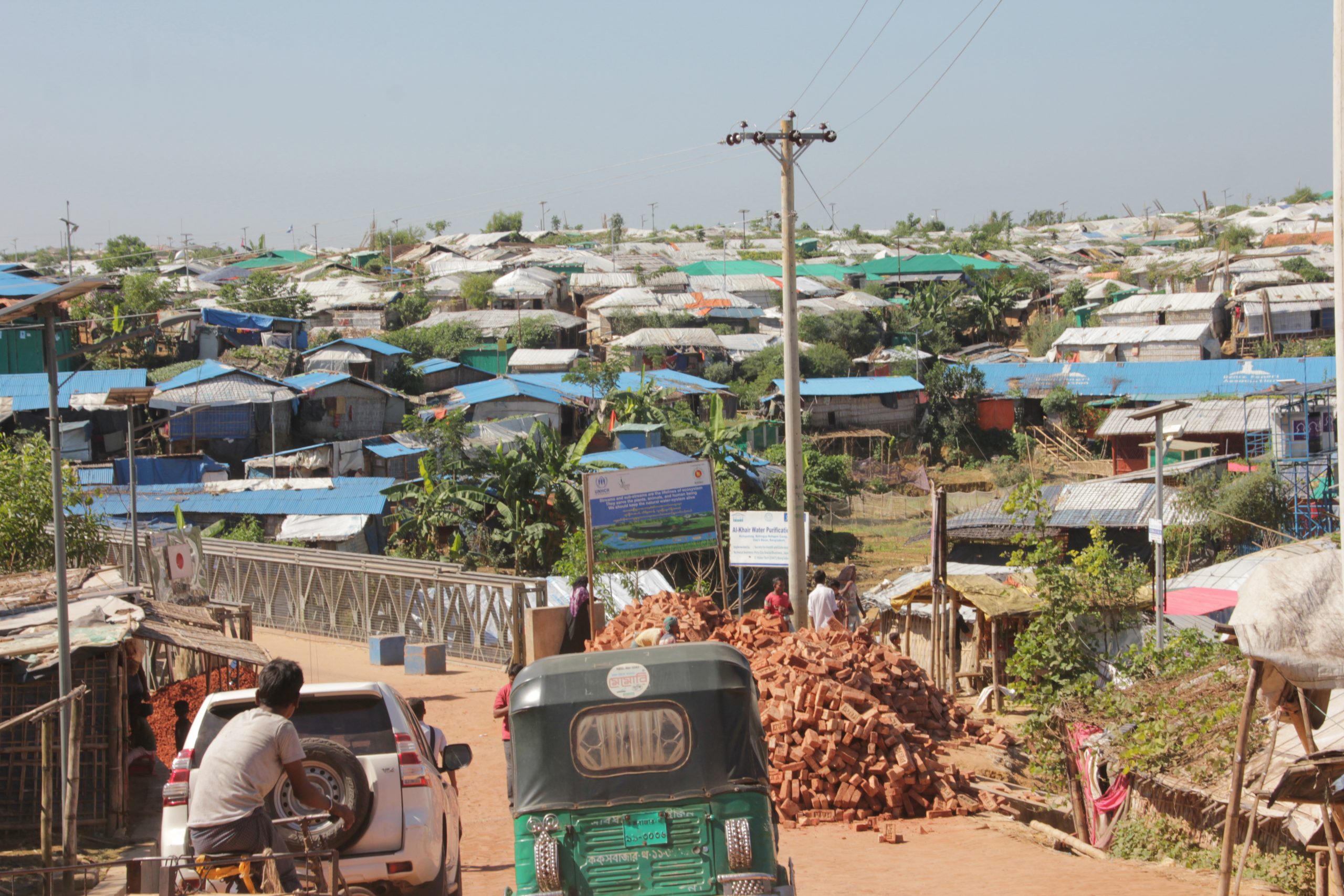
The Rohingya refugee camp in Cox’s Bazar, Bangladesh, where nearly 1 million Rohingya currently live. Photo: Y. Franklin Ishida

26 million of them are refugees, people who leave their countries of residence due to conflict or persecution. 45.7 million of them are internally displaced people, who, for the same reasons, move to other areas in the country. Refugees are protected under international laws. There’s also 272 million migrants worldwide. Migrants choose to cross borders for many reasons – searching for work or education, escaping hardships as a result of natural disasters, reuniting with family – and are protected under domestic laws, but not international law. Lutheran Disaster Response is dedicated to supporting displaced people – and so can you! Here are a few ways to support refugees and migrants in your daily life: 


1. Worship with refugee and migrant communities 

There are ELCA congregations around the country with ministries that support refugees and migrants from around the world. The ELCA is a sanctuary denomination, meaning that our faith calls us to walk alongside refugees and immigrants. Through the AMMPARO strategy and support of Lutheran Immigration and Refugee Service, the ELCA shows its dedication to welcoming immigrants and refugees, regardless of country of origin.   

2. Help children gain perspective on refugees 

By talking about refugees with children, you are showing why it is important to be compassionate and treat others with dignity. Learning about refugees and immigrants from a young age can prepare children for when they interact with them throughout their lives. Try using this educational toolkit from the United Nations Refugee Agency or find age-appropriate books 

3. Support migrant and refugee-owned businesses 

Find refugee-owned businesses in your area and support them. If there aren’t any in your town, try online! If you own a business yourself, try to source from refugee or migrant artisans. This is especially important during the COVID-19 pandemic, when small businesses of any variety are struggling. 

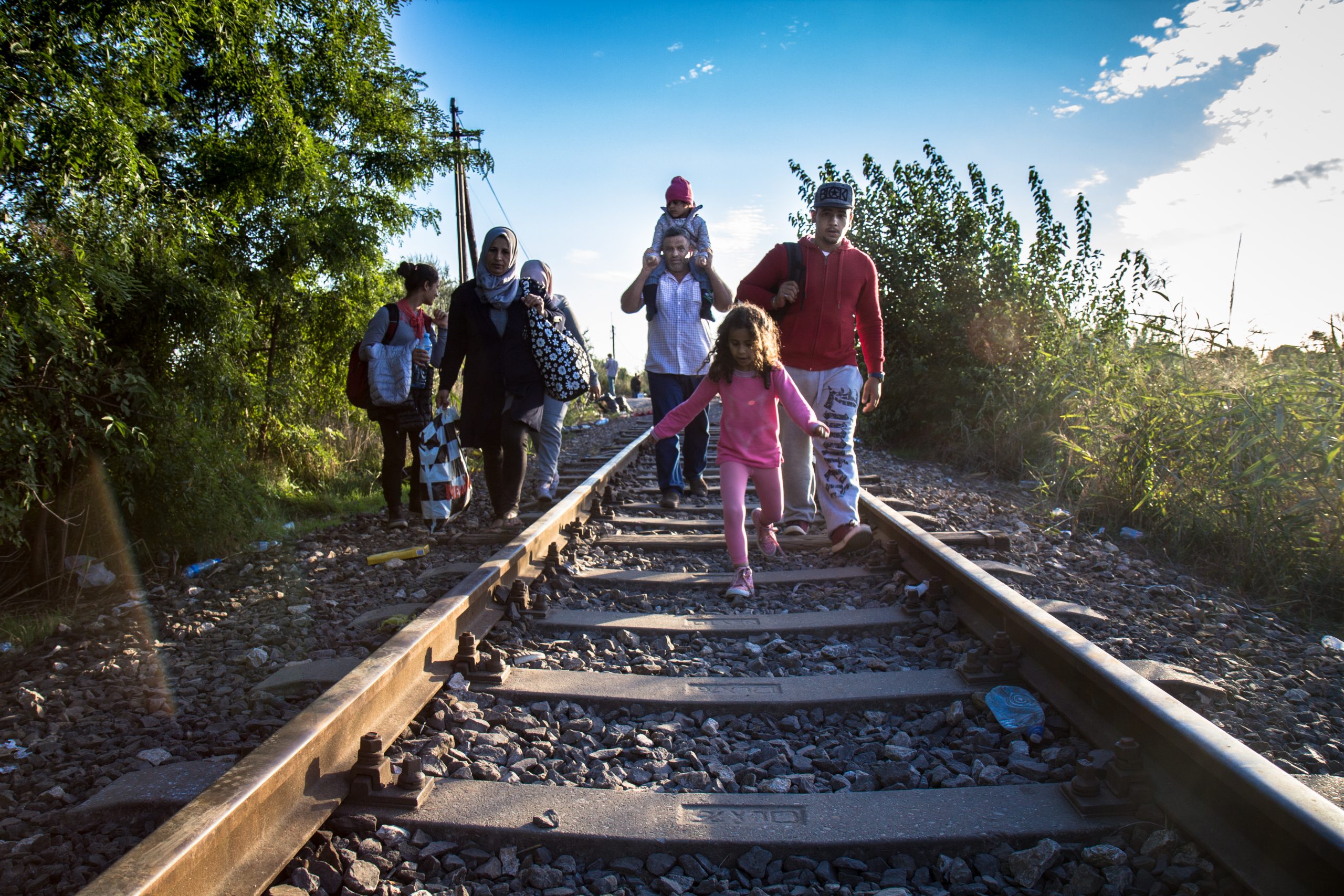
Iraqi refugees crossing the Hungarian border. Photo: ACT Alliance/Fekete Dániel

4. Understand why this issue matters 

As people of God, we are called to love our neighbor and care for those in need. The ELCA social message on immigration says “The presence of newcomers in our church and society heightens our awareness of these realities and of the experience of new immigrants, refugees, and asylum seekers in the United States. This awareness makes us more appreciative of the gifts our new neighbors bring and of the barriers as well as the opportunities they encounter. 


5. Donate 

Lutheran Disaster Response supports refugees and host communities around the world. Donations to the South Sudan fund, the Middle East and Europe Refugee Crisis fund, and AMMPARO will be used in full to support our work with refugees and migrants to bring them hope and renewal in a tumultuous time.  


Adapted from “5 ways to support refugees during the coronavirus crisis from the UNHCR 


Share

Crisis within a Crisis: Immigration around the Globe. Exacerbating the existing vulnerabilities of the world’s refugees and internally displaced people in the midst of a pandemic.

“Governmental oppression, war and famine send historic numbers of people streaming via dangerous routes into nearby countries that are overwhelmed and often reluctant to accept them. People are treated as “suspicious” or are brutalized simply because of their gender, race, ethnicity or religious beliefs”.

A Social Message on Human Rights, 2017

An unprecedented global pandemic that knows no border has brought into sharp focus the intersection of immigration and public health policy, and the unique challenges that immigrants, refugees and asylum seekers face throughout the world today. This pandemic is on track to exacerbate the vulnerabilities of some of the 272 million international migrants worldwide. Persons displaced internally and across borders are particularly at risk – and the majority of the world’s 25.9 million refugees and 41.3 million internally displaced persons are in developing countries that are being affected by the pandemic, where government institutions and medical facilities won’t be able to cope with the disease due to lack of infrastructure, resources and human capital.
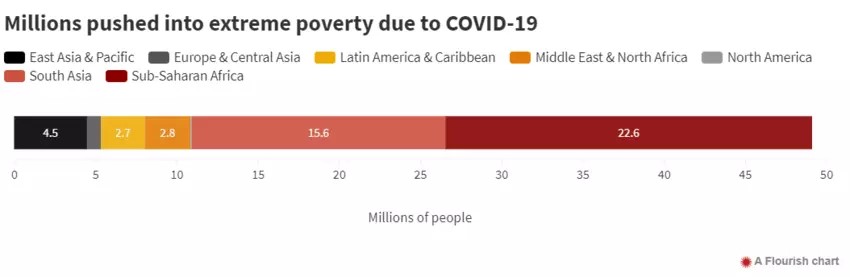
COVID-19 outbreak: Migration, effects on society

https://assets.weforum.org/editor/responsive_large_webp_gKyssTbK1uVQQcxOsKfhCaQkB-v0IUg9HL_wHf-uQO8.webpGovernments are increasingly introducing measures to ‘flatten the curve‘ as infections are detected in a growing number of countries. As of 26 March, over 180 countries, territories and areas had passed travel restrictions due to COVID-19, including prohibitions of entry of nationals from other countries. These measures are complemented by the closure of borders in several countries, as well as the temporary suspension of labor migration from South Korea to Argentina, though the epidemiological research on pandemic travel bans show that they are ineffective and do not prevent the spread of disease particularly when the pandemic has already spread. A virus spreads among citizens just as fast, without selecting who to target. 
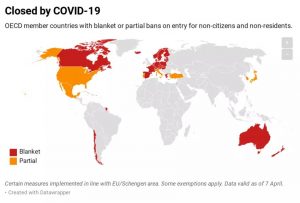
https://www.weforum.org/agenda/2020/04/covid-19-is-throttling-vital-migration-flows/

Migrants living in camps at the doorstep of Europe or the United States face the possibility of a devastating virus outbreak given their proximity to highly affected countries and their often-cramped living conditions, coupled with already stretched healthcare services. According to AMMPARO companions, serious outbreaks have already happened among migrants and shelters that are Covid-19 free are no longer accepting new residents for that reason. Physical isolation is not an option.

While the coronavirus pandemic has eclipsed a recent crisis at the border between Turkey and Greece, the situation of facilities in the Greek islands is alarming, leading some to call for the immediate evacuation of migrants. Similar fears of a COVID-19 outbreak have been expressed over a makeshift migrant camp at the US-Mexico border.
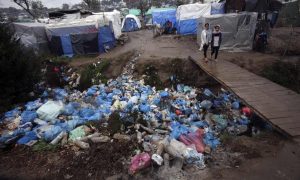
20,000 people are currently living in and around Moria refugee camp on Lesbos. Photograph: Miloš Bičanski/Getty
https://www.theguardian.com/global-development/2020/mar/11/lesbos-coronavirus-case-sparks-fears-for-refugee-camp-moria

The ELCA continues to  and related matters in Mexico and the Northern Triangle of Central America through the AMMPARO program and its advocacy work.

The plight of migrants in camps is not only at stake in those regions worst affected by the pandemic. As the virus progresses, it will endanger the lives of many in countries that host a large number of displaced persons, such as Jordan, Lebanon, Syria or Bangladesh. Resettlement is even more remote as the International Organization for Migration and the United Nations High Commissioner for Refugees have been forced to temporarily suspend refugees’ resettlement travels due to states’ mobility restrictions and concerns over exposing refugees to COVID-19. Developing countries will need the support of the international community to combat the virus for all who live in their communities.
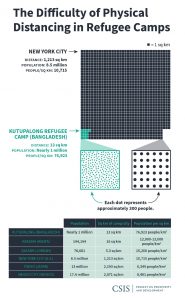
https://www.csis.org/analysis/can-i-stay-or-can-i-go-now-longer-term-impacts-covid-19-global-migration

Coronavirus is also exacerbating the vulnerabilities of migrants working in destination countries. Questions are being raised about the risks for migrant workers in the Gulf Cooperation Council (GCC) countries, as most of them live in highly populated migrant labor camps with insufficient sanitary conditions and pre-existing health issues caused by their work. In addition,  detained administratively in cramped facilities are at greater risk of becoming infected. Belgium, Spain, the Netherlands and the United Kingdom have released some irregular migrants from administrative detention given the inability to proceed with deportation under the current state of emergency. The same pledge is being done in the United States, especially after the death of a 57-year-old man in immigration custody held at the Otay Mesa Detention Center in San Diego and a second death of an immigrant detained at Stewart Detention Center in Georgia

More generally, the lockdown of some countries is impacting all state services, slowing down both migration processing and assistance provided to asylum seekers. Some essential migrant support services are simply being closed until further notice due to the prohibition of social gatherings, as is the case with a migrant kitchen at Colombia’s border that normally feeds around 4,500 Venezuelan migrants every day and offers basic medical services.

In the United States, migrants including unaccompanied children are being turned back at the border or deported back to countries of origin despite their well-founded fear of persecution. All immigration cases except of those detained are being adjourned to new dates. 
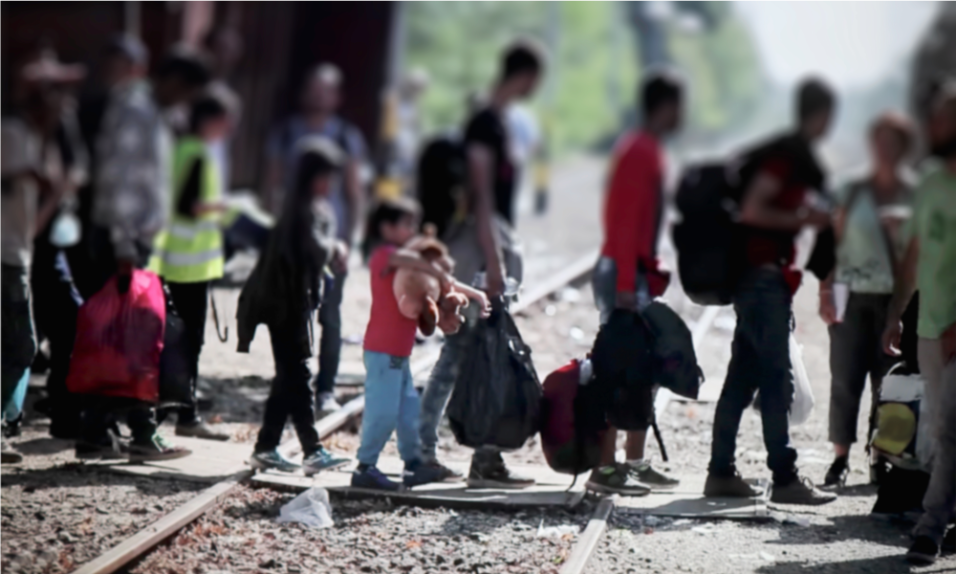
United States Southern Border – Mexico
https://oecd-development-matters.org/2020/04/02/covid-19-consequences-for-international-migration-and-development/

Migrants’ socioeconomic status may negatively impact their ability to take all precautionary measures against COVID-19 and to receive medical care if contaminated due to lack of or inappropriate health insurance and insufficient financial resources. Among these migrants, those in an undocumented   are often uninsured and may be reluctant to enter medical facilities for fear of being reported if no appropriate firewalls exist regarding data sharing with the immigration and law enforcement authorities. From China to South Africa, and the United States, calls are being made for inclusive COVID-19 responses to ensure migrants are incorporated not only into public health strategies and planning around the world, but also in their national economic relief responses.

Our Church, Our Social Statements, Our Actions During Times of Coronavirus
A longer-term impact of COVID-19 may be on the future of migrants’ integration and social cohesion. Feelings of distrust and instances of discrimination exacerbated by fake news, misinformation and the politicization of the issue have already emerged. The spread of the virus in some countries in Western Africa has even been referred to as the ‘coronization of populations’ – that is, a new form of colonization through the coronavirus, exposing a deep-seated xenophobia as well, especially an Anti-Asian sentiment.

Uncertainty and anxiety should not become justifications for scapegoating migrants, but rather should be an opportunity to better display empathy and solidarity. The loss of control being felt across communities in the United States and elsewhere – related to the inability to cross borders, the restrictions on freedom of movement, displays of extreme panic buying, and feelings of physical isolation – provide insights into the daily struggles faced by displaced persons around the world every day. As church, we should use this understanding to ensure migrants are not left behind and address the scourge of racisms within the policies that sustain our country and communities as well as those in other countries. Lutherans have a long history of supporting migrants in the US (e.g. 2019 Churchwide Assembly actions through the adoption of the AMMPARO strategy in 2016 and becoming a sanctuary church body in 2019 as well as CA19.03.11 and CA19.05.31). The ELCA Human Rights Social Statement encourages us to draw attention and find courage, and act with discernment and action to promote and protect human rights.

In recent years, migrants are often treated as “suspicious” or are brutalized simply because of their gender, race, ethnicity or religious beliefs. And the root causes of their migration journey usually lie because of war, extreme poverty, lack of access to basic services, such as clean water, and environmental degradation, which doesn’t allow them to flourish within their communities. Our church teaches us that “through Jesus, our relational God took on the vulnerable and finite human form of a Jewish man, a group oppressed by the Roman Empire. The Word’s embodiment in concrete, finite form teaches that recognizing the multidimensional needs of human bodies is one means of honoring God’s creation. Working to uphold rights is a concrete way to respond to the neighbor’s need”.
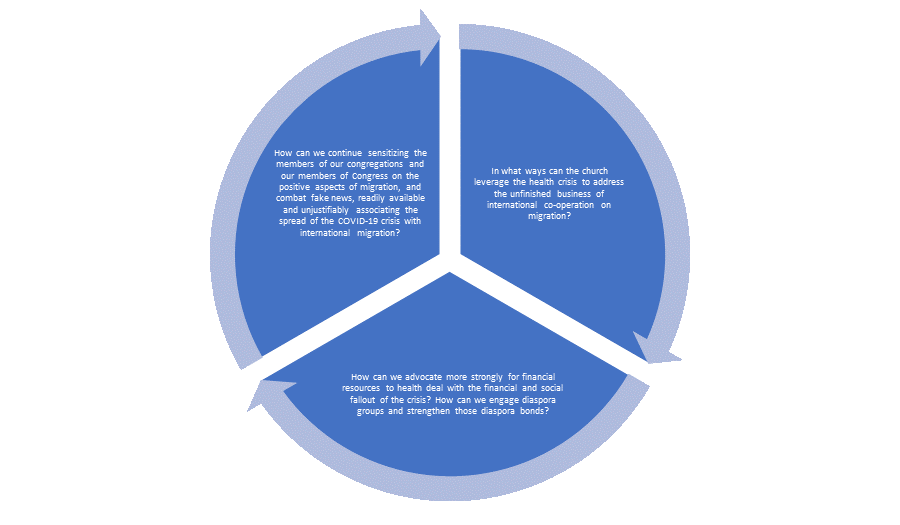
                                             REFLECTION QUESTIONS


Genesis 12:1 – The call of Abram:  “Go from your country and your kindred and your father’s house to the land that I will show you.”


Look for more information about how the AMMPARO network is responding to vulnerable communities both international and in the US in upcoming blog posts.


 

Share

Amplifying the Message in Word and Deed: Liberation not Annexation

By Kathryn Mary Lohre

The government of Israel has declared its intention to annex West Bank settlements and the Jordan Valley, as soon as July 1. Israel Prime Minister Benjamin Netanyahu depends on the backing of the US presidential administration to legitimize what would be considered illegal under international law.

The Palestinian people, who have lived under Israeli military occupation for nearly 53 years, are crying out once again. They are calling us to recognize yet another looming pandemic: the dissolution of prospects for peace with justice for Israelis and Palestinians – Jews, Christians and Muslims.

In recent weeks, these pleas from our Palestinian Christian family have included:

To our Palestinian family, and especially our Palestinian Lutheran family: the ELCA hears your cries. This cannot be overstated – to you, and to anyone else who is listening. Presiding Bishop Elizabeth Eaton has spoken out clearly on behalf of the ELCA, and also with ecumenical partners. This is critical.

At the same time it falls to all of us to work to amplify your call for “liberation not annexation,” and to accompany you in being a “disturbing presence” for peace through prayer, action, and advocacy with our elected leaders (For Peace in God’s World, 1995). Consistent with our social teaching, we denounce beliefs and actions that “ordain the inherent right of one people, race, or civilization to rule over another” and that “despair of any possibility of peace.” Therefore, as an act of Christian witness, we denounce the government of Israel’s plans for annexation and the political and theological beliefs that falsely justify it as a viable solution for peace.

When we are a disturbing presence for peace, our focus is on justice. Thus, we make a clear distinction between our critique of unjust Israeli government policies and our commitments to anti-Semitism and right relationship with the Jewish community. Our Churchwide Strategy for Engagement and Israel and Palestine can and does coexist with A Declaration of the ELCA to the Jewish Community. As Lutherans we live faithfully in the tension of this “both/and,” as justice is at the heart of both sets of commitments.

When we are a disturbing presence, we work to uncover the deep, systemic connection between the oppression of one people and the oppression of another, and between the liberation of the oppressed and the liberation of all. The racism that has kneeled on the necks of Black Americans for 400 years is part of the same global pandemic as the racism that has been kneeling on the necks of Palestinians for 53 years of military occupation, and that has been even more suffocating under Israel’s nation state law, adopted in 2018. The Palestinian cry for justice cannot be heard apart from the Black cry for justice. For those of us who are not crushed under the weight of anti-Black racism or military occupation, we must redouble our efforts to learn, listen, and be transformed for the sake of the liberation of our whole human family.

When we are a disturbing presence, we put people front and center. This means we look to our Palestinian partners, and especially our Lutheran family, to guide our work and witness for just peace. We also engage with our ecumenical and inter-religious partners to amplify these voices, and to enhance the impact of our collective advocacy. Importantly, it also means that we build strong relations with our Jewish partners so that when our church’s decisions, policies, and public witness cause misunderstanding, tension, or conflict, we can interpret as we seek to accompany both the Palestinian people and the Jewish community in seeking justice for all.

500 years ago, Martin Luther wrote the treatise “The Freedom of a Christian.” In it, Luther summarizes the Christian life, also reflected in Galatians 5:1: “For freedom Christ has set us free.” Our freedom in Christ is not a freedom for ourselves, but for the sake of our neighbors, lived out in love. As an expression of the liberating love we share in Jesus Christ, we join our Palestinian family, and our partner Bishop Azar, in calling for “liberation not annexation.”

Please join in ELCA advocacy through Peace Not Walls: June action alert

Kathryn Mary Lohre serves as Assistant to the Presiding Bishop and Executive for Ecumenical and Inter-Religious Relations & Theological Discernment for the ELCA

The original blog post can be found here by Ecumenical and Inter-Religious Relations

Share

Amplifying the Message in Word and Deed: Liberation not Annexation


By Kathryn Mary Lohre

The government of Israel has declared its intention to annex West Bank settlements and the Jordan Valley, as soon as July 1. Israel Prime Minister Benjamin Netanyahu depends on the backing of the US presidential administration to legitimize what would be considered illegal under international law.

The Palestinian people, who have lived under Israeli military occupation for nearly 53 years, are crying out once again. They are calling us to recognize yet another looming pandemic: the dissolution of prospects for peace with justice for Israelis and Palestinians – Jews, Christians and Muslims.

In recent weeks, these pleas from our Palestinian Christian family have included:

To our Palestinian family, and especially our Palestinian Lutheran family: the ELCA hears your cries. This cannot be overstated – to you, and to anyone else who is listening. Presiding Bishop Elizabeth Eaton has spoken out clearly on behalf of the ELCA, and also with ecumenical partners. This is critical.

At the same time it falls to all of us to work to amplify your call for “liberation not annexation,” and to accompany you in being a “disturbing presence” for peace through prayer, action, and advocacy with our elected leaders (For Peace in God’s World, 1995). Consistent with our social teaching, we denounce beliefs and actions that “ordain the inherent right of one people, race, or civilization to rule over another” and that “despair of any possibility of peace.” Therefore, as an act of Christian witness, we denounce the government of Israel’s plans for annexation and the political and theological beliefs that falsely justify it as a viable solution for peace.

When we are a disturbing presence for peace, our focus is on justice. Thus, we make a clear distinction between our critique of unjust Israeli government policies and our commitments to anti-Semitism and right relationship with the Jewish community. Our Churchwide Strategy for Engagement and Israel and Palestine can and does coexist with A Declaration of the ELCA to the Jewish Community. As Lutherans we live faithfully in the tension of this “both/and,” as justice is at the heart of both sets of commitments.

When we are a disturbing presence, we work to uncover the deep, systemic connection between the oppression of one people and the oppression of another, and between the liberation of the oppressed and the liberation of all. The racism that has kneeled on the necks of Black Americans for 400 years is part of the same global pandemic as the racism that has been kneeling on the necks of Palestinians for 53 years of military occupation, and that has been even more suffocating under Israel’s nation state law, adopted in 2018. The Palestinian cry for justice cannot be heard apart from the Black cry for justice. For those of us who are not crushed under the weight of anti-Black racism or military occupation, we must redouble our efforts to learn, listen, and be transformed for the sake of the liberation of our whole human family.

When we are a disturbing presence, we put people front and center. This means we look to our Palestinian partners, and especially our Lutheran family, to guide our work and witness for just peace. We also engage with our ecumenical and inter-religious partners to amplify these voices, and to enhance the impact of our collective advocacy. Importantly, it also means that we build strong relations with our Jewish partners so that when our church’s decisions, policies, and public witness cause misunderstanding, tension, or conflict, we can interpret as we seek to accompany both the Palestinian people and the Jewish community in seeking justice for all.

500 years ago, Martin Luther wrote the treatise “The Freedom of a Christian.” In it, Luther summarizes the Christian life, also reflected in Galatians 5:1: “For freedom Christ has set us free.” Our freedom in Christ is not a freedom for ourselves, but for the sake of our neighbors, lived out in love. As an expression of the liberating love we share in Jesus Christ, we join our Palestinian family, and our partner Bishop Azar, in calling for “liberation not annexation.”

Please join in ELCA advocacy through Peace Not Walls: June action alert


Kathryn Mary Lohre serves as Assistant to the Presiding Bishop and Executive for Ecumenical and Inter-Religious Relations & Theological Discernment for the ELCA


Share

Voter Suppression Damage Requires Challenge

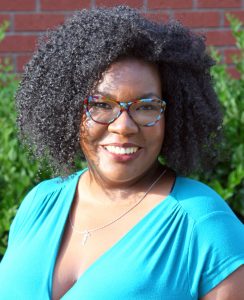
By guest blogger the Rev. Athena C. Thomasson-Bless, Social Justice and Advocacy Coordinator, ELCA North Carolina Synod

In a year where we are experiencing the COVID-19 pandemic and the Black Lives Matter Movement is gaining traction challenging police brutality and systemic racism, voting is both more important than ever and may look different this time around. An emphasis of the ELCA presiding bishop is that we are church for the sake of the world. Part of being the church for the sake of the world in 2020 is to encourage and advocate for fair elections and the right to vote.

North Carolina where I pastor and serve on synod staff is a state infamous nationwide for voter suppression controversies. These include gerrymandering, the manipulation of boundaries so as to favor one party or class; same-day registration regulation, which can allow eligible voters to register to vote and cast their ballots on the same day; and voter identification (ID) provisions, which were struck down for disproportionate affect on minority voters.


VOTER SUPPRESSION’S UNEVEN IMPACT

I have experienced some of the hoops that one must jump through to be able to vote in North Carolina and elsewhere as someone who was a student for the past nine years and has moved over six times in that span. I’ve waited in lines and driven over an hour to my polling place on one occasion. What I experienced was inconvenience. For many black and indigenous people of color, voter suppression can be a be a vote-prohibitive experience. For example, in the Kentucky primaries this week only 200 polling places were open for voters. And there was only one polling place in Jefferson County, the county with the most people and the largest black population in the state.

Projections this year indicate mail-in ballot use is on the rise. In the first half of this year, many states which do not already have a vote-by-mail election system are scrambling to reimagine the ways we can vote in the midst of COVID-19 realities. Projections by some experts of a second wave of the COVID-19 virus in the fall, and outbreak numbers rising as I write in states including North Carolina, add to the fear that voters may have going to polls. Looming pandemic realities are a real and tangible problem for our election system.

In North Carolina, usually less than 5% of votes are cast by mail in absentee ballot. However, this year, a surge of up to 40% more mail in absentee ballots according to state officials is anticipated. This is why a new bill, House Bill 1169, has been passed in the North Carolina Senate to provide more resources for voting by absentee ballot and to make it easier on voters to request and submit ballots. This bill had three votes against it, all coming from Black Representatives who did not like the bill’s mention of what they called misleading voter ID requirements. This opposition resonates with challenges in our country to white supremacy and systemic racism. Currently North Carolina does not have voter ID requirements in place due to court rulings that struck them down citing the possibility of motivation by racism. Even with this bill generated by bi-partisan support overall and providing more resources for voting by mail, the damage of voter suppression is evident.

Voter suppression has more often than not intentionally targeted the ability of black and Indigenous people of color to exercise the right to vote. This form of systemic racism is not just present in North Carolina, but across the nation. And as adaptation of voting methods to accommodate pandemic realities increases, myths about voter fraud may rise as well.


CIVIC ENGAGEMENT

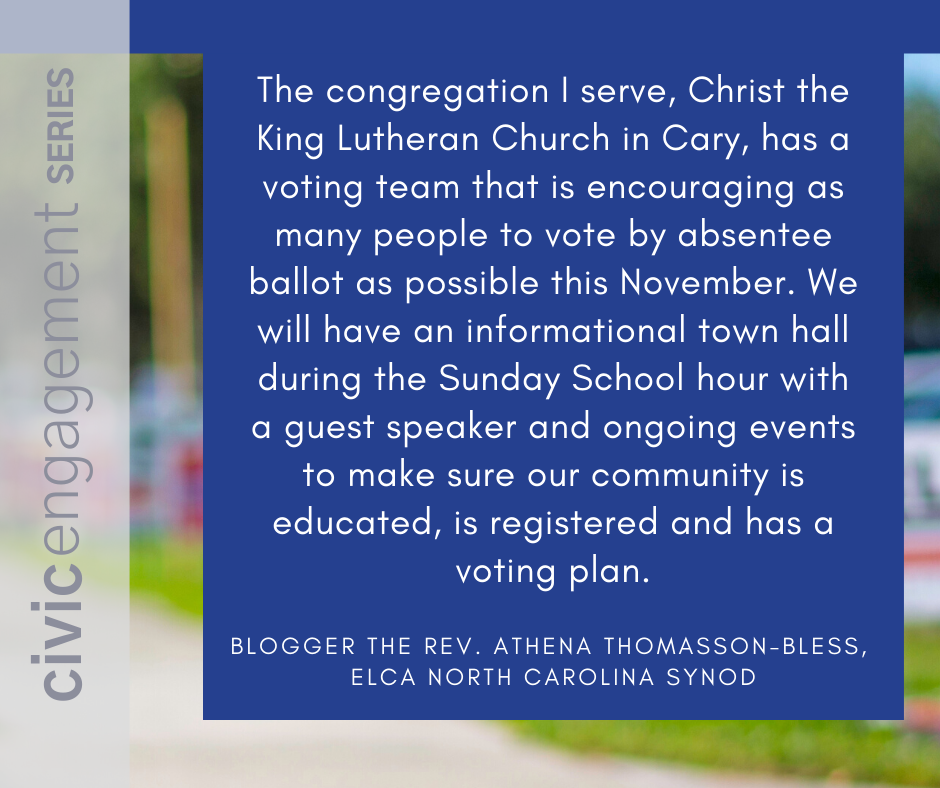
As Christians and as Lutherans, we have a responsibility to combat the sin of systemic racism and to advocate for fair and accessible elections. On a congregational level, congregations can provide resources and have Get Out the Vote drives.* The congregation I serve, Christ the King Lutheran Church in Cary, has a voting team that is encouraging as many people to vote by absentee ballot as possible this November We will have an informational town hall during the Sunday School hour with a guest speaker and ongoing events to make sure our community is educated, is registered and has a voting plan.

Our elections may look a little different this year, so please: educate yourself, your congregation and your community. Start now! November will be here before we know it. Check out your state’s Board of Elections website and our #ELCAVotes resources, stay informed – and make sure to register to vote. We have the opportunity and the responsibility to advocate for justice and peace and use our voice to vote this November.


* Tips for Get Out The Vote drives and more can be found in the ELCA Civic Engagement Guide.

Share

Vacation Bible School – At Home!


It’s hard to overstate the impact COVID-19 has had on our communities and our worship experiences. Summer 2020 has begun with a great deal of uncertainty – about our health, the health and well-being of our neighbors, jobs and more. But these past few months have revealed in surprising ways what we have known by faith – God is still at work in our world, inspiring hope, motivating change and leading us to a brighter future. And many congregations have been hard at work, adapting to meet the new needs and changing landscape of worship and faith formation.

To help with this, ELCA World Hunger is delighted to share an adapted version of this year’s Vacation Bible School: “On Earth As in Heaven…At Home!” This adaptation simplifies some of the activities in the original leader’s guide, offers tips for doing crafts and games at home, and provides links to pre-recorded videos you can share.

“On Earth As in Heaven…At Home” Leader’s Guide

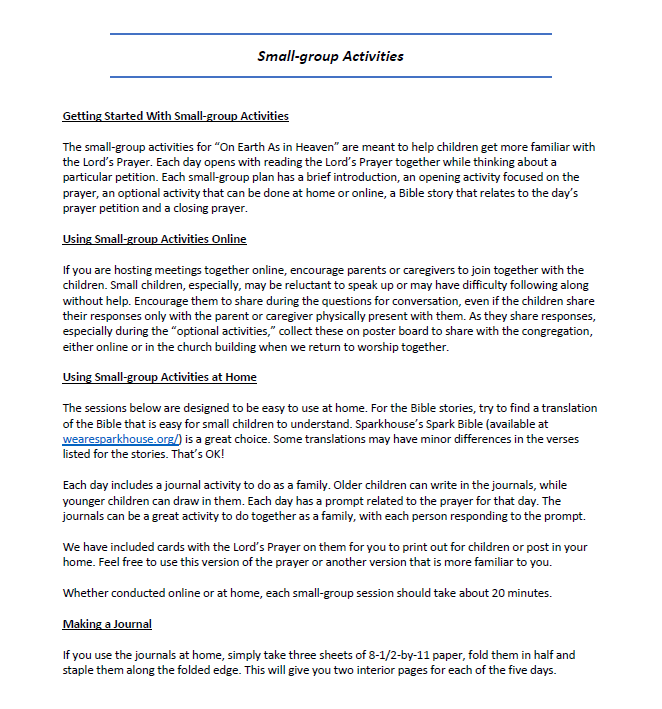
The new leader’s guide for this at-home VBS provides simplified instructions for a shorter schedule, as well as alternative activities for parents or caregivers to use at home. The small-group times from the original format have been re-structured into short bible studies, with tips for hosting an online meeting or for households doing the activity on their own. We also included tips for helping children use a journal as part of the small-group times.

New game ideas have been added with an eye toward smaller households doing them, rather than large groups, and new craft ideas can be done with both younger and older children at home. There are also links to the songs for “On Earth As in Heaven” and to pre-recorded videos.


Videos

We are also happy to share that we have pre-recorded videos for the skits and for the Story Time station for “On Earth As in Heaven!” The skits were recorded and performed by Paige and Alexis Greve. There are five videos – one for each day – and these can be shared, posted to your congregation’s website, or played live during online gatherings. Each skit helps introduce the theme for the day.

There are also five skits that tell the stories of projects supported in part by ELCA World Hunger. ELCA churchwide staff tell the stories in the videos, so in each one, children will meet one person who works for the ELCA and hear the story of our neighbors working to end hunger around the world. Each story also includes some fun facts about the countries featured.

All of the videos can be viewed or downloaded from the ELCA’s Vimeo showcase page at https://vimeo.com/showcase/7224146.


Music

ELCA World Hunger also has original music for “On Earth As in Heaven!” There is a song for each day, and you can find zipped folders for each song on our resource page at https://elca.org/hunger/resources#VBS. Each folder will have a recording with vocals, an instrumental recording and a songsheet with chords.

In the leader’s guide for “On Earth As in Heaven…At Home,” we included a permissions letter that details the rights your congregation has to fair use and sharing of the songs and other materials associated with “On Earth As in Heaven.”


This adaptation of VBS for 2020 is the product of many conversations with leaders across the ELCA who provided their input and suggestions as it came together. All of the materials were developed, too, with the generous support of gifts to ELCA World Hunger, and we are happy to provide them for free because of this. If you use “On Earth As in Heaven…At Home,” please consider inviting participants to continue supporting the work of our church toward a just world where all are fed.

If you have any questions or feedback, please contact Ryan Cumming, program director of hunger education for ELCA World Hunger, at Ryan.Cumming@ELCA.org, or Brooke De Jong, program assistant for hunger education, at Brooke.DeJong@elca.org.

Blessings in your ministry!

Share

Invitation to join ELCA Anti-Racism Pledge

We invite you to join the ELCA Anti-Racism Pledge.

Peace Not Walls is the ELCA’s campaign for peace with justice in Israel and Palestine. It is crucial here that we talk about peace with justice. There is no peace without justice. A way of thinking about peace without justice is ‘negative peace’ – this just means that there is an absence of physical violence, but it does not address the structural and systemic elements of inequity that favor one group over another, structures that perpetuate gross disparities in access to healthcare, education, economic opportunity, and threatens people’s lives. A positive peace is when there is justice, when there is opportunity for reconciliation, when there are systems and structures in place that build positive relationships and seek to establish equity, where human dignity and human rights are centered. In the context of Palestine and Israel we are seeking a positive peace, peace with justice.

And in the same breathe we are seeking that same positive peace here in the US. Along with the ELCA, we condemn racism and white supremacy, and need to work to dismantle the systems that prop up ways of being and operating that threaten the lives of Black people in our country. Just as we are engaged with peace and justice work in Israel and Palestine and recognize the structural violence of the occupation, we need to interrogate the systems and structures in our own context that not only allow, but give life to racism, a racism that impacts our Black, Brown and Indigenous brothers and sisters on a daily basis. These struggles for peace and justice are connected.

As church we are called to confess the sin of racism, condemn the ideology of white supremacy, and strive for racial justice and peace. Beyond statements and prayers, we are called to also act and respond to injustices. We invite you to commit to one or more of the actions listed in the ELCA Anti-Racism Pledge.

Share

When I Broke by Regina Banks

You remember the story of Jonah and the whale, right? God commands Jonah to preach repentance to his foes in the city of Nineveh. But Jonah wasn’t down with being God’s little messenger. Not about that. Not to them. So, he booked passage on the first ship heading anywhere but there. The Bible tells us plainly that Jonah “ran away from the Lord.”

That worked out about as well as you would expect and after many storms and tribulations Jonah found himself in the belly of a whale; saved from certain drowning by a God with a plan. In the belly of the whale, the reality of the task being asked of him became clear to Jonah. In the belly of the whale, the enormity of the force sending him to Nineveh became clear.

When I announced my intention to go to law school my mother’s family became suspiciously excited. As I went through the application process I talked with them about this school or that. A couple of days would pass, then worked casually into the next conversation somehow would be the stats for that law school’s Criminal Law department. They weren’t subtle. But I of course they thought criminal law. My grandfather was the first Black Genesee County (MI) deputy in the 1950’s. He studied law then finished his career as a magistrate. His only daughter (my mother) was a probation officer briefly. 3 of his 4 sons are, to this day, sworn law enforcement officers. One of them even married a state trooper! Adding a prosecutor to the family would complete the set.

But my distaste for criminal advocacy was years old by then. I was a precocious (read: nosey) kid. I would listen to adult conversations and easily decipher their unimaginative codes. I heard the stories of unnecessarily brutal arrests, cases that went up on scant evidence, hanging judges, and “facilities” (jails and prisons) unfit for humanity. My relatives believed, and still believe, that change can come from within the system and at the very least the system was a little less antiblack during their shifts. But I had no interest in being in the criminal law space. And honestly, I had passively accepted the culture’s prevailing attitudes about crime and criminals. Some neighborhoods simply do require a stronger police presence. I too looked over my shoulder at ATMs for “super-predators.” I took Criminal Law and Evidence because they were required then filled my schedule with Federal Labor and Employment Law, and Alternative Dispute Resolution. I was going to work a standard 9-5 resolving employment contract disputes via forced arbitration clauses (and get filthy rich doing it!) I kept maps of all the exciting places my jet-set lifestyle was going to afford me. Nineveh was not on the itinerary.

After many storms and trials I learned that my skills and talents lay with legislative and executive advocacy. I learned the basics then studied and honed it as the science and the art that it is. I advocated for domestic violence survivors and employees unfairly paid. I advocated for the fair treatment of our immigrant siblings. I advocated for the poor, the unhoused, the mentally ill. I’ve traveled abroad waving the banner for ecological justice and climate change abatement. And then the children. Always the children. I even found time to advocate for more green space in my own neighborhood. Everything and anything except anything that touched on crime or policing. Sure #BlackLivesMatter. But I don’t have to be the spokeswoman for it.

Then I spent I my three days in the belly of the whale. To be more precise the month of October 2019 broke me. It excised whatever small trace of “If you’re not doing anything wrong, you’ve got nothing to fear from the police” remaining in my spirit. Early that month my favorite human, my nephew Xavier, turned 8 years old. He got a new video game that he just loved. He wanted to play it with me. All. The. Time. Sometimes late into the night. We did that. He’s unreasonably scared of spiders. It’s one of those truly annoying things I love about him. I’m constantly called on to go 2 or 3 rooms away and kill the spider that he defiantly heard and is certainly on its way to come and get us. Sometimes he hears them outside. When I’m in a particularly generous mood I go and hunt for his imaginary spiders outside our front door.

Stop right now and Google the name Atatiana Jefferson.

When the news of her death reached the nation something in me broke wide open. It wasn’t just the fact of her death. It’s that her death made headlines for less than one news cycle. I was angry and heartbroken and incensed and grieved and irate and perplexed and exhausted and dying inside. I’m not certain when I was swallowed by the whale. But I was for sure in the belly of the beast; driving along the beautiful California coast from Sacramento to Monterey to offer a keynote address at the synod professional leaders conference– blind through tears. I don’t remember, and it doesn’t really matter what I actually said to the Lord in my car that afternoon. “In my distress I called to the Lord, and the Lord answered me. From deep in the realm of the dead I called for help, and the Lord listened to my cry.”

Through the sacrifice of one beautiful black life, I fortified a voice that advocates for Black bodies.

I’m not yet in Nineveh. I am only now beginning to understand the reality of the task set before me. Through my television screen filled with visions of cities all over the world rallying and rising and rioting I am just now learning the enormity of the source sending me. I am stumbling and fumbling and walking slowly and being led by the Spirit and those who have been on the road longer. I’ve been practicing what I will say when I arrive. I’ve begun saying small snippets in places I would have never dared before. I’ve rallied more. I’ve organized more. Staff meetings are different with me around now (thank you for making space for this, Amy Reumann.) I’ve begun saying in larger and larger spaces that the system we’ve built around crime and punishment requires repentance. I’ve been inviting others into the conversation. But we have not yet arrived in Ninevah. There’s still room for you on the road.

Bio:

Regina Q. Banks lives in Sacramento, CA where she proudly serves as the Director of the Lutheran Office of Public Policy- California. She is very active in her community, dedicating most of her free time to organizing public advocacy to support a host of social and political causes. She is a lifetime member of Delta Sigma Theta Sorority (a public service organization) and, when permitted, shares her life with an ill-tempered chihuahua named Ender Jay.


Share

Juneteenth: We Will Breathe

by Joe Davis

Juneteenth commemorates a day when my ancestors could breath a little more freely. On June 19, 1865, in Galveston, Texas, enslaved Africans were read federal orders that they were freed, even though the Emancipation Proclamation was signed over two years prior. They didn’t know they were free because, in spite of the law, they were still brutalized by those who weaponized power. This was this liberatory announcement that initiated the joyful reunion of long-separated loved ones and the work of reconstructing after centuries of being held down by the harsh American slave system. 

Today, families of African descent throughout the United States celebrate this Freedom Day, which gave us a brief moment to inhale deeper than before. However, as a Black artist and educator living in Minneapolis, MN during an uprising that has sparked freedom demonstrations around the world, I know that oppressive powers have only shifted their weight on the necks of vulnerable Black bodies as we cried out to breathe. 

I can only imagine how profoundly the Giver of all life and breath (1) must become enraged and grief-stricken every time the breath in our bodies is snuffed out by violent power. But I needn’t imagine this response, as Jesus incarnated this reality when he protested abusive authority decrying those holding power through violence as hypocrites and snakes (2) and damaged temple property when it was being valued more than the humanity of his people (3). Although divisive and controversial to corrupt religious leaders and exploitative lawmakers, Jesus embodied a form of justice not rooted in revenge or retribution, but instead in restoration and healing. Even though he could have commanded an army of angels to battle on his behalf (4) his love for the most vulnerable was held so deeply in his body that he lived and died among them in a communion of shared vulnerability. Jesus gave his all, his last breath, to empower them, and to empower us, to rise again. His desire was that we would all be freed from the grips of power-hoarding, death-dealing systems and breathe in the abundance of life-affirming community. 

Jesus intensely understood the soul wound and how violence, at its core, is a spilling over of trauma and suffering from one body to another. Resmaa Manekem, body-centered therapist and author of My Grandmother’s Hand: Racialized Trauma and the Pathway to Mending Our Hearts and Bodies, describes the soul wound as trauma routinely passed on from person to person and from generation to generation. The only way to stop the cyclical pattern is not punitive force but reparative action and a commitment to the practice and process of healing. This calls for the healing of the oppressor and the oppressed, as stated by Dr. Joi Lewis, Twin Cities healer, author, and founder of the Healing Justice Foundation. Dr Lewis states, “Oppression is not an inevitable state of affairs and no human being would agree to oppress another person or agree to be oppressed if they weren’t already hurt.” 

The wounds of violence reach the innermost essence of our beings, it viscerally impacts our flesh and becomes ritualized in every part of society and culture from policing to politics. When we heal the systems that live inside of us, then we can also heal the systems that live outside of us. And that is the path to collective liberation that Jesus calls us all to embody (5). 

Juneteenth, also known as Jubilee Day, speaks to this call, an ancestral echo of the struggle for freedom heard in the litany of voices throughout history. If we listen, we can hear it resonating in the song of Moses, Aaron, and Miriam—among countless other scriptural leaders —organizing themselves and their people to escape the slave system of pharaohs and kings who denied their demands for human dignity until death was too close to home (6). Once their lungs were no longer constricted by the tyrannical rule of empire, they had enough space to breathe new life into prophetic visions of Jubilee, where prisoners could be liberated, debts forgiven, and the land renewed (7). 

I long to live in a world not of crippling dependence on guns and cages as lethal enforcers of systemic injustice, but a world where our bodies and our institutions rise with the deep, slow rhythms of healing. We don’t live in that world yet, but it’s worth working for with every breath we have.


Joe Davis is a nationally-touring artist, educator, and speaker based in Minneapolis, MN, whose work employs poetry, music, theater, and dance to shape culture. He is the Founder and Director of multimedia production company, The New Renaissance, the frontman of emerging soul funk band, The Poetic Diaspora, and qualified administrator of the Intercultural Development Inventory. He has keynoted, facilitated conversation, and served as teaching artist at hundreds of high schools and universities including New York, Boston, and most recently as the Artist-in-Residence at Luther Seminary where he received a Masters in Theology of the Arts.


1: Genesis 2:7 (CEB) the Lord God formed the human from the topsoil of the fertile land and blew life’s breath into his nostrils. The human came to life. 

2: Matthew 23 (CEB) Jesus Calls Out the Legal Experts and Religious Leaders; Matthew 12:34 (CEB) Children of snakes! How can you speak good things while you are evil? What fills the heart comes out of the mouth. 

3: Matthew 21: 12 (CEB) Then Jesus went into the temple and threw out all of those who were selling and buying there. He pushed over the tables used for currency exchange and the chairs of those who sold doves. 

4: Psalms 91:12 and Matthew 4:6 

5: Luke 17:20-21Pharisees asked Jesus when God’s kingdom was coming. He replied, God’s kingdom isn’t coming with signs that are easily noticed. Nor will people say, ‘Look, here it is!’ Or ‘There is!’ Don’t you see? God’s kingdom is already among you. 

6: Exodus 12:29-50 

7: Leviticus 25: 8-18

Share