Skip to content

ELCA Blogs

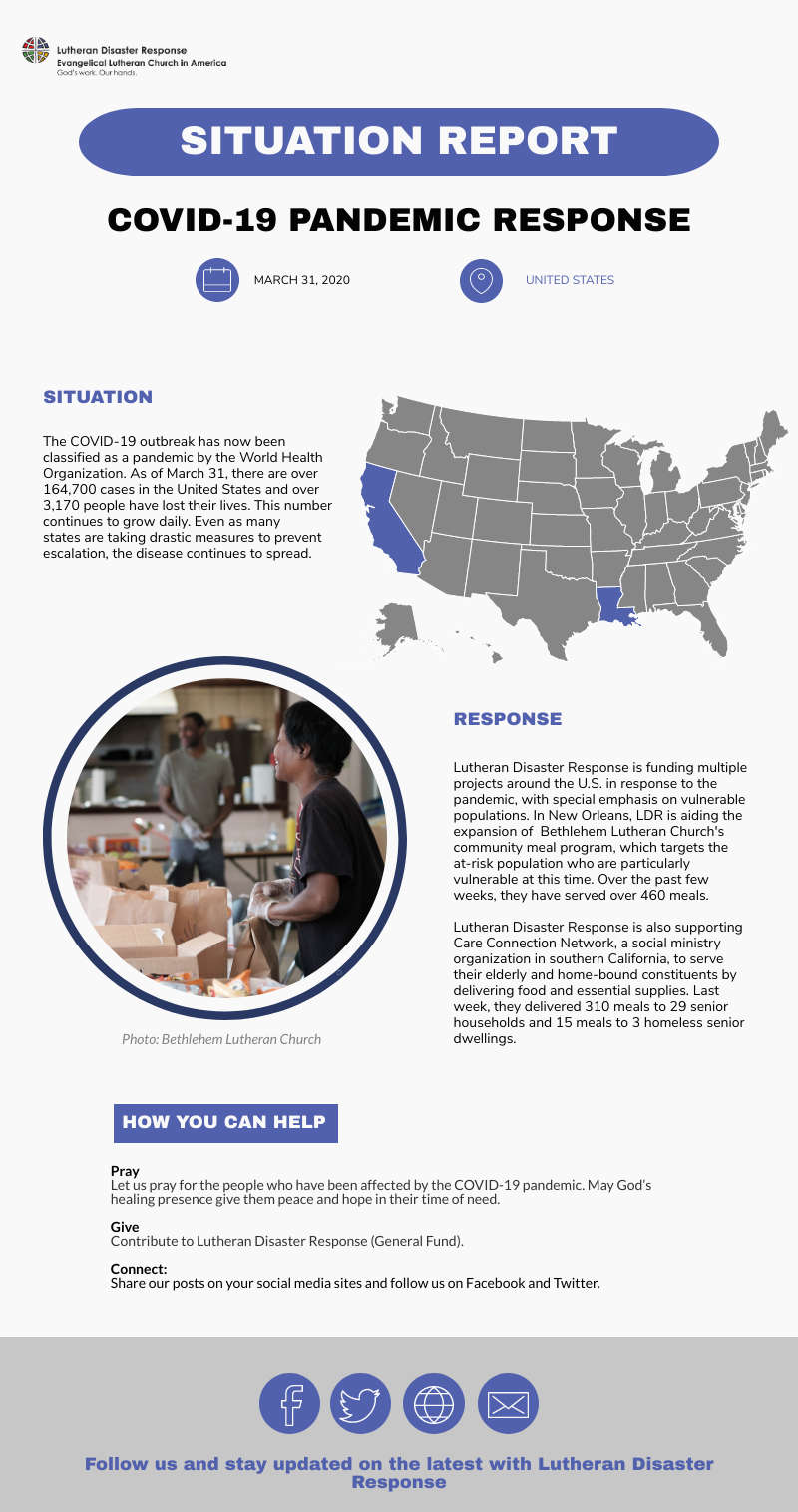
Situation Report: COVID-19 US Response


Be a part of the response:

Pray
Please pray for people who have been affected by the COVID-19 pandemic. May God’s healing presence give them peace and hope in their time of need.

Give
Thanks to generous donations, Lutheran Disaster Response is able to respond quickly and effectively to disasters around the globe. Your gifts to Lutheran Disaster Response (General Fund) will be used where they are most needed.

Connect
To learn more about the situation and the ELCA’s response:

  • Sign up to receive Lutheran Disaster Response alerts.
  • Check the Lutheran Disaster Response blog.
  • Like Lutheran Disaster Response on Facebook and follow @ELCALDR on Twitter.
Share

ELCA Advocacy: COVID-19 Aid Package Passes


This post was originally published as an ELCA Advocacy Action Alert. Sign up for ELCA Advocacy e-alerts and stay up-to-date on the latest developments in federal legislation at https://elca.org/advocacy/.

On March 27, Congress passed the Coronavirus Aid, Relief, and Economic Security Act, H.R. 748 (CARES Act), a third economic aid package to help bring direct relief to families, reinforce struggling industries and the healthcare sector, and extend assistance to vital state and federal support programs.

Members of Congress and their staff worked intensely to deliver bipartisan initial response to the crisis, and we thank the many Lutherans who called their lawmakers to advocate for important faith-rooted principles and policies that support those of us at greatest risk in this pandemic. The first bill put $8.3 billion towards healthcare, including funding for global response to the pandemic. The second bill strengthened nutrition assistance programs and unemployment benefits, allowed for free coronavirus testing predicated by kits availability, and also provided extra sick leave for millions of workers.

SOME ELEMENTS OF THE CARES ACT

In the third relief package, Congress passed aid to people experiencing unemployment and economic uncertainty and relief to families and businesses, including several provisions consistent with ELCA Advocacy’s priorities of faithful and timely attention to pressing concerns that affect our neighbor’s well-being and the wholeness of creation.

  • Unemployment insurance benefits expanded to people who have exhausted their state unemployment insurance and to people who do not qualify for the traditional state unemployment insurance, such as gig workers, self-employed people and contract workers;
  • Housing assistance of $7 billion offered, including targeted funding for those of us experiencing homelessness;
  • State, tribal and local government support of $150 billion for urgent needs and $150 billion for healthcare system reinforcement designated;
  • Child Care and Development Block Grants made available to states to provide immediate assistance to child care centers;
  • Evictions moratorium for 120 days enabled for renters in homes covered by a federally backed mortgage;
  • International COVID-19 response increase allotted of $1 billion, including support for repatriation of U.S. government personnel and American citizens, for displaced populations and for global disease detection.

In addition to this overview, refer to the companion ELCA Advocacy blog post for additional information about what’s coming in a fourth package as well as links to connect eligible individuals seeking assistance with sources of aid.

YOUR ADVOCACY MATTERS

The initial draft of the CARES Act proposed that people too poor to pay income taxes would get smaller cash payments than people with higher incomes. Your advocacy made a difference in removing that inequity in the final version – thank you! We will also need your voice in the time ahead to advocate with populations not guaranteed automatic cash stimulus payments, such as recipients of Social Security or Supplemental Security Income. There is more to do.

As Congress will likely adjourn for several weeks, we encourage you and other advocates to watch for possible tele-conference town halls and other forums to connect with your lawmakers while they are in-district. The ELCA Advocacy resource, “August Recess Guide,” contains some tips for in-district opportunities. Express both your thanks for their action and share your specific concerns and community needs as we live aware of our role doing “God’s work. Our hands.” in this uncharted time.

If you are currently working with a hunger ministry, please also see ELCA World Hunger’s blog post “Tips for Responding to Hunger in a Pandemic.”

Share

Easter Sermon Starter: 5th Sunday of the Pandemic


These reflections are a part of ELCA World Hunger’s Sermon Starter series which is published via email every Monday. You can sign up for the weekly email here on the right side of the page, if on a computer, or near the bottom of the page, if viewing on a mobile device. Pastor Tim Brown is the writer of these reflections. Pr. Tim is a Gifts Officer and Mission Ambassador for the Lutheran School of Theology at Chicago and a pastor and writer out of Raleigh, NC. You are invited to use the message below for personal devotion as well as prompts for sermon writing. 

April 12- Easter Sunday

Jeremiah 31:1-6

Should you decide not to preach on Matthew’s resurrection account, my suggestion would be to choose the Jeremiah offering (the alternative option) rather than the reading from Acts as the basis for the sermon. And the choice is purely contextual, if I’m honest with you, because fine Easter sermons can be crafted from either text.

But the Jeremiah reading has this wonderful cadence that dances a bit on this day of celebration, and the wonderful theme of “Again” used in the text can be played with to craft a sermon of resurrection hope that might be most impactful in this strange time of wilderness.

“Again, I will build you…” says the Lord. “Again, you shall take your tambourines…” says the Divine.  “Again, you shall plant…” says the Holy Gardener.

“Again” might just be the message your people need. For though it is Easter, it is also “The 5th Sunday of the Pandemic” for most of us, and perhaps the third or fourth Sunday of “shelter-in-place.”  These realities must be spoken of, too.

In fact, I dare say that every year, Easter speaks to these kinds of realities; we just fail to recognize that fact most years from the comfort of our new dresses and freshly pressed suits with floral print ties.

Your people will gather together, in person, again.  Your people will be able to embrace one another, again. Families separated by quarantine will be able to kiss one another, again.

It will happen again! There will be a time after this pandemic. If there’s one thing Easter makes abundantly clear, again and again, every year, it’s that there is always an “again.”

Neither life, nor pandemic, nor crucifixion nor death can stop that. On this Sunday above all others (but also, all the others!) this is the Gospel message.

A final lovely nugget hidden in this prophetic text is the heavy but heartening truth that the people of Israel didn’t just find grace after they were through the wilderness period, but rather, as Jeremiah says, they found “grace in the wilderness.”

There is grace in the wilderness. And I’m not talking about silver linings or optimism or “glass-half-full” sort of grace, but rather the kind of grace that knocks you off your feet and helps you survive another day sort of graces.

I’m talking about Easter-sized sort of graces.

Reminding people that though shopping is suspended, and socializing in person is suspended, and yes, Easter sunrise service is suspended in these days, grace is not suspended.  God’s grace is never suspended.

Grace is found again and again, even now, even in these days.  Which is worth celebrating and shouting “Alleluia” for this morning.

Again we will hold hands. Again we will join together. Again there is grace to be found, even today.

Again and again and again — and no quarantine, no shelter-in-place, no tomb will ever cause that not to be true.

Matthew 28:1-10

On this Easter, many churches around the world are empty, just like that tomb was empty in ancient Palestine on that “first day of the week.”
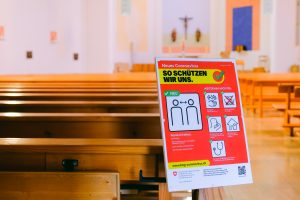
In this pandemic, the most honest sign of love that the Christian world can give to the greater world, and to one another (and by extension, to the God seen in the risen Christ), is an empty church building. I’m serious.

There may be a few places in the world where the pandemic has not yet reached levels where churches are empty; places that may be far from you geographically but, through the faith that connects us, not so far at all. If there are, they will gather together in body for the rest of us as we all gather together in spirit on this Sunday.

Perhaps this is a good Sunday, the Feast of the Resurrection as it is formally called, to remember that our church gatherings are both local and universal, every time we gather. Our communion liturgy connects us both with one another, but it also connects us across continents and cultures, and with the distant past and with the future, as we join the “saints of every time and place.” That “every” there really does mean every, Beloved.

This is what our theology tells us.

Notice how Matthew’s resurrection account opens a very poignant and timely door for us today, a door upon which the sermon can hinge. The angels, when greeting the women, tell them the resurrection news and instruct them to go tell the disciples to meet Jesus back in Galilee.

And then, the text says, they go “with fear and great joy.”

We often, I think, assume that great joy and fear are mutually exclusive, but this text reminds us that they need not be. We can be both fearful and joyful, which is probably where a lot of your parishioners are at in these days, right?

Yes, we may be quarantined, and there is some fear around the future, but on this Easter Sunday we are also filled with great joy because we remember the promise that the love of God cannot be stopped by anything, not even death.

Yes, we may have to shelter-in-place, and there is some fear about what that is doing to the economy, but on this Easter Sunday we are also filled with great joy because we remember the promise that God resurrects bodies, and they are paramount, and we are saving people’s lives in these days, just as all of us will one day dance bodily with the risen Christ.

Yes, we may be separated from one another, and there is some fear and anxiety about when we can be back together, but there is also great joy on this Easter Sunday because we remember that every Sunday leading up to this, we’ve been practicing in our souls and hearts for the day when we truly, truly need the Easter story, and by God, it’s today.

On this Easter Sunday, do not take the easy way out and present a rosy picture; Easter isn’t meant for rosy days.

Easter is meant, necessary even, for days of fear and tombs and women gathering in the darkness unsure of what they’ll find.

Easter is meant for today, by God.  Alleluia!

Children’s Message

Online Children’s Messages can’t reliably lean on congregational participation, especially if the kids aren’t old enough to type in a chat box or if you’re incapable of hearing them.  I’m going to continue assuming that you’re recording this for them to experience online.

Have a huge Alleluia banner, or even a sheet of paper with an individual letter spelling out the word Alleluia, on it.

Welcome, everyone!

(name) here, and I’m so glad you’re here on this Easter Sunday! <pretend to look into the camera> Wow!  Look at all those Easter dresses and fancy clothes you all have on.

Well, oh, and someone is still in their pajamas! Which is great! God loves us no matter what we’re wearing.

And, in fact, God loves us no matter where we are! And just because we can’t be together today doesn’t mean that we can’t celebrate Easter, right?

Now, there’s one word we haven’t been saying all of Easter. It starts with an A and…wait, I have something to show you. <pull out the Alleluia banner, or at least the first letter of the word, if they’re on individual sheets of paper> Here it is!

Alleluia!  It’s kind of like yelling “Yeah!” to God.

So, what I want you to do is shout it with me. Everyone. On the count of three.  Ready? 1-2-3 <hold up the banner> Alleluia!

You know what? If we all shouted that at the same time, we’re more connected than ever!

Can you do me a favor? Ask a parent or guardian to video you giving your biggest Alleluia. You can say it loud, sing it or even take a picture with you holding an Alleluia banner that you made. Can you do that? Have them send it to me.

Because on Easter we celebrate that Jesus was resurrected from the dead, and that even though we might be separate from one another this Sunday, we won’t stay that way forever, and that nothing can ever separate us from God’s love.

So, send the church those videos or those pictures, and let me see those resurrection smiles! Oh, and don’t worry. You can wear your Easter best or your PJs…God doesn’t care.  Jesus is risen, which means we can celebrate no matter where we are or how we are!

Post the videos, with permission, to your social media sites.

Share

April 5, 2020–Betrayed

Grace Heimerdinger-Baake, Ankeny, IA

Warm-up Question

When have you felt betrayed and how did you deal with those feelings?

Betrayed

The COVID-19 virus is not only making hundreds of thousands of people sick, but it has also caused financial hardships for many. An article from Delaware’s News Radio, shared the struggles Delaware restaurants are facing due to the coronavirus pandemic. Carrie Leishman, president and CEO of the Delaware Restaurant Association, and her team worked countless amount of hours to convence the governor not to shut down restaurants in the state of Delaware. The State of Emergency declaration closed all restaurants except for carryout and delivery. Leishman said in an interview, “We feel somewhat betrayed.”

Despite being open to carryout and delivery, most restaurants will be unable to pay their staff, thus leading to mass unemployment and financial hardships for employees and owners. 

These feelings of betrayal spread further than restaurant owners and staff. Schools have resorted to online learning. Churches are live streaming worship. Stores have a very limited supply of toilet paper, wipes, pasta, bread, and other necessities. It’s easy to feel betrayed watching people take the last two packages of toilet paper, leaving you with nothing. 

COVID-19, you have left us feeling betrayed.

Discussion Questions

  • Imagine, you are the governor of Delaware and you must decide whether or not to close restaurants, movie theaters, and gyms. How would you make the decision? How would you deal with the consequences of your actions?  
  • Do you know anyone who is out of work due to the coronavirus? 
  • How have you been personally “betrayed” by the COVID-19 virus? 

Sunday of the Passion

Isaiah 50:4-9a

Philippians 2:5-11

Matthew 26:14-27:66

(Text links are to Oremus Bible Browser. Oremus Bible Browser is not affiliated with or supported by the Evangelical Lutheran Church in America. You can find the calendar of readings for Year C at Lectionary Readings

For lectionary humor and insight, check the weekly comic Agnus Day.

Gospel Reflection

The passion narrative may be the most familiar story in the Christian faith, but this narrative of Jesus’ betrayal, arrest, trial, and death on the cross is a story which is hard to hear and read. This story is filled with heartbreak, betrayal, loss, and grief. 

Not only does this story relate all the terrible things which happen to Jesus, but it also hits close to home for most people. Think about it. Have you been betrayed, deserted, or teased?  Have you ever felt like God was nowhere to be found when you were in the midst of struggle? 

Jesus has. 

  • Jesus was betrayed by Judas, a disciple. 
  • Jesus was deserted by his other disciples. 
  • To save himself, the disciple Peter pretended he didn’t know Jesus. 
  • Jesus was laughed at, teased, and called names. 
  • Jesus called out to God, with God nowhere to be found, as he was dying on the cross. 

Despite these dreadful experiences, there is hope. Jesus’ story doesn’t end on Good Friday. Good Friday becomes Easter Sunday. Death does not have the final word. Life reigns through the Resurrection. This is the Good News that provides us hope through all of life’s obstacles. 

Many of us affected by COVID-19 are waiting for our Easter morning. We waiting for the stone to be rolled away. We are waiting for schools to resume, for businesses to open, to hang out with friends, and to just return to normalcy. In the meantime, we carry our stories of betrayal, grief, loss, and loneliness with us as we begin Holy Week. We hang on to the hope of the great triumph of Easter morning, knowing the Passion story doesn’t end with Jesus dying on the cross. As we live in this time of loneliness, loss, and sickness, we wait with hope of our own Easter morning in the knowledge that we are never alone. Jesus understands our hurting hearts and walks with us amid our awful experiences. 

Discussion Questions

  • With which character in the Passion narrative do you identify ? 
  • We hope that we would not have followed the crowd in saying “Let him (Jesus) be crucified!”  Sometimes it isn’t easy to avoid the mob mentality. When has it been difficult for you to avoid doing what everyone else is doing?
  • Before Jesus’ last breath, he cries out “Eli, Eli, lema sabachthani?” (“My God, my God, what have you forsaken me?”)  Is it true that God forsakes Jesus? Why or why not.
  • When facing difficulties and hardships in your life, is it helpful to know that Jesus has experienced hardships and betrayal too? Is just knowing that enough?  What do you need to hear when you’re living through grief, pain, confusion, or loss?

Activity Suggestions

Gather cardstock, markers, scissors, rulers, and pens. Cut the cardstock into 3.5” x 2” rectangles. Each person takes two rectangles and writes words of encouragement on the card and a favorite Bible verse. If available, laminate the cards with self-laminating sheets. Think of a person who is experiencing a difficult time and mail them the encouragement card. Carry the other one around with you for when you need encouragement and to remember the love of Jesus. If time permits, you may create more cards for others.

Closing Prayer

Gracious God, you have created me in your image and you love me so much that you sent your Son, Jesus Christ, to die on a cross. Help me to know and feel your presence in moments of despair. Strengthen me to be a source of hope and light to all who are desperate for hope. Amen.


Share

CARES Act inclusions and next steps in response to COVID-19

On March 27, Congress passed the Coronavirus Aid, Relief, and Economic Security Act, H.R. 748 (CARES Act), a third economic aid package to help bring direct relief to families, reinforce struggling industries and the healthcare sector, and extend assistance to vital state and federal support programs.

Members of Congress and their staff worked intensely to deliver bipartisan initial response to the crisis, and we thank the many Lutherans who called their lawmakers to advocate for important faith-rooted principles and policies that support those of us at greatest risk in this pandemic. The first bill put $8.3 billion towards healthcare, including funding for global response to the pandemic. The second bill strengthened nutrition assistance programs and unemployment benefits, allowed for free coronavirus testing predicated by kits availability, and also provided extra sick leave for millions of workers.


SOME ELEMENTS OF THE CARES ACT

In the third relief package, Congress passed aid to people experiencing unemployment and economic uncertainty and relief to families and businesses, including several provisions consistent with ELCA Advocacy prioritization of faithful and timely attention to pressing concerns that affect our neighbor’s well-being and the wholeness of creation.

  • Unemployment insurance benefits expanded to people who have exhausted their state unemployment insurance and to people who do not qualify for the traditional state unemployment insurance, such as gig workers, self-employed people and contract workers;
  • Housing assistance of $7 billion offered, including targeted funding for those of us experiencing homelessness;
  • State, tribal and local government support of $150 billion for urgent needs and $150 billion for healthcare system reinforcement designated;
  • Child Care and Development Block Grants made available to states to provide immediate assistance to child care centers;
  • Evictions moratorium for 120 days enabled for renters in homes covered by a federally backed mortgage;
  • International COVID-19 response increase allotted of $1 billion, including support for repatriation of U.S. government personnel and American citizens, for displaced populations and for global disease detection.


PUTTING ASSISTANCE INTO MOTION

In these trying times, many of us are experiencing difficult circumstances. Provisions of the CARE Act as well as the first and second packages will make a significant difference to some of us, and congregations can have an important role to play connecting their communities with sources of aid as well as providing support in the application process. Use these links to learn more about programs for eligible individuals seeking assistance.

Many crucial decisions on access to benefits will be made by the states. Additional information on applying for benefits and ministry resources may be available from a state public policy office in the ELCA Advocacy network.


A FOURTH BILL

As members of Congress turn their attention to a fourth bill addressing jeopardy caused and exposed by the coronavirus, ELCA Advocacy activity will focus on measures to support our vulnerable neighbors through difficult days ahead.

  • Supplemental Nutrition Assistance Program (SNAP) benefits boosted for all households receiving SNAP regardless of their immigration status
  • Support for children of immigrants established
  • Earned Income Tax Credit and Charitable Tax Credit extended
  • Health care coverage and COVID-19 treatment provided for those who are uninsured
  • Testing and treatment for incarcerated individuals ensured
  • Additional assistance designated for those on Medicaid, straining to fund childcare and struggling with homelessness
  • Emergency rental assistance directed to protect low-income renters at risk of eviction
  • Safety ensured for immigrants and asylum seekers
  • Broadband and energy grid connectivity funded through robust infrastructure allocation, especially in rural areas
  • Child Tax Credit bill supported in House in order to include 26 million children in low- and moderate-income families excluded from tax bill passed in 2017
  • Population reduction in centers housing detained immigrants facilitated as soon as possible, especially facilities not regulated by Performance-Based National Detention Standards
  • Paid-leave and direct cash benefits reached to include most undocumented immigrants and/or their families


YOUR ADVOCACY MATTERS

The initial draft of the CARES Act proposed that people too poor to pay income taxes would get smaller cash payments than people with higher incomes. Your advocacy made a difference in removing that inequity in the final version – thank you! We will also need your voice in the time ahead to advocate with populations not guaranteed automatic cash stimulus payments, such as recipients of Social Security or Supplemental Security Income. There is more to do.

As Congress will likely adjourn for several weeks, we encourage you and other advocates to watch for possible tele-conference town halls and other forums to connect with your lawmakers while they are in-district. The ELCA Advocacy resource, “August Recess Guide,” contains some tips for in-district opportunities. Express both your thanks for their action and share your specific concerns and community needs as we live aware of our role doing “God’s work. Our hands.” in this uncharted time.

Share

COVID-19: Augusta Victoria Hospital in Jerusalem makes room for emergency

Read here about how Lutheran World Federation Jerusalem Program is responding to COVID-19.

Share

Message of comfort and assurance from ELCJHL Bishop Azar

On March 26, 2020 ELCJHL Bishop Azar shared a letter of comfort and assurance. Please find the full letter here.


Share

ELCA joins letter to Administration on COVID-19 and the Middle East

On March 25, 2020 the ELCA joined other churches and church organizations in a letter to the Trump Administration about COVID-19 and the Middle East.

Generally the letter says, “We urge you to lift sanctions that negatively impact civilian populations and other restrictions that impair governments’ abilities to respond to the health crisis. This includes financial sanctions that impact the ability of countries to import much-needed medical supplies and equipment.” The letter lifts up specifics about Iran, Syria, and Gaza.

On Gaza, the letter states: “The U.S. should end its support for the blockade of Gaza and immediately press Israel to ensure that medical supplies and technology are provided to Gaza, that patients needing treatment outside of Gaza are given the permits necessary for extended periods of treatment, and that family members, especially parents accompanying children, are also granted permits to travel.”

Here is the full Letter to Administration on COVID-19 and the Middle East

Share

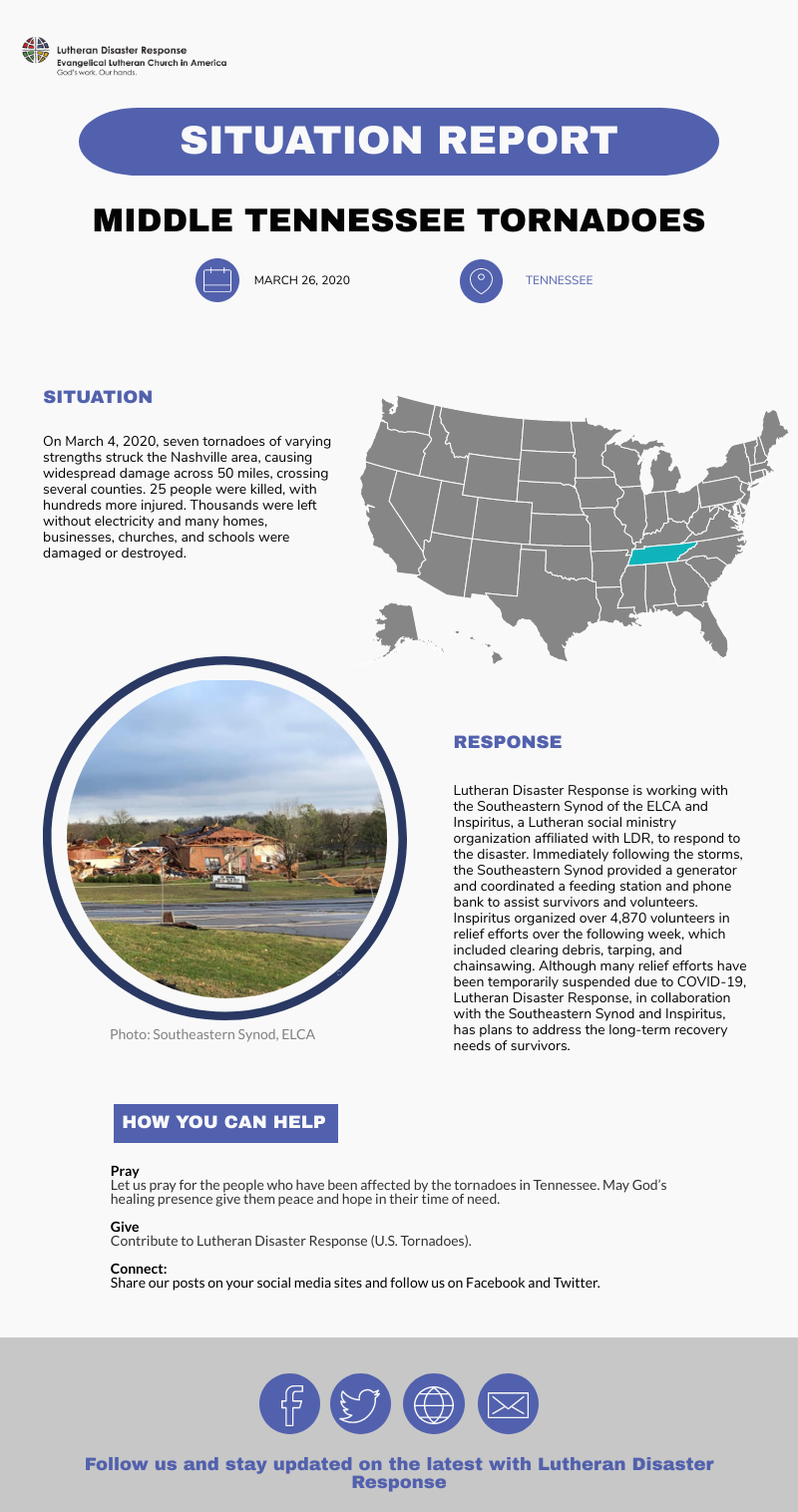
Situation Report: Middle Tennessee Tornadoes

Be a part of the response:

Pray
Please pray for people who have been affected by the tornadoes in Tennessee. May God’s healing presence give them peace and hope in their time of need.

Give
Thanks to generous donations, Lutheran Disaster Response is able to respond quickly and effectively to disasters around the globe. Your gifts to Lutheran Disaster Response (U.S. Tornadoes) will be used specifically for tornadoes such as this one.

Connect
To learn more about the situation and the ELCA’s response:

  • Sign up to receive Lutheran Disaster Response alerts.
  • Check the Lutheran Disaster Response blog.
  • Like Lutheran Disaster Response on Facebook and follow @ELCALDR on Twitter.
Share

Psalm 46


As we continue to adjust into the scary new reality of the unknown, we hope that you take the scripture below to heart. God is will us through this mess. God is with the sick, the poor, the anxious, the doctors, the public health officials, the grocery store workers, the elderly, and each and everyone one of you.


God is our refuge and strength,
    a very present help in trouble.
Therefore we will not fear, though the earth should change,
    though the mountains shake in the heart of the sea;
though its waters roar and foam,
    though the mountains tremble with its tumult. 


There is a river whose streams make glad the city of God,
    the holy habitation of the Most High.
God is in the midst of the city; it shall not be moved;
    God will help it when the morning dawns.
The nations are in an uproar, the kindoms totter;
    God’s voice utters, the earth melts.
The Lord of hosts is with us;
    the God of Jacob is our refuge. 


Come, behold the works of the Lord;
    see what desolations God has brought on the earth.
God makes wars cease to the end of the earth;
    God breaks the bow, and shatters the spear;
    God burns the shields with fire.
10 “Be still, and know that I am God!
    I am exalted among the nations,
    I am exalted in the earth.”
11 The Lord of hosts is with us;
    the God of Jacob is our refuge.

-Psalm 46: 1-11

Share