Skip to content

ELCA Blogs

Face of Grace

by: Ellie Abraham

At the 2018 ELCA Youth Gathering, I left each Mass Gathering feeling a buzz of energy, passion, and excitement that coursed through every extremity of my body like a wave of adrenaline. This feeling came from the power of experiencing God’s love, grace, and hope in community with tens of thousands of other equally energized worshippers.

However, on my final day at the Gathering, Savanna Sullivan invited the audience to not let this joy die out after we left Houston. She said: “If our joy is only for this place, if our joy is only for us, then it is not God’s joy. God’s joy is for everyone.” I took this to mean that the surge of passion I felt that week in Houston didn’t do any good just sitting inside of me, so I should take this newfound passion and energy and use it to share God’s love, grace, and hope with other people back home.

Savanna urged the audience to seek out inequalities and injustices in the world and use our newfound passion to contribute to their defeat—in such a way that we might live for a greater purpose than ourselves. So when I returned home to Brookings, South Dakota, I worked with my pastor at First Lutheran Church to start a volunteering group called Face of Grace at my church. 

So far, we have served free meals to people in Brookings, fundraised and constructed 20 beds for kids who don’t have a bed, organized clothes for a free clothing drive, roofed a garage for Habitat for Humanity, and sewed new costumes for a church that flooded and lost everything. What I am doing isn’t world-changing, but I am glad to be making a difference in my community and sharing the joy that still hasn’t left me since the Gathering.

Ellie is a senior at Brookings High School, where she runs cross country and track. She also sings in the school concert choir and in her church choir, as well as play trombone in marching, concert, and jazz bands. Ellie loves trying new activities outdoors and spending time with family. Next year, Ellie will be attending the United States Naval Academy.
Share

Ashes to Ashes, Earth to Earth : #NoPlasticsforLent

My Story

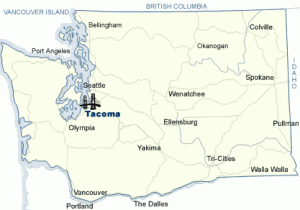
When I was growing up on a small 3 acre farm in Tacoma, Washington with my two parents and three siblings, I HATED going outside and doing yard work. It was the last thing I wanted to do.

Tacoma, Washington

I would rather have been inside the house watching movies on our VHS player. On top of the mandatory all-family yard work on the farm, we lived frugally getting everything second-hand, including my school outfits which did not fit my fashion standards. At all.

Skip to college where I studied pre-med and needed to declare a major, realizing the only realistic option was Environmental Studies, an open major. Taking classes in this program, I finally found something that fit my educational needs. Learning what the environment was ecologically, socially, and locally gave me a new lens to understand and see the world in a deeper way.

My Learning

I learned how my actions could affect my local community, and communities internationally who I had never even considered. I learned how my desire for brand new material goods affected what I now know and fear as Global Climate Change, and that it is occurring at a pace that exceeds what humans have ever experienced before. I learned how this global change is hurting the natural environment, the plants and animals that live in it, and people who are marginalized because of their socioeconomic status, race, location and more. I found my passion. And it’s a shared passion with anyone who wants to self-reflect on who they are and what they do and how they affect their neighbors, communities, and the world in ways that may not be so obvious. It’s a shared passion with anyone willing to be more intentional with their actions towards the environment.

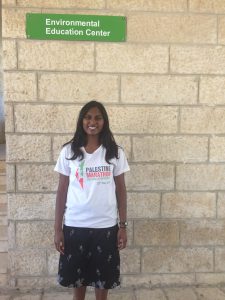
Hannah at the Environmental Education Center in Palestine!

After graduating with a degree in Environmental Studies, I volunteered in Palestine for a year with Young Adults in Global Mission (YAGM), an international service program through the ELCA. It was my first time over the Atlantic and my first time witnessing the joys and hardships of another culture for such a long period of time. I volunteered at the Environmental Education Center in the West Bank. It was the perfect accompaniment to my undergrad studies. Suddenly, I was observing one of the international communities I learned about – one that suffers the impact of my environmental actions at the hands of an unjust and oppressive system. Environmental Sustainability quickly shifted to Environmental Justice. I saw how product consumption in America driven by capitalism, materialism, and greed coupled with living under occupation can devastate countries like Palestine who are trying to keep up in a high-consumption world. Reflecting during my year I thought “I can do better than this”.

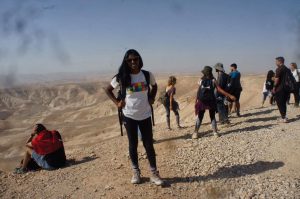
Hannah in the desert during her year serving with Young Adults in Global Mission in Palestine!

Word

2 Corinthians 5:20-6:10

20 So we are ambassadors for Christ, since God is making his appeal through us; we entreat you on behalf of Christ, be reconciled to God. 21 For our sake he made him to be sin who knew no sin, so that in him we might become the righteousness of God.

6 As we work together with him,[a] we urge you also not to accept the grace of God in vain. 2 For he says,

“At an acceptable time I have listened to you, and on a day of salvation I have helped you.”

See, now is the acceptable time; see, now is the day of salvation! 3 We are putting no obstacle in anyone’s way, so that no fault may be found with our ministry, 4 but as servants of God we have commended ourselves in every way: through great endurance, in afflictions, hardships, calamities, 5 beatings, imprisonments, riots, labors, sleepless nights, hunger; 6 by purity, knowledge, patience, kindness, holiness of spirit, genuine love, 7 truthful speech, and the power of God; with the weapons of righteousness for the right hand and for the left; 8 in honor and dishonor, in ill repute and good repute. We are treated as impostors, and yet are true; 9 as unknown, and yet are well known; as dying, and see—we are alive; as punished, and yet not killed; 10 as sorrowful, yet always rejoicing; as poor, yet making many rich; as having nothing, and yet possessing everything.

Ashes to ashes

We are called to be ambassadors of Christ, stewards of the Earth here and now! Now is the acceptable time. We are asked to care for creation as well as our neighbors around us. We can practice being more mindful and intentional with our efforts to preserve our environment and lessen negative impacts on plants, animals, and marginalized communities that are merely trying to survive.

Ash Wednesday is near and it reminds us that like the earth that clings to our feet each day, we are dirt. We are ashes. We are dust. We are creation, we are earth itself.

Ash Wednesday marks the beginning of Lent and of a tradition in the Lutheran Church where we take time to self-reflect, repent, and remember what Jesus did for us before he laid down is life for us.

Ash Wednesday reminds us that we are called by Christ to prayer for, lament for, and care for the earth to which we all will return.

Reflection Questions

1. How can we hold ourselves and the people around us accountable in treating the environment with care, love, and respect? What does it mean to be Christ’s ambassador in this context?

2. What are your consumption habits? How often are you purchasing things with plastic? Where do you put your old electronics?

3. How do you mark Ash Wednesday? What do the words “ashes to ashes” mean to you?

Bio

Hannah Wright Osborn (She/Her/Hers) is a living Lutheran currently residing in the DC Metro Synod where faith and politics are ever present. Her studies in college helped her to understand the value of the farm she grew up on and the recycling of second-hand products. Her year in Palestine further fueled her passion for social justice work. She came back and was invited to lead a trip back to Palestine for other Young Adults of Color near and within the church and to give them space to lead in a white and marginalized society. She has returned back after a successful trip in January 2020 and continues social justice work in her local community through Luther Place Memorial Church.

Share

March 1, 2020–Fake News

Heather Hansen, San Antonio, TX

Warm-up Question

How do you tell the difference between the truth and a lie?

Fake News

Post-truth is an adjective defined as “relating to or denoting circumstances in which objective facts are less influential in shaping public opinion than appeals to emotion and personal belief.”  In 2016, “Post-truth” was Oxford Dictionaries’ Word of the Year.   In a July 2017 article by Lausanne Global Analysis, the term “post-truth” is closely linked with another popular phrase of our time, “fake news.”

Some fake news is generated with a specific agenda, but, as stated in the 2017 Lausanne article, a lot of fake news is simply a matter of careless, unverified reporting, or malicious attempts of greedy people to gain money and power through reporting of fake news on social media, thus generating ad money and attention globally.  Additionally, a 2016 survey by Pew Research Center states that 23% of people have shared fake news, either knowingly or not.  And let’s face it; that was four years ago.  What might the percentage be in today’s social media reports?  

There are a number of psychological reasons why people believe and share fake news.  First, in today’s social media culture, people have the tendency to share and like posts that have more likes and shares.  Closely related to the definition of post-truth, people also tend to share posts that move them emotionally rather than those that contain objective information.  And finally, people are much more likely to believe news, even if it’s fake, if the news aligns with their previously held world-view or ideas.

While some people propose that fake news is spread more rapidly because of what are called “bots” on the internet, research studies conducted and published between 2016-2018 showed that fake news is much more likely to spread by human cause, and that truth has a much less significant rate of sharing and spreading; usually less than 1,000 people are reached with truth, compared to 1,000-100,000 people with fake news.  

So what does this mean for Christians seeking to learn about the world around them?  And how does this relate to today’s Bible texts?  First, people have always been curious and have always been confronted with new experiences and new information.  Second, while fake news  may now be a little easier to create and spread due to the speed of internet and social media, fake news is not a new thing.  In fact, as we see in our Bible text today, even Jesus is tempted with fake news which comes from a place of truth but gets twisted. Even the temptation of Adam and Eve occurs as a result of the devil manipulating words to imply truth which really isn’t the truth at all.

Discussion Questions

  • What do the terms “fake news” and “post-truth” mean to you?  How do you see these terms in action in your every-day life?
  • How can you tell what is fake news and what isn’t?
  • Why should Christians be concerned about fake news or post-truth?

First Sunday in Lent

Genesis 2:15-17; 3:1-7

Romans 5:12-19

Matthew 4:1-11

(Text links are to Oremus Bible Browser. Oremus Bible Browser is not affiliated with or supported by the Evangelical Lutheran Church in America. You can find the calendar of readings for Year C at Lectionary Readings

For lectionary humor and insight, check the weekly comic Agnus Day.

Gospel Reflection

Temptation is and has always been a large part of human existence, hasn’t it?  From the Old Testament lesson in Genesis on the temptation of Adam and Eve in the garden, to the temptation of Jesus by the devil in the gospel text for this week, to the regular temptations we face in our everyday life, there always seems to be a way that temptation tries to get the best of us.  Jesus even teaches us in the Lord’s Prayer to ask for God’s help in avoiding temptation!  The challenging thing about temptation is that it often disguises itself as truth, or part truth, when in fact temptation is really fake news–the lie that something else is more important than God’s love for us or the love we have for others.

Let’s take a look at the Old Testament reading and Gospel reading for this week.  First, in Genesis, the sneaky serpent takes the words that God commands and turns them into a lie that seems true…in other words, fake news.  Adam and Eve have been told by God that they can eat of ANY tree in the garden except one; the tree of knowledge of good and evil, and that if they eat from this tree they will die.  Then the serpent  begins tempting them by asking a negative question; “Did God say, ‘You shall not eat from any tree in the garden’?”  Already, the tempter is trying to paint a negative picture of God’s words. 

Of course when someone starts with a question that gets you thinking about what you can’t do, you are going to hear the rest of the story in a different way!  Then, the snake tells them that the real reason God doesn’t want them to eat from the tree of knowledge of good and evil is to keep them from being as knowledgeable as God.  The snake turns the truth, that they will die, into something that seems more desirable by telling them that they will be as knowledgeable as God. 

In the Gospel reading from Matthew, the devil uses words from the Old Testament, in two cases, almost direct quotes.  But, again, as with the fake news in Genesis, the truth is found in the meaning behind the words.  God gives us the promises in Old Testament scripture as signs of God’s faithfulness, comfort, and love, whereas the devil uses them to tempt Jesus into showing power and testing God.  Jesus shrewdly answers the devil with scripture as well; reminding the devil of the true meaning behind the scriptures.  What we see, however, in both stories, is the devil using fake news or post-truth to try and draw us from God and the life and love God promises.

So, what are the devils or temptations in our own lives today that draw us away from the freedom, love, and life that God promises us?  Perhaps the fake news for us is found most readily in the form of advertisements and marketing that tell us we need certain products to live a fabulous life or be better people. We are told we need these things to be more beautiful or handsome, “cooler” or more accepted and appreciated.  Another daily temptation is to post things on social media whether or not they are true, so that we can gain more attention and power.  Maybe the temptation to give in to convenience lies to us and tells us we can do more, when really, the more we add to our lives, the less time we have for what is most important…God, our families, friends and other loved ones, and caring for our neighbors.

Today’s Gospel helps us to understand in a world of post-truth that temptation is really fake news.  As people of God, we are given the assurance of love, acceptance, belonging, forgiveness, mercy, and unconditional grace.  These we are called to share with all people.  As we combat the reality of “fake news” in our world—the lies that people tell about others and the world, the lies we tell ourselves, and the temptations which draw us away from loving and living freely—are called to face temptation and tempters with words similar to those used by Jesus. We confess our love and trust in God, so that we don’t test God, but live fully in reliance on God’s truth and faithfulness, even in the wilderness of life.

Discussion Questions

  • How can you determine what is temptation or fake news in your own life?  Which people or resources can you rely on to help you?
  • In what ways does temptation sneak up on you in life, and how can you be more aware of it?
  • What fake news do you feel called to reveal the truth about, and how will you do that?

Activity Suggestion

Play the game “Two Truths and a Lie”.  Have each person in your group tell two truths about themselves and one lie.  As a group, try to determine what they said that is a lie.  What is hard about figuring out the truth?  What helps you to know what is truth and what is a lie?

Closing Praye

Holy God, as we enter the season of Lent and a time of repentance and reflection, help us to be aware of all the temptation around us and to find the truth in the midst of the lies.  Help us to know the truth about ourselves and keep us from spreading fake news in the world.  Amen.


Share

ELCA partners with census for neighbor and ourselves

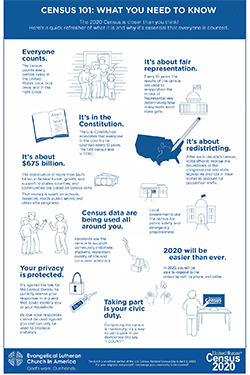
Our communities are significantly shaped by census data, and Census 2020 will update these numbers for the first time in 10 years. The ELCA is an official partner of the 2020 Census to encourage the most accurate count possible.

“Funding for over 100 federal programs, many of which combat poverty and hunger and support people in need, are distributed based on population,” says the Rev. Amy E. Reumann, Director of ELCA Advocacy. “An accurate count ensures that resources more justly go where they are needed most. It is also critical for representation in the political process as census information determines electoral maps.”

Undercounting is a significant issue among groups which benefit most from anti-poverty programs and from greater representation in decision-making. “Hard to count” individuals in census experience include persons residing in rural areas, young children, LGBTQIA persons, people experiencing homelessness, people who do not speak English, indigenous peoples and racial and ethnic minorities. The Census aims to count everyone regardless of immigration status, and as a result of the U.S. Supreme Court ruling, there will not be a question about citizenship status on the 2020 Census.

People underrepresented in previous census counts are not strangers. They are part of our congregations and communities. As we work toward a just world where all are fed, for your neighbor and yourself – encourage your community to be counted!

Share

Meet Claire

by Claire Embil

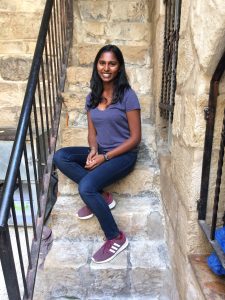
I am thrilled to have the opportunity to serve as one of the Gathering Hosts for the 2021 ELCA Youth Gathering in Minneapolis, MN. This will be my third Gathering and I can’t wait! I went to the 2015 Gathering with my home church as a participant, and in 2018 as a volunteer with Lutheran Campus Ministry. In Houston, I helped lead youth through building house frames during their Interactive Learning day. Each Gathering has been different and brought something new to my faith. I am so excited to see what God and the Gathering teams have in store for each of us in 2021 and in these next 16 months leading up to it.

I am currently a junior at the University of Wisconsin-Madison double majoring in English-Creative Writing and Religious Studies with a minor in Photography, mainly digital but I do some film work. After college, I plan to go on to seminary and become an ordained pastor in the ELCA. Outside of school, I spend time serving with Lutheran Campus Ministry, ELCA Young Adult Leadership Team, and Lutheran Student Movement. When I’m not studying or doing church activities, I enjoy attempting to learn to play guitar, traveling (I’m currently at 28 out of 50 states), and I am also a competitive gymnast.

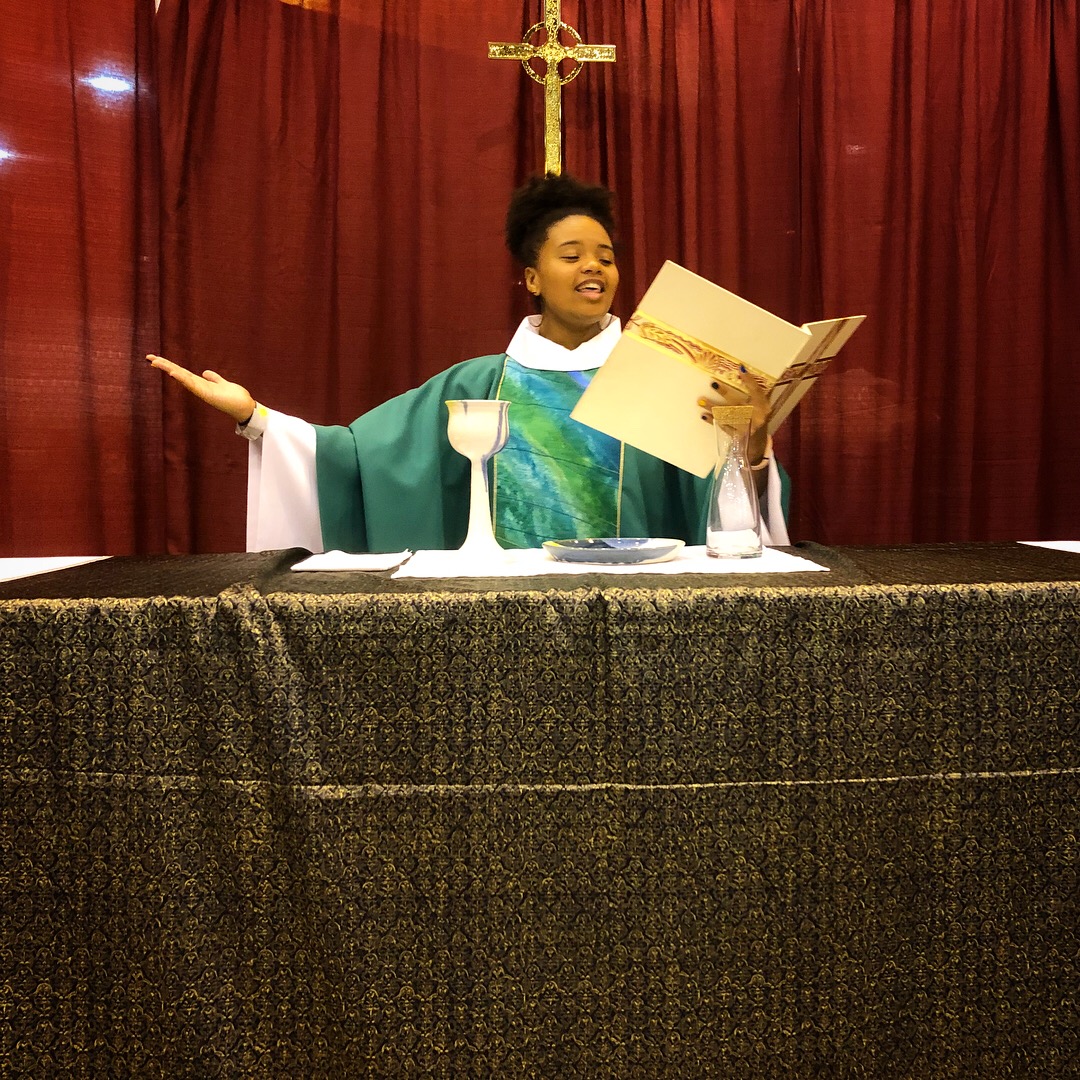
It was actually in the exhibit hall space for Interactive Learning in Houston that I finally stopped running from God’s call for me. The Association of Lutheran Church Musicians had a section set up for youth to go through stations of some of the parts of worship. This included a station for dress up. I wanted to try on the vestments and take a picture behind the altar. I stood up all dressed in Green for Ordinary Time, and it hit me. There is a very distinct sound that can be heard when a gong is rung. This feeling that hit me was just like that except I was the gong. I could feel something resonate in my entire being, and I knew that God had a call for me that would change everything. I found my place in the world at Gatherings and I can’t express enough how grateful I am to get to participate again in a ministry that completely transformed my faith twice over.

Claire Embil is a junior at the University of Wisconsin-Madison studying English creative writing, religious studies and photography. She is actively involved with the ELCA Young Adult Leadership team, the ELCA Youth Gathering, Wisconsin Campus Ministry, Lutheran Student Movement, and competitive gymnastics.

Share

ELCA World Hunger Sermon Starter- Ash Wednesday


These reflections are a part of ELCA World Hunger’s Sermon Starter series which is published via email every Monday. You can sign up for the weekly email here on the right side of the page if on a computer or near the bottom of the page if viewing from a phone. Pastor Tim Brown is the writer of these reflections. Pr. Tim is a Gifts Officer and Mission Ambassador for the Lutheran School of Theology at Chicago and a pastor and writer out of Raleigh, NC. You are invited to use the message below for personal devotion as well as prompts for sermon writing. 

February 26- Ash Wednesday

Matthew 6:1-6; 16-21

It’s curious how Jesus will use soil to heal things.

Like the man Bartimeaus, who is blind. He gets mud rubbed in his eyes to help him see. That makes no sense.

Or, how Jesus will draw in the sand as the woman about to be stoned is held on silent trial. Why would he turn to the dust to draw as charges are being brought up?

Or, consider the resurrection itself. How could the ground, the earth, the grave, bring about eternal life?

And yet soil is how Jesus seems to choose to heal.

If you want further thought on the healing properties of soil, consider this Irish idea about the healing properties of dirt. I’ve felt something like this, actually. Every time I put my hands in the earth of my yard, as I toil away growing and pruning and planting, I find my soul as improved as the soil.

What is it, Beloved, about dirt that helps to heal things?

We embrace this notion on Ash Wednesday. As we pull the dust of our lives and have it placed on our brows; as those burned Alleluias of praise become marks of humility (as, ultimately, all words of praise, should), we hold tightly to the belief that this dirt will, by God, heal us.

Matthew’s Gospel warns against practicing our piety in public. But on this day we hold that advice loosely as, though our piety is marked on our brow, the reasons themselves stay mute inside of us.

Because, honestly, we all come to Ash Wednesday with different, specific reasons: those moments we thrust needles into our veins to feel something; those moments we lashed out in rage, cursed out of fear, or judged out of prejudice; those times we cheated to get ahead, or because we are born ahead and denied someone their God-given dignity with impunity.

We all come to Ash Wednesday with a personal confession on our lips.

And yet we all, no matter our confession, receive the same sign of redemption: a dirt cross that intends to heal.

And note that the symbol on our brows is not just any sign. It is not a money sign, as if that can save and redeem us. And it is not the sign of this political party or that political party, as if our politics can save us.

All these things we rely on in life to save us: money, status, politics…they all blow away, like dust, as that dirt cross is smudged into our brows as an act of redemption.

On this day, though our piety is public, we don’t wear it with any sort of pride, Beloved. Because we all know, deep in the recesses of our hearts, that those things we bring to the altar on Ash Wednesday are not a moment of pride, but implicit acknowledgments that we cannot do this thing called life without the kind of redemption that our God in Christ gives.

Soil heals.  Perhaps it does every day, if you believe the websites. But even if you don’t, you know it does on Ash Wednesday, by God.


Share

February 23, 2020–Listen Up

Dave Dodson, Houston, TX

Warm-up Question

Do you ever engage in discussions or debates on social media? Do you think that social media is useful to debate important topics?

Listen Up

In the last couple of months, it seems like there has been even more political news in front of us than usual.  A presidential impeachment, Brexit in Europe, a cabinet shakeup in Russia – all of these events stacking on top of one another.  Thanks to social media, we see much of these events as they happen.  However, as technology improves, brand new problems are cropping up which we have to anticipate and deal with.

Boston University professor, Danielle Citron, is tackling one of these problems: the rise of “deepfake” video clips.  Deepfake fraudsters will soon be able to create phony video clips using cutting edge audio and video technology to make it appear as if a leader or public figure said or did something horrifying, when in reality, the whole video is simply computer-generated imagery.  These videos will be posted onto social media, and then be shared again and again by angry individuals who think the video is real.

To combat this, Citron has developed an Eight-Point Plan to combat the spread of deepfakes.  She is confident that we will be able to use technology to detect deepfakes, which can then be targeted and taken down by social media platforms.  But will this be enough?

Unfortunately, human nature might not make it this easy.  Human beings are hampered by a psychological tendency called “confirmation bias”.  To put it simply, we tend to dismiss information or sources which challenge our existing ideas.  At the same time, we automatically believe anything that helps confirm what we already believe.  We’re not very good at listening with an open mind.  Instead, we often seem to just want to be proven right.

Discussion Questions

  • When is it important to listen with an open mind?
  • What could make it hard for us to listen to other people and perspectives?

Transfiguration of Our Lord

Exodus 24:12-18

2 Peter 1:16-21

Matthew 17:1-9

(Text links are to Oremus Bible Browser. Oremus Bible Browser is not affiliated with or supported by the Evangelical Lutheran Church in America. You can find the calendar of readings for Year C at Lectionary Readings

For lectionary humor and insight, check the weekly comic Agnus Day.

Gospel Reflection

In high school, one of my teachers gave us an important rule for our class debates: No one was allowed to raise their hand while another person was speaking.  It was a wonderful rule, and the reason was simple.  As our teacher pointed out, when you raise your hand, you have stopped listening.  From that moment on, you are thinking about what you are going to say, not listening to the current speaker.  In our Gospel lesson today, Peter has let his enthusiasm run away with him, and he has metaphorically raised his hand.

Our story takes place at the top of a mountain.  Stories in the Bible that take place on top of mountains are momentous, holy experiences.  For instance, God revealed himself to Moses and handed down the Ten Commandments on Mount Sinai.  Today’s story mirrors that experience.

In this story, Jesus and three of his closest disciples – Peter, James, and John – have gone off together to a “high mountain”.  As they reach the top, an amazing transfiguration takes place.  Jesus becomes radiant and shines with the glory of God.  As this happens, two of the most important figures in the Hebrew scriptures appear.  Moses represents the law and commandments, while Elijah represents the greatest of the prophets.  In these two figures, the whole of the Old Testament is symbolized.  In this vision, we see Jesus as the law and prophecies fulfilled.

It isn’t surprising, then, that Peter gets excited! He blurts out his idea to build special places for Jesus, Moses, and Elijah right then and there.  You can imagine his surprise, then, to hear the voice of God booming down, telling him to be quiet and listen.

What did Peter do wrong?  Aren’t we supposed to get excited and want to work for God?

The problem isn’t Peter’s enthusiasm.  Instead, it’s the fact that Peter’s eagerness to do something was stopping him from experiencing what the moment truly was.  Peter was so busy with planning his next moves that he failed to truly experience the magnificence of Jesus’ transfiguration.  The voice of God had to remind him to be quiet, be still, and truly listen so that he could grow.

It is certainly possible that we do this today, even when we’re trying hard to be great followers of God.  Do we get caught up in planning church events, youth gatherings, and even outreach programs?  Do we work so hard on building our church that we sometimes forget to be still and listen?  It is easy to get caught up in our excitement to serve God.  Sometimes, like Peter, we need to be reminded to be quiet, be still, and bask in the presence of God’s love.

Discussion Questions

  • Does your church have members who run systems like audio and visual technology during the service? Do you think that it’s challenging to do those things and still be in a worshipful frame of mind?
  • Why do you think so many religions throughout the world, including ours, promote meditation and quiet reflection as an important spiritual practice?

Activity Suggestions

One of the finest meditative practices in Christianity is the walking of the Labyrinth.  Consider projecting a labyrinth onto a paved space, and then tracing it with sidewalk chalk.  Walk the labyrinth as a group, and invite your congregation to use it as well! For a guide on walking the labyrinth, check out this fantastic source from Saint Mark’s Lutheran Church in Salem, Oregon: http://stmarksalem.org/about/labyrinth/

Closing Praye

Heavenly Father, we thank you so much for the love and excitement you inspire in us.  We want so much to serve you and to work for the coming of your kingdom.  We ask that you help us remember to stop and listen.  Grant us the peace and patience to seek your voice in the stillness of our hearts.  In the name of Jesus we pray, Amen.


Share

February Update: Advocacy Connections

from the ELCA Advocacy office in Washington, D.C. – the Rev. Amy E. Reumann, director

TRAVEL BAN  |  GIRLS’ EDUCATION  |  DISASTER AID FOR PUERTO RICO  |  FAIR HOUSING RULE  |  CENSUS 2020


TRAVEL BAN EXTENDED:  On Jan. 31, 2020, the Trump administration announced an expansion of the January 2017 travel ban to include more countries in Africa and Asia. Under the new policy, citizens from Nigeria, Eritrea, Myanmar and Kyrgyzstan will be barred from applying for visas to immigrate to the United States. The National Origin-Based Antidiscrimination for Nonimmigrants (NO BAN) Act would address this executive action and assist those of us escaping perilous or life-threatening situations. Support for the NOBAN Act can be facilitated in a current Action Alert.

In a statement on the expanded travel ban, the Rev. Elizabeth A. Eaton writes, “As Lutherans, these actions should concern us. Through the life, death and resurrection of Jesus, God has set us free from ourselves to serve our neighbor. This expanded policy separates families from loved ones already here. Further, it prevents people — especially those escaping perilous or life-threatening situations in several of these nations — from coming to safety in the U.S. It does not enhance our safety or reflect our vocation as Christians.”


GIRLS’ EDUCATION:  On Jan. 28, the House of Representatives passed the Keeping Girls in School Act, a bill that seeks to strengthen U.S. international programs by reducing education barriers faced by millions of girls around the world. The bill calls on continued U.S. government and private investments to ensure quality and equitable education, promotes girls’ empowerment and streamlines existing programs.

Hundreds of ELCA Advocacy network members used an Action Alert in support of this legislation to send over 1,000 messages to members of Congress. An identical bill in the Senate awaits committee action before it can be sent to the Senate floor for a vote.


DISASTER AID FOR PUERTO RICO: The House of Representatives passed legislation to provide an emergency aid package for Puerto Rico in the wake of ongoing earthquakes and aftershock damage to the island. Support for this emergency aid in the Senate is the subject of an Action Alert, which emphasizes the lowest-income families in the greatest distress and the pressing need for authorizing proactive disaster policies for the greater United States.

The new package comes as the Trump administration recently released half of the blocked allocated assistance to help Puerto Ricans recovering from severe storms such as Hurricane Maria who now face additional devastation across the region. Two years after the 2017 hurricanes, more than 30,000 households are still waiting for assistance to have their homes repaired and/or rebuilt. Recent earthquakes have only accentuated the devastation many have experienced. Community Development Block Grant (CDBG) funding is desperately needed to assist survivors with building materials, furniture and labor so that they can rebuild their lives and homes.


FAIR HOUSING RULE: In January the Department of Housing and Urban Development (HUD) proposed a new rule that would weaken oversight and national data on fair-housing initiatives in low-income communities of color. Under the new proposal, the Affirmatively Furthering Fair Housing (AFFH) rule would be rendered almost completely ineffectual. Before March 16, use the Action Alert to make a public comment discouraging implementation of the change.

AFFH was first designed to help localities promote diversity and inclusivity under the 1968 Fair Housing Act and take proactive steps to reverse the effects of housing segregation. ELCA World Hunger recently shared a blog outlining the effects of altering the AFFH rule and explaining how discrimination in housing is an intersectional moral issue that affects multiple aspects of our lives.


ELCA PARTNER WITH 2020 CENSUS:  The ELCA is an official partner of the 2020 Census as we work toward a just world where all are fed and further our commitment to greater justice in public policy and the electoral process. More than $675 billion in federal funds, grants and support to states, counties and communities is based on census data. An accurate count determines electoral maps and ensures that resources more justly go where they are needed most, including to vital programs that combat poverty and hunger and support people in need.

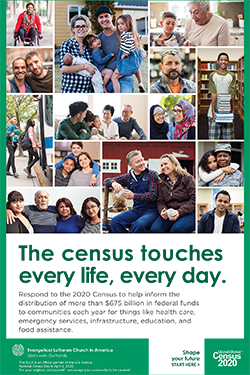
Posters are available from ELCA.org/resources/advocacy to help ELCA congregations encourage participation, particularly among hard-to-count populations such as people residing in rural areas, young children, LGBTQIA people, people experiencing homelessness, indigenous people, people who do not speak English, and racial and ethnic minorities. National Census Day is April 1, 2020, at which time all homes should have been invited to complete the census. For your neighbor and yourself — encourage your community to be counted!


Receive monthly Advocacy Connections directly by becoming part of the ELCA Advocacy network – http://elca.org/advocacy/signup , and learn more from elca.org/advocacy .


Share

‘Tis the Season: #NoPlasticsforLent

The Season

I didn’t fully appreciate (or understand) liturgical seasons growing up. As a kid, Lent was a baffling time of year that somehow started with a fun pancake party on Shrove Tuesday and took a seriously somber turn PRETTY quickly, culminating in the highly scary Bible slamming during my church’s Good Friday Tenebrae service. Growing up in the deep South, a lot of my Christian friends from non-liturgical traditions didn’t observe these seasons or days. It wasn’t fair – they didn’t give up soda or chocolate or meat for 40 days.

Lent changed for me in middle school when my dad, probably half-serious, half-desperate, suggested that I give up being rude to my sister for Lent.

Shocking that these three cool kids didn’t always get along!

It didn’t make any sense to me.

What about chocolate?

I was just starting to worry about my waistline anyway, and Lent would be a great time to make a change.

The Word

Isaiah 58: 4 – 9

You fast only to fight.

Is this the kind of fast that I’ve chosen, only a day for people to humble themselves?

Is it only for bowing one’s head like a reed and for lying in sackcloth and ashes?

Is that what you call a fast, a day acceptable to the Lord?

But this is the fast that I choose:

To loose the chains of injustice and untie the cords of the yoke,

To set the oppressed free and break every yoke.

To share your food with the hungry,

To provide the poor wanderer with shelter

When you see the naked, to clothe them,

And to not turn away from your own flesh and blood.

Then shall your light break forth like the dawn and your healing will quickly appear.

Then you will call and the Lord will answer;

You will cry for help and God will say:

Here am I.

The Fast

I heard a (very awesome young adult) pastor, Rev. Erin Coleman Branchaud preach on this text a few weeks ago and explain that this part of Isaiah is about the people of God asking to be recognized for their good fast. God helps them understand what REAL fasting that is pleasing to the Lord looks like.

It looks like fasting from the injustice we participate in every day – knowingly and unknowingly.

Fasting from leaving our neighbors without food and shelter.

Fasting from shame.

Fasting from building walls between us and our loved ones.

Fasting from destroying the earth.

Fasting from fighting with our little sisters.

THIS is part of what Lent is about for us. And maybe sometimes fasting from a specific item or food can be part of this fast. But, as Rev. Coleman Branchaud noted, Lent is not “a baptism of our self-improvement goals”.

Lent, a season during which we remember Jesus’s 40 days of walking in the wilderness, invites us to reflection, to lament, and to THIS fast – one of justice and peace. Lent welcomes our pain and sorrow and frustration and asks us to lay down the things that keep ourselves and our neighbor in chains. Lent invites us to be intentional, to notice our own habits, and to walk in the liberating steps of our Savior.

The Movement

So why plastics?

This year at the ELCA Churchwide Assembly the body gathered – including a huge number of young adult voting members – called on the ELCA to get serious about its commitment to care for creation.
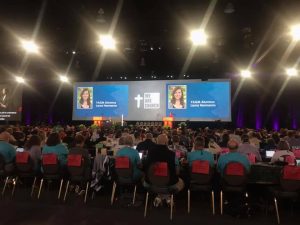
The whole group of voting members gathered at the ELCA Churchwide Assembly in August 2019

The #NoplasticsforLent initiative, led by young adults across the church, calls us to prayer for creation, to lament the ways we have been complicit in the degradation of the earth, and to action to care for our neighbor in fasting from the things that are hurting our planet.

Our suggestion is that individuals, families, and communities fast for 40 days from single-use plastics.
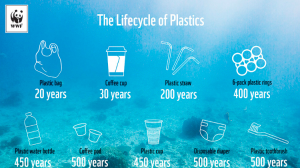
A few examples of single-use plastics from the World Wildlife Fund

We want this initiative to be accessible to all, and if this is not possible for you in your context or community, we invite you to sustainability practices that make sense for you.

The Details

We will publish a sign-up next week where individuals, families, and communities can share whatever it is that they’ve pledged to do to fast from degradation of creation this Lenten season!

Over the course of the next two weeks we will publish videos with how-to tips and easy switches to make, and we encourage you to share your ideas for fasting from plastics with each other on social media with the hashtag #NoplasticsforLent .

We will have weekly devotionals, like this one, published each Monday of Lent. These devotionals will be by young adult writers who are passionate about their spirituality and about care for creation.

We know that it will take more than giving up plastic cups at communion to heal the earth, but we hope that walking together as the Body of Christ in this initiative during this Lenten season will help us both individually and communally be better neighbors to plants, animals, the earth, and each other in our day-to-day lives. We also hope that it will move us toward more long term justice-seeking for the creation in our care.

We invite you to this Lenten practice of prayer, lament, and fasting as we walk for these 40 days with Christ.

The Promise

We invite you to this fast from the ways we harm our neighbor, creation.

And this is what Isaiah tells us:

That when we seek justice, love God, and serve others in this way

“light will break forth like the DAWN.“

As we pray and mourn for creation,

“Healing will quickly appear.”

Even when we feel overwhelmed by the challenges of environmental degradation,

“You will call and the Lord will answer;

You will cry for help and God will say:

Here am I.”

Reflection Questions:

  1. How do you understand Lent? Has your understanding changed at all over time?
  2. Have you ever participated in a Lenten practice? If so, which have been the most meaningful and why? If not, what other spiritual habits or practices have you engaged in?
  3. Why is care for the earth important for you as a person of faith?
  4. What sustainability practices or creation care practices might you commit to this Lent as an individual? With your family / friends? With your congregation / community? How will you hold one another accountable?
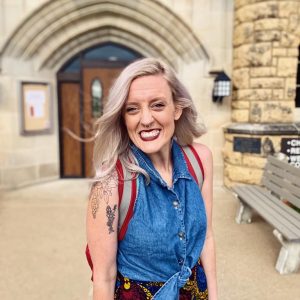
 

Savanna Sullivan (she/her/hers) serves as the Program Director for ELCA Young Adult Ministries at the ELCA Churchwide Office in Chicago, IL. She was a main stage speaker at the 2018 ELCA Youth Gathering in Houston, TX and gives presentations around the country to ELCA and ecumenical groups about Young Adult culture and empowerment in the church. She is passionate about helping young people seek the Divine in themselves and pushing the church to equip, amplify, and respect the voices of young leaders. She loves banana pudding, the Clemson tigers, and memorizing poems.


Share

#TreasuresOfDarkness: An African Descent Month Devotional-A reprise for 2020 (excerpt) by Rev. Kwame Pitts

#TreasuresOfDarkness: An African Descent Month Devotional-A reprise for 2020 (excerpt)*


Darkness/Black:

Devoid of Light

Lacking knowledge or culture.

Wickedness.

Evil.

Lack of spiritual or intellectual enlightenment.

Ignorance.

Sullen.

Foul.

Hostile.

Throughout our complex and convoluted history, forcibly exiled to these divided United States , we as People of Color specifically, children of the African Diaspora, have had the label affixed to our very being, everything that could be seen as negative and malevolent, based on the color of our skin. Our ancestral home, was known as the dark continent:

Therefore, it is no surprise the roots of the detriment of our humanity has become a learned and permanent part of the dominant culture and the status quo’s misinformation.

In the movie Malcolm X, Malcolm who is at the brink of spiritual awakening, is confronted by another prisoner, who is a follower of the Nation of Islam about the meaning and the portrayal of the words Black and white and how these are attributed to humanity. Malcolm slowly becomes angered after the description and definition of white is shown to him:

White:

The opposite of Black

Free from spot or blemish

Innocent

Pure

Without evil intent

Honorable

Harmless

“It is inherent in every monotheistic faith that there are only truth and error, good and evil…Since the dark-skinned heathen obviously did not belong on the side of truth and good, the Christian assigned him…to error and evil.” Dr. Kelly Brown Douglas, What’s Faith Got to Do with it? Black Bodies/Christian souls.

This mindset has filtered down throughout Christianity, to where many, as People of Color have become ashamed about who we are and questioned why the Creator would curse us with this troublesome skin. Unfortunately and because of the onset of what Dr. Douglas defines as “Plationized Christianity”, scripture after scripture has been misused to enforce racism, stereotypes and our sacred bodies being dehumanized into nothing more than beasts.

“Our American Christians are too busy saving the souls of white Christians from burning in hellfire to save the lives of black ones from present burning in fires kindled by white Christians.” Dr. James Cone, The Cross and the Lynching Tree.

This February as always is African Descent History Month; as scholars, troublemakers, seminarians, pastors, theologians and questers towards knowledge and empowerment, we are flipping the definition of darkness/blackness on its proverbial head and reclaiming the power of this word. Darkness does not equate a people blessed and enriched with melanin, created and formed in the image of Creator, who has blown sacred breath into our sacred bodies, giving us LIFE and a purpose.

Follow us at #treasuresofDarkness this February, as many beloved siblings of Faith, of Love and of Light share with you their perception and translation of the concept of darkness in Scripture and in sacred/holy texts.

ASE!

AMEN!

Peace.

The Rev. Kwame Pitts(M.Div, LSTC), is empowered and embolden by the presence of the Ancestors, living out her life as such. Her call is not only to prophetically teach and preach but also experience her Faith along a dual and sometimes complex spiritual pathway, as Creator has called her. Following and continuing the responsibilities laid out through her Womanist theologian mentors and Elders, her Ancestors both known and unknown and venerating her namesake and the work of building a nation, Kwame lives her life authentically, as a Woman of the African Diaspora, working and rooted in transformative and social justice. She has been ordained in the ELCA since 2015 and currently serves in Upstate NY Synod both as Pastor and Campus Pastor. She continues towards completion of her Master’s of Sacred Theology (STM) from Chicago Theological Seminary, 2020.


**To view the entire post from #TreasuresOfDarkness, follow: https://medium.com/@TravelingPastor/treasuresofdarkness-an-african-descent-month-devotional-3cf60143bd9e. 

Share