Skip to content

ELCA Blogs

Day One of MYLE and the tAble

The overall theme of “ONE” resonated strongly on the first day of MYLE. The theme for the first day, “One body, many parts” was truly embodied as people traveled from across the country to gather as one community at the University of Houston for the Gathering pre-event. On the first day, there was time to begin forming relationships at community life and breaking bread with one another over dinner. Worship began with greetings from Texas-Louisiana Gulf Coast Synod Bishop Michael Rinehart. The Assistant to the Bishop for the Metropolitan D.C. Synod, Rev. Leila Ortíz, preached at opening worship, reminding everyone attending MYLE that as being one in the body of Christ, we matter, we are necessary, and we make the body of faith whole.

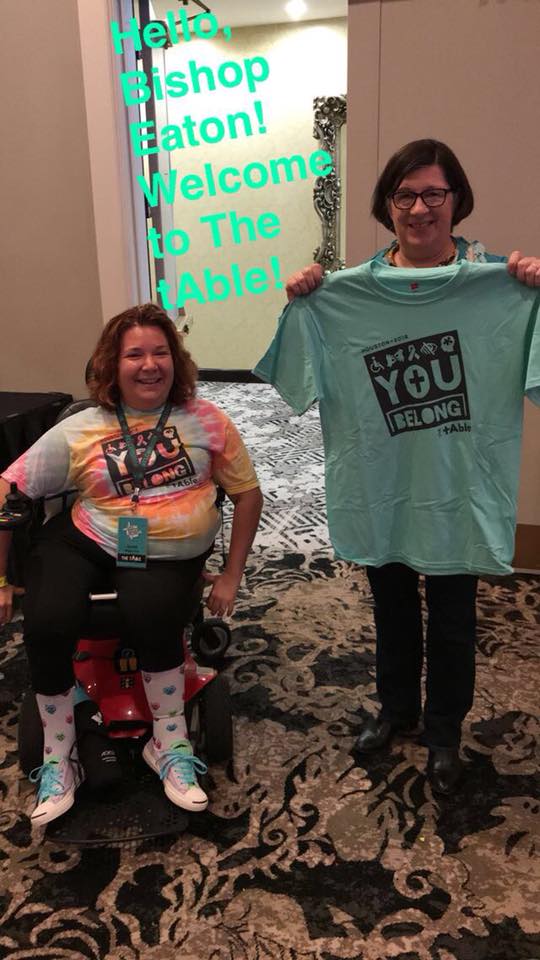
“You Belong” was the theme for the tAble, held at the Crowne Plaza. Participants traveled from around the country to come together for this pre-event to the Gathering. The theme for the first day, “Who do you belong to?” was asked throughout the day. During registration and afternoon activities, Bishop Eaton stopped by to spend time with participants. The time together began in worship, centering in the space by reflecting on the day’s theme. Rev. Leslie Welton the assistant to the bishop in the Rocky Mountain Synod and pre-event chaplain, presided over worship. She reminded participants to center themselves in their bodies to experience worship however it would be meaningful and comfortable. The first day at the tAble was also a time to establish and build trust with one another in the space, living into a full and embodied experience. At the end of a busy day concluding in evening prayer, participants gathered together.


Follow the 2018 ELCA Youth Gathering on social media:

Don’t forget to follow the hashtag #ELCAYG2018!

Follow instructions to download the ELCA Youth Gathering app here.

Share

the tAble and MYLE Begin!

What does it mean to truly belong? What does it mean to be a part of the one body of Christ in the midst of the diversity of God’s creation? These questions are a part of the foundations for the tAble and MYLE, the pre-events to the ELCA Youth Gathering. The pre-events embody the full expression of inclusivity within the church.

The theme for the tAble is “You Belong.” With this theme, there are a series of questions for young people who live with a wide range of physical, cognitive and emotional disabilities within our church to ask, “where do I fit in?”, “why am I different than others?”, and “what gifts could I possibly bring?”.

the tAble reminds us that we are all welcome at Christ’s Table and that we all belong in the fullness of who God created us to be. The daily themes, questions will be the areas of wonder to be explored during the pre-event are:

  • Who do you belong to?,
  • Why do you belong?,
  • Your gifts belong at the table. How do you belong?, and
  • Who belongs with you?.

MYLE’s theme is “ONE,” with the foundation in Ephesians 2:14-19. What does it mean to be a part of the one body of Christ when God expresses the fullness of God’s diversity in cultures and languages? How is unity in God expressed within the many people around the world who follow Christ in a number of beautiful and meaningful ways?

Each day, MYLE will focus on “ONE” in a number of ways:

  • One body, many parts (1 Corinthians 12:14-26);
  • One mission, many gifts (1 Corinthians 12: 4-11);
  • One household, many rooms (John 14:2); and
  • ONE in CHRIST (Ephesians 2:14-19).

MYLE and the tAble express and embody that You Belong at Christ’s Table, and that we are unified as ONE in the beauty and diversity of God’s creation. These are vital pre-events to express the fullness of expression of God’s church, and there is reason to rejoice as these pre-events begin today.


Follow the 2018 ELCA Youth Gathering on social media:

Don’t forget to follow the hashtag #ELCAYG2018!

Follow instructions to download the ELCA Youth Gathering app here.

Share

Connected to the Gathering

The time has come! The ELCA Youth Gathering is just days away, and MYLE and the tAble begin programming tomorrow.

After bake sales, car washes, crab feed dinners, parent meetings, planning meetings, laughter, maybe some nervousness, definitely a lot of excitement, and time of intensive planning and prayer, it is now the appointed time. Team leaders have been in Houston putting the plans and activities they’ve been working on for the past two to three years to life. Youth are beginning to arrive. The city of Houston is prepared to welcome us.

Make sure to follow us in a number of ways on social media. Find information and follow the faith formation and fun at the following places:

Don’t forget to follow the hashtag #ELCAYG2018 on social media.

You can also follow instructions to download the ELCA Youth Gathering app here.

For those who have offered your prayers, your resources, and of so much more to provide the youth from your faith communities a unique and formative experience, make sure to continue to connect to what is happening in Houston!


Share

A Restored Moral Narrative

By Rev. Dustin G. Wright, Messiah Lutheran Church in Schenectady, New York


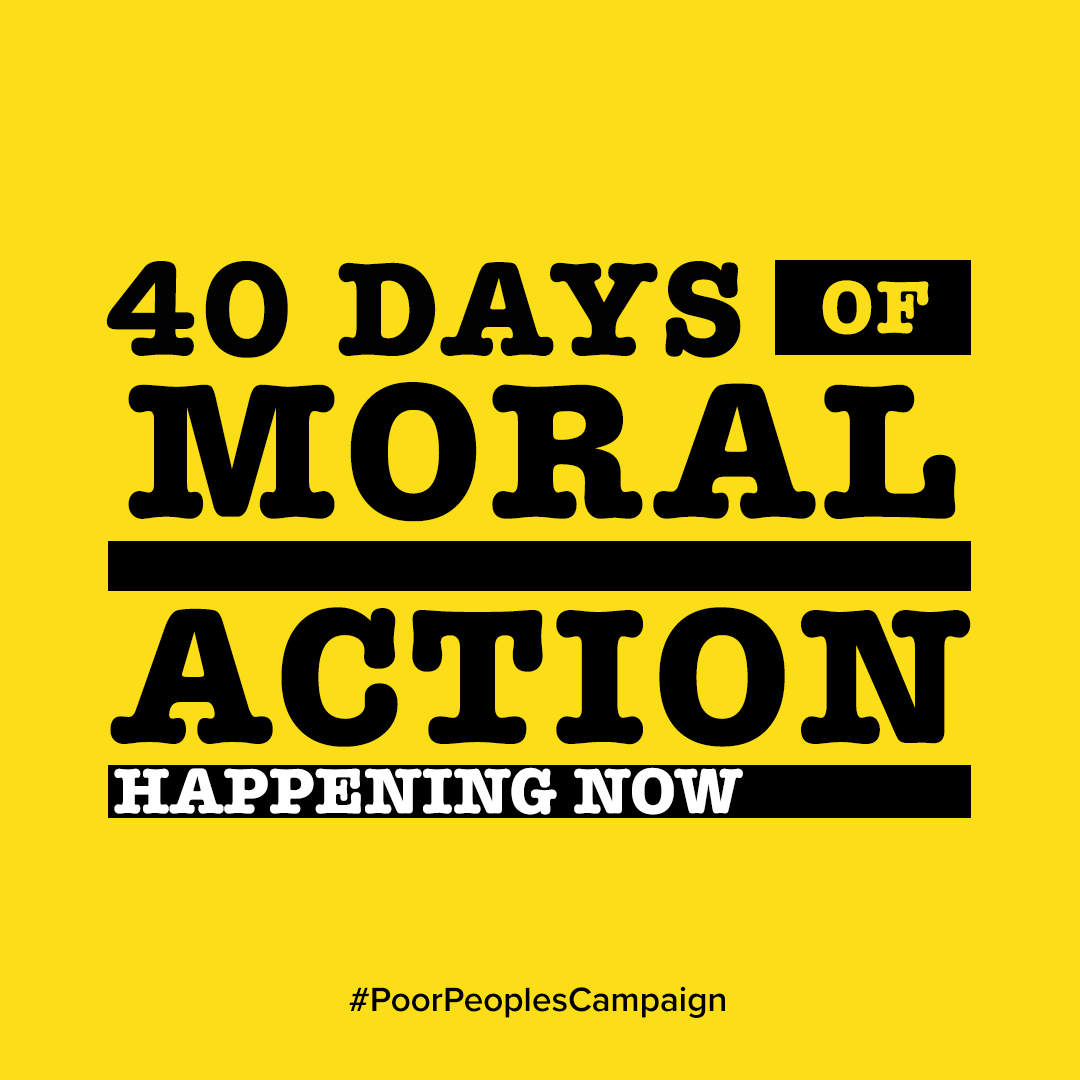
About a month back during the Week One action of the Poor People’s Campaign: A National Call for Moral Revival, I sat with a diverse group of justice-minded folks from across New York State blocking the doors to the Capitol Building in Albany. Wearing my collar and favorite stole, I was trying to accompany children, women and people living disabilities in saying how unnecessarily hard it is for so many in a state that puts itself out there as one of the most progressive places in the country. I was simply doing what I thought people on the Way of Jesus should be focusing on, and in the midst of all the singing and chanting, I got into a conversation with a young woman from Brooklyn sitting next to me.

Seeing my collar, she said something like, “Wow, there’s a lot of religious leaders here.” A little surprised, I responded with something like, “Of course there is, this Poor People’s Campaign is just picking up where MLK left off after all fifty years ago!” And then, she said something that struck me to the core after four years of ordained ministry… “Wow, I didn’t know religious people cared about important things.”

It was in that moment that I really began to realize how truly important the Poor People’s Campaign is. A lifelong Lutheran, I was born in 1986, and despite my childhood pastor preaching against the 2003 Iraq War and teaching about issues like hunger and poverty, I also spent my entire life in a context where many Americans, for a bunch of different reasons, seem to think following Jesus is more about making LGBTQIA folks feel unwelcome; telling women what to do with their bodies; and saving souls from eternal torment in the next life rather than saying much of anything good at all about how we ought to live both individually and collectively in this life.

Jesus was a refugee, a day laborer, after all, lynched in the manner of a political revolutionary by one of the most powerful empires the world has ever known specifically because he sought to challenge and change that system. While he talked about getting into heaven, for sure, this world, not the next, was the focus of his ministry. As it says on the stoles of two leaders of the Poor People’s Campaign, Rev. Liz Theoharis and Rev. William Barber, Jesus was a poor man. How then could followers of the Way of this poor revolutionary become identified with policing folks’ bedrooms but not saying much of anything about the systemic sins of poverty, racism, militarism and ecological devastation?

The “moral narrative” of this country, influenced in part by a false, ahistoric and heretical brand of Christian Nationalism that has almost nothing to do with the teachings of Jesus, has quite simply become distorted.

“A New and Unsettling Force: Confronting the Distorted Moral Narrative” is the theme for this week of the Poor People’s Campaign, and I pray you will join me, people of faith and others of good will across this country in doing just that.

In Christ,

Rev. Dustin G. Wright

Pastor, Messiah Lutheran Church in Schenectady, New York

President, New York State Council of Churches

Share

God’s Word Spoken Publicly, Boldly and Honestly

By  the Rev. Amy Reumann, Director of ELCA Advocacy


   When the Attorney General and the White House Press Secretary invoked St. Paul’s instruction “be subject to the governing authorities” to quell criticism of the Administration policy of separating families seeking asylum at the border, faith leaders reacted swiftly to the misuse of Scripture. The ensuing uproar focused on a narrow interpretation of Romans 13 that ignored the larger meaning of the passage, which holds all persons and structures to God’s higher standard of love. It can in no way be used justify the horrific practice of tearing children away from their parents or any unjust law. Many have weighed in on the misapplication of the text to falling in line behind this new interpretation of immigration policy.  But it also raises a larger question. Just what is our relationship to government, as Lutherans? When do we submit, and when is resistance called for? 

Luther had a lot to say about this. He bequeathed us with a unique take on the role of the church in society. As branches of the emerging Protestant movement wrestled with how to relate to the ruling powers – full separation from the irredeemably sinful affairs of state and society, or fully combining royal and church leadership – the Lutheran movement forged its own path. Luther’s reading of the Gospel and understanding of God’s ordering of the world led him to believe that Christians can make use of the governing structures, because they are gifts from God for order, for peace and for providence for those who have little.  

In the Large Catechism, Luther stresses the place of government three times, with an emphasis on the ways it is a means by which God cares for the most vulnerable:

  • Fourth Commandment:civil government is an extension of the parental role, responsibility and authority, and is to serve so that children can live full and productive lives.
  • 1st Article of the Apostles’Creed:“good governments” is lifted up as a gift of God,  alongside necessities like body, soul, life, food, drink, spouse, child, air, water, peace and security.
  • 4th Petition of the Lord’s Prayer:daily bread includes all the necessities we need for our daily life and the role of the rulers was to ensure daily bread for all.

Luther drew on the poetry of the Psalms to speak further regarding governmental care for the poor. In his commentary on Psalm 82 he addresses the duties of a prince and their virtues that include furthering the Word of God by ensuring “justice for those who fear God,” and just laws to prevent the oppression of the poor, wretched, widows and orphans. The government itself is a “divine hospital” to care for those in need, to ensure no one will become a beggar.  

Luther is very clear on what makes a good government. Cooperation, participation and submission to the just laws of a benevolent government are in line with these emphases. But submission to the governing authorities is never blind nor automatic. We are to evaluate laws, discuss policies as a faith community and discern a faithful response. As the ELCA, we do so within the framework and guidance of our social teaching documents.

The ELCA Social Statement “Church in Society: A Lutheran Perspective” sums up this up when it states that:

This church must participate in social structures critically, for sin also is at work in the world. Social structures and processes combine life-giving and life-destroying dynamics in complex mixtures and in varying degrees. This church, therefore, must unite realism and vision, wisdom and courage, in its social responsibility. It needs constantly to discern when to support and when to confront society’s cultural patterns, values and powers. (Church in Society, p. 3)

Lutherans are called to careful discernment on social issues and, rooted in our understanding of the Gospel, to affirm laws that align with it, oppose those that are contrary to it and to speak up in all cases. Laws and policies that do harm to the most vulnerable are to be strenuously opposed. The social statement continues:

As a prophetic presence, this church has the obligation to name and denounce the idols before which people bow, to identify the power of sin present in social structures, and to advocate in hope with poor and powerless people. When religious or secular structures, ideologies or authorities claim to be absolute, this church says, “We must obey God rather than any human authority” (Acts 5:29). With Martin Luther, this church understands that “to rebuke” those in authority “through God’s Word spoken publicly, boldly and honestly” is “not seditious” but “a praiseworthy, noble and … particularly great service to God.” (Church in Society, p. 4)

Lutherans have some wonderful theology here that we need to dust off and put it back in use. Now. When rhetoric dehumanizes or demonizes people of different races, nationalities or religious traditions the church is called to name and denounce idols of white supremacy, ethnic nationalism or religious intolerance, inside itself and in public life. When public policies perpetuate the poverty or oppression of our neighbor, we are to work tirelessly to change them. Family separation spectacularly fails the test of our faith values and has earned our rebuke and resistance. Should all the children be reunited with their parents, there are still families torn apart by our nation’s policies, caught in our broken immigration system, separated by this Administration’s travel ban, or locked up in our system of mass incarceration. If children at the border horrifies us, so should these other cases.

Faith community leaders, including Presiding Bishop Eaton, have spoken resoundingly in opposition to family separation. When the Presiding Bishop speaks, it is a call to action for the church to join in confronting not only the policies but the values and powers behind them. We must speak God’s powerful Word publicly, boldly and honestly in these days. ELCA Advocacy is here to help you with that.


Be sure to join the ELCA e-Advocacy Network.

Share

Luther on “Exiles”: Hospitality for World Refugee Day 2018


Therefore not single persons, as formerly, but entire families are now in exile because of their confession of the Word. It is a crime not to help these. – Martin Luther, Lectures on Genesis (Chapter 18)

Martin Luther’s Lectures on Genesis contain some of his most compelling teachings about who the church is called to be in the world.  Reflecting on the story of Abraham, Luther stakes out his claim that the church is called to be an agent of hospitality in an often inhospitable world. It’s an account worth reflecting on today, as we commemorate with others around the globe World Refugee Day.

An “Unparalleled” Example

Luther’s teachings on hospitality come in his lecture on the 18th chapter of Genesis, which tells the story of Abraham playing host to three visitors. As he is cooling off in the heat of the day, Abraham sees three men approaching. Immediately,

“he ran from the tent entrance to meet them and bowed down to the ground. He said, ‘My lord, if I find favor with you, do not pass by your servant. Let a little water be brought, and wash your feet, and rest yourselves under the tree. Let me bring a little bread, that you may refresh yourselves, and after that you may pass on—since you have come to your servant.’ So they said, ‘Do as you have said.’ And Abraham hastened into the tent to Sarah, and said, ‘Make ready quickly three measures of choice flour, knead it, and make cakes.’ Abraham ran to the herd, and took a calf, tender and good, and gave it to the servant, who hastened to prepare it. Then he took curds and milk and the calf that he had prepared and set it before them; and he stood by them under the tree while they ate” (Genesis 18:2b-8).

Abraham’s hospitality to the strangers is an “unparalleled” example of hospitality for Luther, according to Leopoldo A. Sánchez M. Yet, unique as it is, for Luther, Abraham’s example is one the church is called to follow.

Luther begins by noting especially Abraham’s earnest service of the strangers and his “generous and bounteous” attention to their needs. For Luther, this arises, in part, from Abraham’s own experience as an exile, a wanderer without a stable land. Equally important, though, for Luther, this virtue of hospitality is a basic teaching Abraham takes from the “patriarchs and from the practice of the church” (which Luther extends to include the religious heritage of Abraham.) This is so basic a practice to the church as church that Luther writes,

“At all times the church has been like some refuge of the exiles and the poor.”

There is a link between Abraham’s hospitality and the reference to hospitality in the book of Hebrews, according to Luther. There, readers are reminded, “Do not neglect to show hospitality to strangers, for by doing that some have entertained angels without knowing it” (Hebrews 13:2).

This is certainly nothing new. Hospitality is one of the most basic ethical practices of the people of God throughout scripture. In fact, Ezekiel points to inhospitality as the sin that brought down Sodom: “This was the guilt of your sister Sodom: she and her daughters had pride, excess of food, and prosperous ease, but did not aid the poor and needy” (Ezekiel 16:49), a verse Luther cites in his lecture here.

Hospitable Treatment of “All Guests”

Luther’s interpretation of Abraham makes clear that hospitality is primarily extended properly to other people of faith, people in the “in-group” of one’s neighbors or what Luther calls “exiles..because of their confession of the word.” Here, he means Christians forced to leave their homelands because of religious persecution. Had the visitors to Abraham not been among these, Abraham would have cared for them “but he would not have fallen down to the earth in accordance with brotherly love. For he knows that God dwells in the brethren and fellow believers, who are true temples of God, and not in the enemies of the faith or in those who have no knowledge of the true religion.”

That said, there is no reason to limit hospitality only to fellow believers, or to draw firm lines between who is worthy of “refuge” and who isn’t. “Even if they had been enemies,” Luther writes, Abraham “would not have let them go but would have refreshed them first in accordance with love.” He goes on to say:

“I am not displeased with the opinion of those who say that Abraham learned from instances that had happened both to him and to his ancestors, and that he experienced rather often that angels, coming in the form of human beings, enjoyed the hospitality of human beings, as we shall hear later about Lot in Sodom (Gen. 19:1 ff.). Because of this experience they treated all guests rather respectfully and hoped for occasions on which they themselves would associate with angels.”

For a theologian who was well-known for his displeasure, even this modest allowance is worth noting.

More pointedly, Luther goes on to say:

“Indeed, we should be generous not only toward the brethren and such as are exiled because of their confession but also toward those who are strangers in the state, provided that they are not manifestly evil…Even though he is not suffering because of the Word but is in distress in other respects, he should not be disregarded by us.”

Interestingly, Luther seems also to enjoin public officials and other citizens beyond the church to extend this same sort of protection and assistance, praising Elector John Frederick’s approach to exiles:

“By God’s grace the wretched exiles now have a place under our most illustrious Prince. Here they can flee for refuge, and here they are safe. But I am afraid that someone else will come—someone who does not know Joseph (Ex. 1:8); and I fear that this will happen because of the excessive cruelty, inhospitality, and greed of human beings. The nobles, the burghers, and the peasants do not help the churches with a single obol to be able to be generous toward exiles.”

Without reading too much into this, it appears that Luther believes that hospitality is not private Christian charity but a public virtue for the community and state, inasmuch as the latter creates the opportunity for the church to be of service.

A Realistic Assessment

Luther isn’t idealistic, though. He knows that there are those “exiles” who may take advantage of hospitality for their own greedy or malicious purposes. But here, we have to remember that Luther is not a consequentialist; the morality of an action is in its practice, not in the good or bad consequence that it brings about. Hospitality is a virtue, a good in itself. Drawing on Jesus’ willingness to heal the ten lepers, despite knowing that most would not show him gratitude, Luther commends the practice of hospitality in spite of the risks:

“If we are deceived now and then, well and good. In spite of this our good will is demonstrated to God, and the kind act which is lost on an evil and ungrateful person is not lost on Christ, in whose name we are generous. Hence just as we should not intentionally and knowingly support the idleness of slothful people, so, when we have been deceived, we should not give up this eagerness to do good to others.”

Why should the church practice hospitality? Not because every stranger is an “angel” in disguise, but because that is what the church does in the name of Christ.

At a time when more than 68 million people around the world are either refugees or internally displaced because of violence or persecution, Luther’s call to practice earnest hospitality is as important as ever. While we can’t risk drawing too simple of a line between his time and ours, we also can’t risk losing sight of a virtue so central to what makes us church.

This is one of the reasons ELCA World Hunger continues to support projects that accompany refugees, migrants, and others on the move. The practice of hospitality is not merely a command that Lutherans are called to follow but rather, as Luther himself highlights, part of heritage as people of faith and as exiles ourselves. And who knows, maybe by so doing, we will entertain angels. But even if we don’t, we can still take comfort in the fact that the church will be what it is called to be: “like some refuge of the exiles and the poor.”


For more on Lutherans and refugees, see this earlier post.

To support refugees and other neighbors seeking refuge in the United States, join the efforts of ELCA Advocacy through this important advocacy action in honor of World Refugee Day.

Ryan P. Cumming, Ph.D., is the program director of hunger education for ELCA World Hunger.

 

Share

Happy Juneteenth!

– Rozella Haydée White

I am from Houston, Texas and I grew up celebrating Juneteenth. When I left Houston in 2007, l lived in three different cities over the course of 10 years. Imagine my surprise when most people in these places (Philadelphia, Atlanta, and Chicago) had never heard of Juneteenth. I was astonished! How could such an important part of American history be known by so few people?

On January 1, 1863 the Emancipation Proclamation took effect, abolishing slavery after 400 years. This changed federal legal status of more than 3.5 million slaves. Many, including myself, wonder about the intent and signing of the Proclamation. It happened during the American Civil War and the north needed more people to fight against the south. Releasing slaves was seen as a political move to increase people power for the war rather than a moral move to grant human beings their freedom.

However, the Emancipation Proclamation didn’t reach the people in Texas until June 19, 1865. As Texas was not a battleground state in the Civil War, the initial proclamation did not apply. Slaves in Texas didn’t find out their status had changed until two years after the fact. The Proclamation was shared in Galveston, an island 60 miles southeast of Houston. Freed slaves rejoiced.

The following year, Juneteenth was born.

Last year marked an important part of history in Houston. Emancipation Park, purchased in the historic Black community of Third Ward by freed slaves in 1870, underwent major renovations. It reopened last June after a multi-million dollar project aimed to restore and revitalize an integral piece of history of the Black community and the wider city of Houston.

Here’s the thing – we don’t know what we don’t know. But at some point, we have to ask ourselves, who is telling the story of history we cling to? What perspectives are informing our viewpoints? How are we listening to a plethora of voices, bringing to bear the variety of experiences that make up a reality? This is why the Gathering has partnered with Folklore Films to prepare service learning materials. You’ll get to hear from the founder of this amazing organization, Marlon Hall, on the main stage.

So much of the history I thought of as THE history turned out to be written from one point of view. I love Chimamanda Adichie’s Ted Talk, “The Danger of a Single Story.” It reminds us that history is often written from the point of view of the most powerful. What history have missed because we haven’t listened to the voices of the oppressed?

As you prepare to enter into my beloved city, take time to consider the history of this extraordinary place. We are the most diverse city in the United States, with a largely integrated population. We are a hospitable people, having a deep love and respect for Texas history. We welcome all, simply asking that folks be open minded and caring of our community and of our people.

Happy Juneteenth and welcome to Texas, y’all.


Rozella Haydée White is a spiritual life coach, leadership consultant and inspirational speaker and writer. She is the owner of RHW Consulting which seeks to restore hearts to wholeness and empower women to create and live a meaningful life. She believes that everyone is gifted and has the power to transform themselves, their communities and the world when they tap into their most authentic self.

Share

“The lifeline that never goes away”: St. Matthew Trinity’s Lunchtime Ministry


St. Matthew Trinity Lutheran Church’s Lunchtime Ministry offers a warm meal, hospitality and community to neighbors in Hoboken, New Jersey. This important work is supported in part by a Domestic Hunger Grant from ELCA World Hunger. Stanley Enzweiler is the Program Manager of St. Matthew Trinity’s Lunchtime Ministry and has worked with the ministry since 2016. Below, he shares more about what this ministry means to the people of Hoboken. To apply for a Domestic Hunger Grant to support your ministry, visit ELCA.org/DomesticHungerGrants.

Everyone’s life, at some point, takes an unexpected body blow. An accident, an addiction, the loss of a job or family member. These forces come out of nowhere, and for a while, it seems like the world is against you. However, eventually someone throws you a lifeline—a good lawyer shows up, a friend makes a job offer, or time spent in the stability of everyday life heals that wound.


Lots of people who have come back from having their feet kicked out from under them believe that those in the worst shape—people who are homeless or living in poverty—are either lazy or helpless. “I helped myself, so why can’t you?” moralizes one person, while another shakes their head, saying, “I’ve been so fortunate, and all these poor people are just down on their luck. No one actually wants to be homeless.”

As anyone who has worked in a social service will tell you, both perspectives take it too far.  Many people in poverty have gotten the wind knocked out of them, but, unlike those in more fortunate situations, they haven’t had lifelines thrown their way. They often don’t have a stable job to begin with, or their family and friends are unable to give them a loan or a place to stay.  On the other hand, many people have simply rejected or misused the lifelines thrown to them.  And yes, some people do want to be homeless.

What I love about St. Matthew Trinity Lunchtime Ministry, a soup kitchen and drop-in center operating out of St. Matthew Trinity Lutheran Church in Hoboken, New Jersey, is that we don’t care about that stuff. Of the 65 or so people we serve every day, some are looking for work, some are waiting on their benefits to come in, some are about to lose their housing, and some enjoy living on the streets. But we do not screen our guests based on why they are in need. We don’t ask for your fingerprints or your ID or your immigration status. Our only requirement is respect for the people and space around you. We’ll give you a warm meal, a fresh pair of socks, and a listening ear no matter what you did last year or last night. Whatever your story is, we will welcome you.

And here’s the really amazing thing. Even if you break the rules at Lunchtime Ministry and have to leave our community for a few days, we will always welcome you back. Everyone messes up a time or two, but no one is beyond forgiveness. We are one lifeline that never goes away.

Len (pictured at left), one of our longtime guests, was generous enough to share his story with us. Born in Jersey City in 1959, he attended technical school in Texas before getting deployed to California to work as a forklift driver for the U.S. Air Force. After his honorable discharge, he stayed in California until his father died, and he returned to New Jersey to take care of his mother. She died in 2011, leaving him with nowhere to go. Although he stayed at other county shelters, a few bad decisions got him kicked out of these for life.

Len came to Lunchtime Ministry as a last resort. Although we are not an overnight shelter, he is able to get a few hours of sleep on our benches or floor during our open hours. Like many of our guests, he helps out when needed by cleaning tables, taking out the garbage and posting event flyers. He also attends church services, Alcoholics Anonymous meetings, and Bible study. Most of all, he is known for encouraging our volunteers with one-liners such as “This is the best food in town…and I’m not just talking about the prices!”

Like many social services, we are a community effort.  We welcome volunteers from all walks of life and enjoy partnerships with numerous other social services. Our financial support comes from various sources, including ELCA World Hunger’s Domestic Hunger Grant, whose recent gift toward our food and supply costs will assist us in continuing to dish out delicious and filling meals every day.

It’s easy to list the things that make Lunchtime Ministry unique—the food donations from restaurants as diverse as Qdoba Mexican Grill and Schnackenberg’s Luncheonette, the free haircuts on Mondays, the cardboard barn in which we collect spare change for ELCA World Hunger, the “billritos” that our chef Bill makes from scratch on Wednesdays, the guitar music half an hour before we close. But when we’re asked why our program is necessary to Hoboken, there’s only one answer: respect. For many people in town, we are the one place where they can spend a peaceful morning, the one place where they have a forgiving community, the one place where they can go when they have burned all their other bridges.  In Len’s words:

“A little respect goes a long way.  A lot of respect could be eternal.”

Share

Summer’s Here: Toward a Leaner Liturgy

Today’s post is by James Boline, pastor at St. Paul’s Lutheran Church, Santa Monica, California, a Reconciling-in-Christ congregation of the Southwest CA Synod.

Summer is upon us. Even though we won’t reach the season’s solstice until the 21stof June, as we flipped the page in Sundays and Seasons after the Day of Pentecost, we arrived at the section marked “Summer” starting with Holy Trinity Sunday (aka Memorial Day Weekend this year). And with that turn-of-page and turn-of-month, school’s almost out, graduates are commencing, LGBTQ Pride season revs up, “June is busting out all over,” perhaps you find yourself yearning for a “leaner liturgy” in these months of travel and transition.

At St. Paul’s in Santa Monica where it is perpetual summer, we have the luxury of taking our time in worship with a 10:00 service and a year-round outdoor coffee hour which follows. The congregation rarely murmurs (much) about services which extend 15–20 minutes beyond the one-hour mark during the school year. Thus, every summer my colleague Cantor Barbara Hoffman and I try our best to shore things up a bit in order to give our saintly sinners/sinful saints at St. Paul’s a summery break.

We start with an abbreviated/streamlined gathering rite at the font, which at St. Paul’s is located in the very heart and center of the sanctuary. For us, this summer rite is often a brief seasonal Kyrie-infused confession found in a resource called Prayers for an Inclusive Church, by Steven Shakespeare (Church Publishing, New York, 2009). Occasionally, albeit rarely, we have gathered simply with a hymn, followed by the greeting and prayer of the day. One could also consider using a responsive reading of the day’s psalm here as well, letting the service flow quickly to the “Word” section.
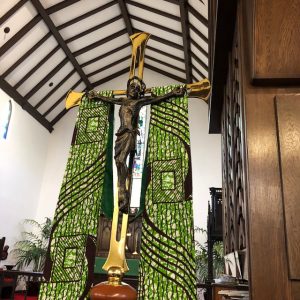

As we are encountered by all the readings during the service of the Word, we use Lord, Let My Life Be Good Soil (ELW #512) for the gospel acclamation all summer to accentuate the growing season of ordinary time. I have written a harvest stanza to which we segue in the autumn: Lord, Let My Life Bear Good Fruit.” With all my heart, soul, and strength, I do try and keep the summer proclamation as brief as I can, with 5–7 minutes being the goal but 8–10 (or 12, deep sigh) usually being the outcome

We have chosen to omit the Creed during the summer months, so following the hymn of the day we move immediately to the prayers and the sharing of the peace. With great delight, our assisting ministers have begun to write prayers of their own instead of or in addition to the pre-printed intercessions, and our people willingly respond when asked, “For what else shall the people of God pray?” Parish announcements follow the peace and are frequently too long, but always convey the warm welcome and hallowed hospitality of the St. Paul’s community. It’s a constant challenge to keep them — along with the homily — on the shorter side.

A spoken Eucharist can set apart the summer season and keep things moving along. Distribution of communion is continuous at St. Paul’s, having phased-out kneeling at the rail years ago. In summer, we use Calm to the Waves”(ELW #794), “Take, O Take Me As I Am” (#814), “Jesus, We are Gathered” (#529)and other short, repetitive songs/canticles during distribution to get folks out of the hymnal a bit as they commune. (A helpful list of such repetitive songs can be found in The Sunday Assembly (Augsburg Fortress, 2008, p. 221).

All things considered, summer flies by all-too-quickly and maybe worship oughtn’t parallel that notion.  In the final analysis, a few extra minutes of basking in the beauty of holiness and soaking up the Sonlight may well bring a welcome Gospel infusion to our ordinary, mid-Pentecost lives. However you may lean into summer, a leaner liturgy might serve you and your community well for these illusive weeks.

Fabric squares for Ordinary Time by Jeanette Paulson, Adorn This House, Duluth MN


Fabric on processional cross from Evangelical Lutheran Church in Tanzania


Share

The Senate Farm Bill: What a difference bi-partisanship makes

By John Johnson,Program Director for Domestic Policy


Not everything is broken in Washington DC. Last Friday, Senate leaders released their long-awaited version of the farm bill and there is good news for farmers, hungry people, people of faith and frankly the whole country. The Senate’s version of the farm bill renewal is a good bill that addresses many ELCA priorities by maintaining strong support for anti-hunger programs.  It is a model of how legislation in Washington with bi-partisan leadership ought to move in Congress.

Senators Pat Roberts (R-KS) and Debbie Stabenow (D-MI)—the chair and ranking member respectively of the Senate Agriculture Committee—are fulfilling their early commitment to work together on the farm bill. Their press-release statements quote each other positively, a relief in this fiercely partisan climate. A bill that affects every person and every community in the United States and beyond deserves no less.

Hunger advocates, farmers, environmentalists, international aid stakeholders, businesses and law makers now begin pouring over the 1000-page bill in preparation for a planned “mark-up” of the bill on June 13. At this time committee members will amend and tweak the legislation before voting to move it to the Senate floor. That’s the easy part. What lies ahead gets complicated very quickly.

The House bill (H.R. 2) contains language that would restructure the program in ways that would increase food insecurity. The Senate bill contrasts starkly with the House version by making technological investments in the Supplemental Nutrition Assistance Program (SNAP, formerly known as food stamps) and making it easier for states to manage the complex requirements for work and job training while receiving benefits. It also includes restored funding for conservation programs, maintains our commitment to international food aid, includes funding for research and development and protects the farm “safety net.”

The House bill passed out of the House Agriculture Committee on a party-line vote with no cooperation between Democrats and Republicans last month. It failed on the floor to get enough support to pass out of the House and was dramatically pulled and tabled. It is expected to return to the House floor around June 22. That bill’s fate is uncertain, and it is unknown now if leaders in the House will be able to muster the votes needed to send it to a conference with the Senate.

The Senate draft now puts pressure on the House, but as of this writing, several scenarios exist.  Ideally, both chambers should pass their respective bills, meet in conference to iron out differences, vote again on the compromise of the two versions, and send it to the President to sign into law. It all must happen before the current farm bill expires at the end of September. If the School House Rock episode of, “I’m Just A Bill” comes to mind, that’s the way the legislative process is supposed work.

The differences in the bill, however, could become a mountain too steep to climb for some members. If managed poorly, ideological gridlock could create a stalemate in both chambers as the deadline looms closer and stakeholders become more impatient. If the deadline is not met, it’s very likely that lawmakers could toss up their hands and let the outcome of the 2018 mid-term elections drive what happens in a lame-duck session after the November 6 elections. This outcome leaves farmers in the lurch and states with more uncertainty that neither can afford. While unlikely, some have floated the idea of a short-term extension, but this also creates uncertainty and chaos.

As Lutherans, we are reminded of the holy commitment we have to each other in our common life when we pray, “Give us this day our daily bread.” As we find in the Large Catechism, “When you say and ask for daily bread, you ask for everything that is necessary in order to have and enjoy daily bread and, on the contrary, against everything that interferes with enjoying it. You must therefore expand and extend your thoughts to include not just the oven or the flour bin, but also the broad fields and the whole land that produce and provide our daily bread and all kinds of sustenance for us.”

Now Lutherans need to get to work. We need to call our lawmakers at 202-224-3121 with a simple message: work together, do no harm, don’t put farmers and hungry people in peril and do it sooner than later. Our voices will be critical in the coming weeks and they make a difference. Time and again when we lift our voices in the thoughtful ways that Lutherans approach issues like the farm bill, we become a catalyst that lawmakers can’t ignore. It is time do that Gospel work of advocacy now more than ever.

Interested advocates can follow the Senate’s hearing on the farm bill on Wednesday, June 13 starting at 9:30 a.m. EST by clicking on this link.

Share