Skip to content

ELCA Blogs

Meet Gathering Emcee Ben

– Ben Bernstein

Hello ELCA, my name is Ben Bernstein. This will be my second Gathering and I am ecstatic to experience this one as an emcee. I felt that God called me to apply to be emcee because I felt that God wanted me to use my voice within this church. God has blessed me in so many different ways since I have been named one of the emcees. With only two months approaching before the Youth Gathering, my excitement levels are going through the roof.

My life was changed through the 2015 ELCA Gathering in Detroit. I can’t begin to describe the feeling of worshiping our awesome God alongside over 30,000 different siblings in Christ. In those moments, I was able to see that I was not alone in this journey of faith. My fellow Lutheran youth on the other side of the country were experiencing the same high school struggles as I was.

People in our church are passionate about the Gathering. I have had the honor of seeing God at work through so many different people within our church to allow the Gathering to be a success. The ELCA understands that this Gathering of over 30,000 youth from all across the denomination can impact the community of Houston in so many positive ways. I am excited to see how the Spirit of God can lead us together this summer to impact lives in the city of Houston. God has given us youth the ability to change everything.  My hopes and prayers for those who experience this Gathering is that they will take what they learn in Houston and use it in their very own communities.

Looking forward to seeing you all there!

Share

May 13, 2018–A Lonely Lot

Leslie Scanlon, Chesapeake, VA


Warm-up Question

Tell about a time this week you felt lonely.  Tell  about a time this week you felt part of a group.

Think of it like “high/low,” “rose/thorn,” “mountain top/valley,” or whatever metaphor you like to use.

A Lonely Lot

With the rise of technologies that claim to facilitate communication, you might think that we would feel more connected than people in decades and centuries past.  However, an article recently posted by NPR reports that a survey conducted by the health insurance company Cigna concluded that “Americans are a lonely lot” with over 50% of those surveyed responding, “that they feel alone or left out always or sometimes.”

The UCLA Loneliness Scale uses a series of statements and a formula to quantify someone’s sense of loneliness and was used in the survey to determine that many Americans do not feel truly connected to those with whom they are in relationship.  Loneliness is not just an “emotional” issue, but can also negatively affect your physical health in a major way.

The survey results also suggest that the average sense of loneliness is progressively higher as you look at younger and younger generations. (Note: those surveyed were all over 18 years of age.) Some studies have reported a correlation between more screen time/less face-to-face time and higher instances of depression and suicide, but the Cigna survey did not find enough evidence to blame social media for the generational trends.  That might be because not all social media use is equal—positive and negative personal interactions can happen on social media platforms, but they can also be used somewhat passively.  Technology can aid in our relationships being built up, but can also be the means of breaking them down.

Discussion Questions

  • What ways do you interact with people on a daily/weekly basis (outside of the obvious answer: school)?
  • To what clubs, teams, and groups do you belong?
  • How would you describe your use of social media (active/passive, regular/occasional, etc.)?

Seventh Sunday of Easter

Acts 1:15-17, 21-26

1 John 5:9-13

John 17:6-19

(Text links are to Oremus Bible Browser. Oremus Bible Browser is not affiliated with or supported by the Evangelical Lutheran Church in America. You can find the calendar of readings for Year B at Lectionary Readings

For lectionary humor and insight, check the weekly comic Agnus Day.

Gospel Reflection

For the past two Sundays, the Gospels readings in John 15 have been from Jesus’ final discourse to the disciples before his arrest, trial, death, and resurrection.  This Sunday, we skip to chapter 17. Jesus is no longer talking to his disciples, but praying for them.

In the repetitive, seemingly roundabout sentences characteristic of John’s gospel, Jesus articulates in prayer to God (the Creator) that his followers are in fact God’s followers, and that, although he is about to die, it does not change that fact that they are God’s beloved children.

In verse 11, Jesus prays for protection for his flock which he is about to physically leave behind.  One of the reasons he worries for them is because they are going to remain “in the world” (v.11) without him, but “they do not belong to the world” (v.16).

This is not true just of those disciples who physically walked with Jesus, but is true of us too.  We are “in” but not “of this world.  We are called to take part in the aspects of life that this world makes possible, but we are called to do so in a way that gives glory to God.  We are not called to tuck ourselves away and interact with only those who believe, worship, and look like us; we are called to be one (as Jesus talks about in verse 11).  That is not to say that everyone in the church is always going to agree 100% of the time on every topic.  However, there is a way to remain connected and in relationship, despite our disagreements.  We do all of this as part of keeping God’s word and making God’s name known.

This is not always easy work.  Jesus knew this, and that is why he prayed that God would protect, teach, and lead his disciples then and us now.  As people of faith, we are called to not be “of” the world—giving into every whim we might have or striving to be what society tells us we should be.  We are sent out into the world to do God’s work with our hands…as ONE people of God, ONE flock, ONE church.

Discussion Questions

  • What is one example of how you are (or someone you know is) “in” but not “of” the world?
  • What can get in the way of the church being “one”?
  • You have been given the Word of God; what is God sending you out into the world to do? (be as specific as possible)

Activity Suggestions

  • Make a plan of how your youth group can work together (as ONE) to do God’s work in the world…and get started. SMART goals (https://en.wikipedia.org/wiki/SMART_criteria) are helpful when working to create a concrete and achievable plan.
  • Brainstorm ideas about how to make your youth group, church, or other faith-based group more “one.” What is getting in the way of unity in the midst of diversity?  How can you overcome those obstacles?
  • Play a group-building game to help build “oneness” in your group. There are lots of ideas on Pinterest and Youth Ministry blogs.  When choosing, keep in mind the participants’ levels of comfort with physical contact.

Closing Prayer

Gracious and loving God, you have given us so much—your Word, life, and each other—for that we are thankful.  Thank you for being with us in our time together and we ask that you would continue to be with us and protect as we go out into the world this week.  Help us to remember that we are never alone. Amen.

Share

Churches for Middle East Peace Welcomes PLO Re-Commitment to Peace Negotiations, Condemns Anti-Semitic Remarks

Churches for Middle East Peace (CMEP)’s executive director, Rev. Dr. Mae Elise Cannon, attended the Palestine National Council convention this week, including Palestinian Authority (PA) President Mahmoud Abbas’ speech. CMEP welcomes the commitment of the PLO to peace negotiations, but condemns the inflammatory and anti-Semitic rhetoric used during the speech. To learn more about CMEP’s reaction to the speech and Abbas’ subsequent apology, click here or read below. As a member of CMEP, the ELCA affirms the CMEP statement.

For Immediate Release: Churches for Middle East Peace Welcomes PLO Re-Commitment to Peace Negotiations, Condemns Anti-Semitic Remarks.

Washington, D.C. – May 3, 2018 – Palestinian Authority (PA) President Mahmoud Abbas presented his future policy to the first regular session of the Palestine National Council (PNC) since 1996, calling for new negotiations leading to a two-state solution. His re-commitment to the peace process comes after remarks made earlier in January in which he threatened to withdraw from the Oslo Accords and suspend PLO recognition of Israel. However, the conciliatory tone brought to the conversation regarding the two-state solution was severely undermined by anti-Semitic rhetoric peppered throughout the speech.

Churches for Middle East Peace (CMEP) welcomes President Abbas’s renewed commitment to the establishment of a Palestinian state existing alongside Israel and his calls for non-violent popular resistance to Israel’s occupation. CMEP condemns the anti-Semitic and inflammatory remarks and affirms that support for a Palestinian state does not require downplaying historical Jewish suffering or denying their connection to the land.

The PNC is the Palestinian Liberation Organization (PLO)’s parliament representing a wide range of Palestinian political groups, including President Abbas’s own Fatah Party. The PNC endorsed Abbas’s vision of a two-state solution and his calls for non-violent resistance. They elected a new PLO Executive Committee with Abbas serving as its chairman.

Abbas’s remarks before the PNC also included highly inflammatory, anti-Semitic rhetoric, which included claims that modern Israelis have no ties to the land, that European Jews are descendants of the Khazar converts to Judaism and not Middle Eastern Jews, and that the Holocaust can be blamed on Jews’ social behavior.

On May 4th in Ramallah, Abbas issued an apology and clarifying his remarks, “I would also like to reiterate our long-held condemnation of the Holocaust, as the most heinous crime in history, and express our sympathy with its victims… Likewise, we condemn anti-Semitism in all its forms, and confirm our commitment to the two-state solution, and to live side by side in peace and security.”

CMEP Executive Director Dr. Mae Elise Cannon attended the PNC session, along with representatives from Canada, the European Union, Ireland, Sweden, the United Kingdom, the United Nations, and a deputy speaker of Israel’s Knesset.

Cannon said this about the PNC Meetings: “It was appalling to hear some of the comments from Abbas about history and the Jewish people. While I am encouraged by his recent apology and statement, the anti-Semitic tone and emphasis of his speech were unacceptable. At the same time, Abbas’ speech did reconfirm a stalwart commitment to peace and the two-state solution; which should be lauded. The Palestinian Authority has reiterated time and time again that they are willing to be a partner for peace of the core commitments of 1967 borders, a shared Jerusalem, and other final status issues are addressed.”


Share

ELCA Statement on Honduran TPS


On Friday, May 4th, 2018, the Administration announced that it will end Temporary Protected Status (TPS) for approximately 60,000 Hondurans. TPS is a legal immigration status that allows citizens from other countries who are present in the U.S. during a catastrophe in their country to remain in the U.S. until it is safe to return home. As a church that affirms that earthly peace requires safeguarding the dignity and well-being of every person, the Evangelical Lutheran Church in America (ELCA) is disappointed by the Administration’s decision that will separate families and harm communities.

Just this week, over 600 faith leaders and organizations delivered a letter in support of continuing TPS for Hondurans.

“Lutherans are blessed with the gifts that Hondurans bring to our communities throughout the United States and in Central America,” Mary Campbell, Program Director for AMMPARO, said in the letter. “Thanks to the programs we accompany in Honduras, we know that the vast majority of Hondurans that are deported have little to no long-term support despite returning to unsafe conditions, and facing trauma and stigma. Ending TPS would create a crisis in the face of an already challenging landscape in Honduras.”

Through the AMMPARO Strategy, the ELCA strengthened our commitment to walk alongside children and families who are forced to flee their homes in Central America. We did this to respond to the suffering of thousands of unaccompanied children and families that are displaced from their communities due to violence, lack of opportunities and environmental issues.

This marks the 7th time the Administration has rescinded an immigration status that provides protection to members of our communities. Children and family members of TPS or Deferred Enforced Departure (DED) holders from El Salvador, Haiti, Sudan, Nicaragua, Liberia, Nepal, and Honduras, many of whom are U.S. citizens, will bear the brunt of these Administrative decisions.

We pray today for all who are suffering due to these decisions and ask members of our church to join us in prayer and action. At the same time, we urge Congress to pass timely legislation that provides a pathway to citizenship these important members of our communities.


Share

May 2018 ELCA Advocacy Update

ELCA Advocacy Office, Washington, D.C.

The Rev. Amy Reumann, director                                                              ELCA.org/advocacy

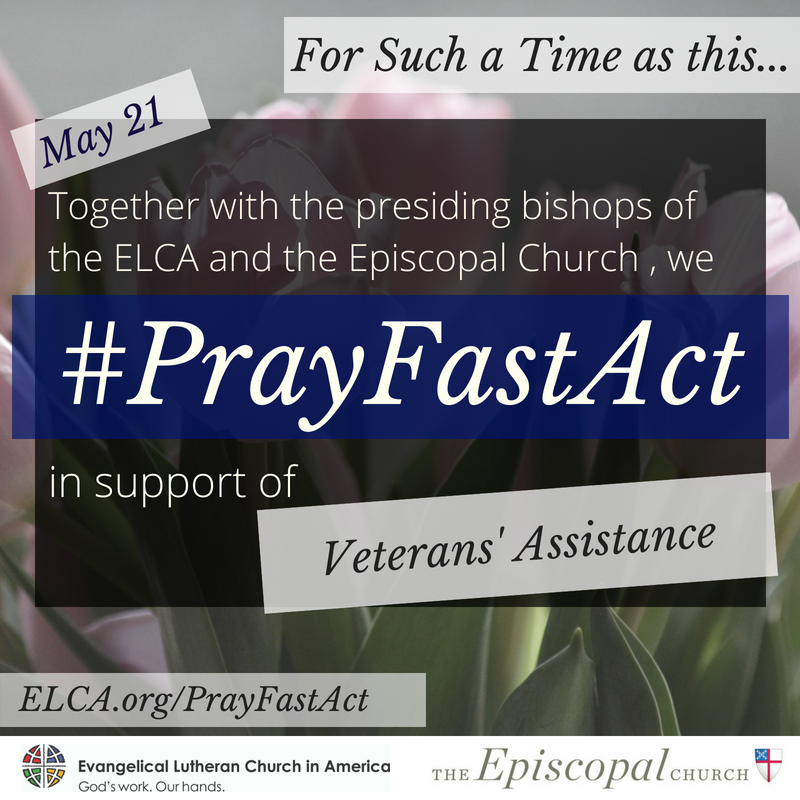
May 21, PRAY. FAST. ACT

On Monday, May 21, we join with the Episcopal Church in our monthly commitment to #PrayFastAct. This month, we center to focus on assistance to veterans and their family members.

New investments and policies in recent years have helped to expand veteran access to education, labor opportunities, healthcare and housing. Yet too many veterans, active service members and their families still struggle with complex challenges, ranging from barriers to benefits and increased mental health risks, to the impacts of the opioid crisis and more. Each returning service member has unique needs—and this month’s action supports effective public policies to meet those needs.
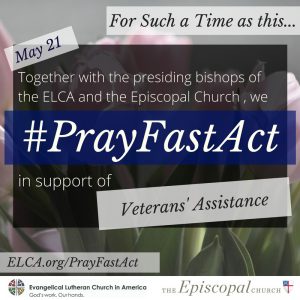
Many ELCA rostered leaders have long served as chaplains in medical centers and on bases across the world. In addition to advocating with and for veterans, congregations can play very important roles in direct engagement. Hosting local events, such as 12-step recovery groups, are often an essential and much-needed service in communities. Training videos and resources for clergy and churches interested in engagement can be found on the Veterans Affairs webpage, and ELCA-specific resources for ministers and chaplains can be found at ELCAchaps.com.

FARM BILL TEXT RELEASED

The House Agriculture Committee marked up the first version of the 2018 farm bill in mid-April, sending it to the floor of the House of Representatives. The proposed bill, which would make significant changes to nutrition and anti-hunger programs such as SNAP, was cleared on a strict 26-20 party-line vote.

The farm bill covers a wide-encompassing set of policies, including rural development, international aid, conservation programs and more. Policies that curb hunger and malnutrition, support vibrant agricultural economies in rural communities, and promote the sustainable use of natural resources are critical values to the faith community. Interested advocates can learn more by reading the ELCA Farm Bill 101 fact sheet on the Advocacy Resource Page.

Numerous food banks, faith groups and service providers voiced concern over newly added work requirements and changes to SNAP eligibility in the bill, which could displace over a million people currently eligible for hunger assistance. ELCA Advocacy shared an action alert for advocates to take action on the Farm Bill shortly after the draft legislative text was released. Advocates are strongly encouraged to take action this month as Congress advances the bill.

EARTH DAY AND ADVOCACY BLOG SERIES

In celebration of Earth Day, ELCA Advocacy is pleased to share a blog series on faith and the environment. The series, written by Deacon Laura Heller of the Delaware-Maryland Synod, covers topical issues from relationships in our ecosystem, clean water, trees, lead pollution and more. Heller, a minister of Word and Service, serves as a Creation Care Ministry coordinator for the synod and makes compelling connections between faith, public policy, and God’s creation.

Interested advocates can take action today on environmental programs at the ELCA Action Center. As Heller observes, ‘Even Martin Luther, in his time, recognized the importance of our relationship with God through creation and he is quoted as saying, “God writes the Gospel not in the Bible alone, but also on trees, and in the flowers and clouds and stars.”’

HUD RENT REQUIREMENTS 

The Department of Housing and Urban Development released a rent-reform bill in late April. The proposal would increase the amount low-income households pay for their rent, from 30 to 35 percent of their income, as well as add convoluted work requirements to various programs. For the lowest income people, the proposal would also triple the minimum monthly rent they must pay.

Nearly all faith traditions support policies that enhance dignity and economic opportunity for all. Increasing rents will do much more harm than good, and could make it even more difficult for millions of families to find good-paying jobs. ELCA Advocacy will send updates on the bill as it proceeds to Congress for approval.

Nearly all faith traditions support policies that enhance dignity and economic opportunity for all. Increasing rents will do much more harm than good and could make it even more difficult for millions of families to find good-paying jobs. ELCA Advocacy will send updates on the bill as it proceeds to Congress for approval.


Lutheran Office for World Community, United Nations, New York, N.Y.

Dennis Frado, director

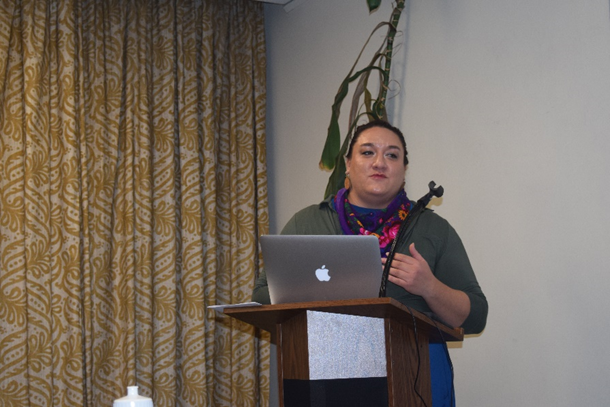
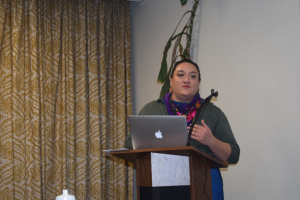
CLIMATE JUSTICE DEMANDED: The 17th Session of the U.N. Permanent Forum on Indigenous Issues was held in New York April 16-27 under the theme “Indigenous peoples’ collective rights to lands, territories and resources.” Lutherans were represented at the forum by Prairie Rose Seminole, ELCA program director for American Indian Alaska Native Ministries.

The Lutheran Office for World Community, together with the United Methodist Women, Inspiraction and the Southern Diaspora Research and Development Center, held a panel titled “Indigenous Women Demanding Climate Justice.” Prairie Rose joined this panel of indigenous women leaders from the United States, Ecuador and Kenya. The panel highlighted how “indigenous peoples protect 50 percent of the world’s land, but their territories, lands, sacred sites and resources continue to be stolen, seized, militarized and/or threatened without free, prior and informed consent.” The panel also highlighted how indigenous women are particularly affected by environmental pollution and climate change.
Read more about the U.N. Declaration on the Rights of Indigenous Peoples, which was adopted by the General Assembly in 2007.


California

Mark Carlson, Lutheran Office of Public Policy                                                                  loppca.org

OVERCOMING SEVERE POVERTY: The Lutheran Office of Public Policy-California is part of an interfaith and wider anti-poverty coalition effort to reduce severe childhood poverty in California by supporting legislation and a budget request that the family grant levels for Temporary Assistance for Needy Families (TANF)/CalWORKS be set at 50 percent of the federal poverty income level and indexed for future increases in the poverty level. Budget hearings have been held, and SB 982 passed the Senate Human Services Committee on April 24.  The evidence continues to mount that severe childhood poverty has long-lasting and costly consequences.

HEALTHY DEMOCRACY: LOPP-CA offered brief testimony in the Assembly Elections and Redistricting Committee in support of AB 2188 that would establish disclosure requirements for paid political ads on social media platforms. Supporters gathered in the Assembly chambers to celebrate success in committee and hear from the bill’s author, Kevin Mullin, and the leader of the Clean Money Campaign, Trent Lange. While the focus of LOPP-CA is on June ballot measures, the November ballot may contain several initiatives that promise to vex voters. As social media grows in influence and the potential for deception, especially by wealthy interests, bills like AB 2188 will help shed light and level the playing field.

LOOKING AHEAD:  We are thrilled that Sacramento City Councilmember Eric Guerra, a legislative staffer with a compelling personal story of resilience, will be the LOPP-CA breakfast speaker at the Sierra Pacific Synod Assembly on June 2, meeting under the theme “We Are Church Together: These Are Our Neighborhoods.” With homelessness, the shooting of Stephon Clark and immigration on many people’s minds, it will be an informative and inspiring morning.


Colorado

Peter Severson, Lutheran Advocacy Ministry-Colorado                                                   lam-co.org

LEGISLATIVE SESSION NEARS END: The General Assembly has just two more weeks of session before adjourning for the year, with nearly 300 bills yet to be acted upon. Legislators will be meeting late into the evening for the remaining working days. We continue to support important bills that are still alive related to paid family leave (HB 1001), expanding the School Lunch Protection Act (SB 13), and extending the state’s civil rights division (HB 1256). We have also joined a coalition to support HCR 1002, which would add a question to our November ballot asking voters to abolish slavery in the Colorado Constitution. Finally, we are opposing an anti-sanctuary bill (SB 220).
CIVIL RIGHTS OP-ED: Pastor Daniel Smith, from Ascension Lutheran Church in Colorado Springs, wrote an op-ed for Colorado Politics in support of the reauthorization of the Civil Rights Division. You can read the full op-ed here: coloradopolitics.com/religious-exemption-in-states-anti-discrmination-laws-only-would-add-injustice/.

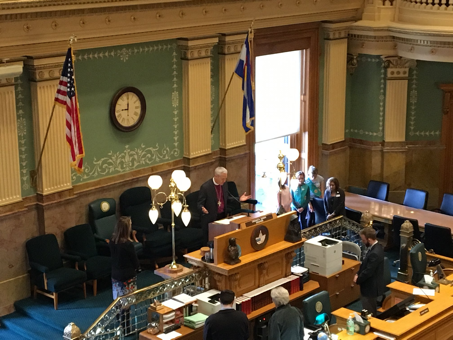
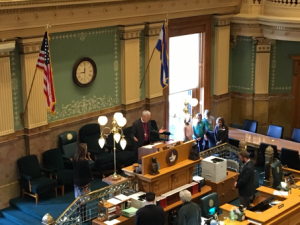
BISHOP OFFERS PRAYERS: Rocky Mountain Synod Bishop Jim Gonia offered prayers at two public events recently. On April 19, he joined students and faith leaders at Clement Park, next to Columbine High School, on the eve of the anniversary of the 1999 shooting and shared a prayer from Evangelical Lutheran Worship asking God to grant healing, peace and courage. The next morning, he prayed the same prayer in front of the Colorado House of Representatives. It was a powerful witness to two important groups in our state.


Minnesota

Tammy Walhof, Lutheran Advocacy-Minnesota                                      tammy@lcppm.org

LEGISLATIVE SESSION: Early pledges of bipartisanship have been replaced by political gamesmanship. Aligning Minnesota laws with recent federal tax changes is exacerbating divisions and will affect whether many Minnesotans pay the price through higher taxes or program cuts.

AFFORDABLE HOUSING: Kendrick and Tammy continue to build relationships with congregations, youth groups, pastors and lay leaders – resulting in many letters to legislators of specific districts. Appropriation requests for rental assistance for severely mentally ill people (Bridges) and one-time matching dollars for Local Housing Trust Funds have both died. Homework Starts at Home (to increase stability of families with school age children) still has a chance for increased base funding. However, there is still time to contact legislators about our $140 million Homes for All bonding request. See LutheranAdvocacyMN.org for talking points.

CLEAN ENERGY: We continue to work with several churches and attendees of our Faith & Clean Energy Campaign events to create clean energy legislative champions. Unfortunately, there are no longer any clear paths to improve Minnesota’s Renewable Energy Standard this year. We’ve been working with partners to prevent legislative efforts to diminish public voice in energy decisions while instead giving more power and voice to fossil fuel industries and power companies.

Join us May 21 at 11 a.m. (last day of session) to deliver our clean energy sign-on letter and generate momentum for 2019!

Watch Facebook for urgent action alerts!When the session ends, continue watching for ways to build toward the 2019 state legislative session and to address federal issues with our members of Congress!

New Mexico

Ruth Hoffman, Lutheran Advocacy Ministry-New Mexico                      lutheranadvocacynm.org

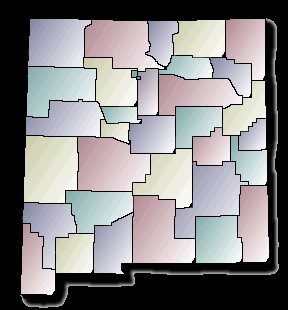
LAM-NM POLICY COMMITTEE MEETS: The LAM-NM Policy Committee met in April at All Saints Lutheran Church in Albuquerque. The Policy Committee is composed of members of ELCA congregations from around New Mexico, including Las Cruces, Los Alamos, Santa Fe and Albuquerque. The committee also includes a representative from the Presbytery of Santa Fe, which is in an advocacy partnership with LAM-NM. The committee reviewed the LAM-NM Bishop’s Legislative Luncheon and Issues Briefing, the successes and disappointments from the legislative session, worked on plans for the fall Advocacy Conference, elected new members and reviewed various reports. The Policy Committee members from southern New Mexico joined the meeting via Zoom to save traveling 450 miles roundtrip to attend. “Thanks” were given for technology!
 

Ohio

Nick Bates, Hunger Network Ohio                                                            Nick@HungerNetOhio.org

A busy April in Ohio!

UNITE TO END RACISM: The month began with many people from around the state traveling to the Unite to End Racism Rally in Washington, D.C., – including Samuel, age 8 of Columbus. “I think it is dumb that kids couldn’t go to school together because of their skin color,” Sammie said, “I am happy that we fixed that, but we have more to do to stop violence against people because of their skin color.”
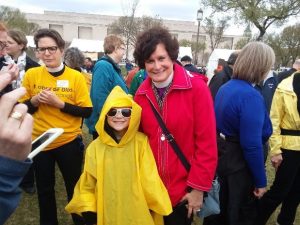
Sammie stands with Bishop Suzanne Dillahunt from the Southern Ohio Synod (left) and Sammie and Pastor John Wallace (HNO Board member and a colleague in the United Methodist Church) watch as the silent march begins from the Martin Luther King Jr. memorial to the rally.

HUNGER LEADER FELLOWSHIP: Ohio will host a World Hunger Advocacy Leader Fellowship. This full-time, paid fellowship will begin in August and last for a year for interested individuals who are considering careers in advocacy, justice and ministry and are looking for professional experience. Some college is preferred. The chosen applicant will have the opportunity to learn and participate in advocating on important issues to reduce hunger in Ohio. Click here to apply!


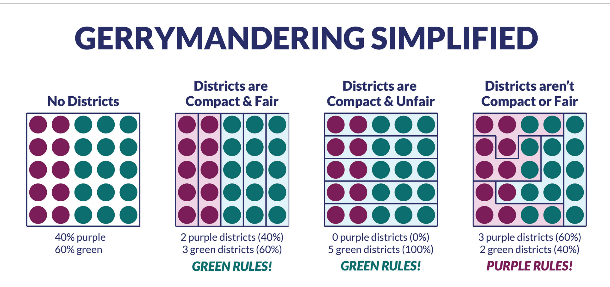
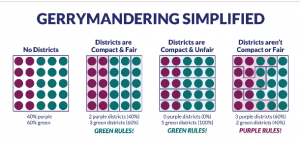
PRIMARY ELECTION ON MAY 8: Click here for our resources on State Issue 1 to distribute to your congregations and encourage them to vote to end gerrymandering in Ohio. Issue 1 will allow elected public servants to focus on serving their community and not only special and partisan interests.


Pennsylvania

Tracey DePasquale, Lutheran Advocacy-Pennsylvania                             lutheranadvocacypa.org


STATE HUNGER COALITION: Staff attended the bi-annual meeting of the PA Hunger Action Coalition. Updates were provided by task force panels focused on:  SNAP (Supplemental Nutrition Assistance Program) and seniors; the farm bill; school breakfast; Summer Food Program; and the state and federal budget and SNAP.

ADVOCACY ALERTS: Advocacy Alerts opposing HB 1659 – SNAP work requirements and HB 2138 and HB 2024 Medicaid work requirements were shared with constituents. Each of these bills would harm Pennsylvanians by making it more difficult for them to qualify for and keep the health coverage and food assistance they need to stay healthy. Passage would require extensive new bureaucracies to administer these requirements, wasting state and federal Medicaid dollars on unnecessary administrative burdens and new red tape.
 LUTHERAN DAY 2018: Arrangements are being finalized for Lutheran Day, May 21. The day’s events will include learning, worship, recognition of advocacy honorees from across the state, legislative advocacy visits and a keynote address by Dr. Richard Alley, Evan Pugh Professor of Geosciences at the Pennsylvania State University, who was a member of the Intergovernmental Panel on Climate Change that received the 2007 Nobel Peace Prize. Learn more.

HOLOCAUST REMEMBRANCE DAY: Staff attended the annual Holocaust Remembrance at the Capitol on April 11. Every year the PA Jewish Coalition sponsors a civic Holocaust Remembrance Day honoring the victims, children and grandchildren.

ELCA DOMESTIC MISSION STAFF TRAINING: LAMPa staff attended the training in Chicago networking, learning and worshiping with colleagues from across the country.


Washington

Paul Benz, Faith Action Network                                                                                             fanwa.org

ECUMENICAL ADVOCACY DAYS – A WORLD UPROOTED: Two members of the FAN staff and a few advocates joined the Washington delegation to Ecumenical Advocacy Day in Washington, D.C., in April. The delegation brought personal stories to congressional staff and asked that Congress redirect funding away from deportation, detention and border militarization and reinvest in refugee resettlement and in addressing the root causes of migration around the world: conflict, corruption, poverty and the effects of climate change.

REGIONAL SPRING SUMMITS: Every year in May and June, FAN hosts spring summits around the state in order to connect with the network, share opportunities for advocacy and strategize for the upcoming year. Areas of focus include economic justice, health care, immigration, criminal justice, housing and homelessness, and the environment. Learn more on our website: fanwa.org/events-2/regional-spring-summits.

INITIATIVE 1631: FAN is one of two faith organizations joining a 150-member coalition called the Alliance for Jobs and Clean Energy, which is working on a ballot initiative that will reduce pollution and invest in clean air, clean energy, clean water, healthy forests and healthy communities by putting a price on carbon ($15 per ton of emissions). Advocates and faith communities are mobilizing to gather signatures; we have 10 weeks to gather 260,000 for the initiative to qualify for the ballot in November.


Wisconsin

Cindy Crane, Lutheran Office for Public Policy in Wisconsin                                              loppw.org

UNITE AGAINST RACISM: The director joined Wisconsinites organized by the Wisconsin Council of Churches to attend Unite Against Racism in Washington, D.C. The National Council of Churches event commemorated the anniversary of the death of the Martin Luther King Jr. The director was quoted in the Washington Post.

LOPPW Advisory Council Member Deb Martin from the East Central Synod walked in the silent march next to ELCA Presiding Bishop Elizabeth Eaton. The director also attended a bystanders-intervening training in Milwaukee.

CARE FOR GOD’S CREATION: LOPPW participated in an all-day Wisconsin Climate Table meeting that included strategizing on how to diversify our table and participating in an anti-racism training.

The director worked on a manual for the South-Central Synod of Wisconsin/LOPPW Care for God’s Creation team. Another team member will add to the draft. We made upcoming presentations known via our website and social media.

PUBLIC BENEFITS BILLS: LOPPW met with the public benefits coalition to strategize how to work with the organizations that are tasked with implementing the changes mandated in the six bills that passed and on a values statement. We are concerned changes will not adequately be made known to recipients and many will fall through the cracks.

LUTHERAN SOCIAL SERVICES: The director met with Hector Colon, the director of Lutheran Social Services of Wisconsin and Upper Michigan to discuss possibly working together to educate members about our efforts and do advocacy. With input from Greater Milwaukee Synod Bishop Paul Erickson, we also discussed a possible event in Milwaukee.




Share

Celebrating Earth: World Oceans

By Laura Heller, Minister of Word and Service and Creation Care Ministry Coordinator for the Delaware-Maryland Synod.


O Lord, how manifold are your works!     In wisdom you have made them all;     the earth is full of your creatures.  25 Yonder is the sea, great and wide,     creeping things innumerable are there,     living things both small and great.   (Psalm 104: 24,25)

On our planet earth, there is a vastness of creation. The diversity of life is one of the most striking aspects of our planet. It is estimated that there are 8.7 million species on earth. In a 2011 study it was suggested that some 86% of existing species on Earth and 91% of species in the ocean still await description, that is, they have not even been discovered.

Recent research is confirming that we are all interconnected, and that is by God’s design. I remember in high school science class we used to talk about the food chain; now we know it is actually an interconnected web of life. And each ocean has its own name, but we now understand that it is actually a world ocean so that things happening on one side of the world impact the waters on the other side of the world.

Unfortunately, trash has become a big problem in the ocean. The Great Pacific Garbage Patch is a collection of marine debris in the North Pacific Ocean. Marine debris is litter, including land based trash that ends up in oceans, seas, and other large bodies of water.

The Great Pacific Garbage Patch, also known as the Pacific trash vortex, spans waters from the West Coast of North America to Japan. These areas of spinning debris are linked together by the North Pacific Subtropical Convergence Zone, located a few hundred kilometers north of Hawaii. This convergence zone is where warm water from the South Pacific meets up with cooler water from the Arctic. The zone acts like a highway that moves debris from one patch to another.

The entire Great Pacific Garbage Patch is bounded by the North Pacific Subtropical Gyre. An ocean gyre is a system of circular ocean currents formed by the Earth’s wind patterns and the forces created by the rotation of the planet. To illustrate, a plastic water bottle discarded off the coast of California can travel south toward Mexico cross the vast Pacific towards Japan, and end up in the vortex of the garbage patch.

The amount of debris in the Great Pacific Garbage Patch accumulates because much of it is not biodegradable. Many plastics do not wear down; they simply break into tinier and tinier pieces known as microplastics. Researchers have collected up to 750,000 bits of microplastic in a single square kilometer of the Great Pacific Garbage Patch. Most of this debris comes from plastic bags, bottle caps, plastic water bottles, and Styrofoam cups.

These microplastics make up 94 percent of an estimated 1.8 trillion pieces of plastic in the patch. But that only amounts to eight percent of the total tonnage. As it turns out, of the 79,000 metric tons of plastic in the patch, most of it is abandoned fishing gear. Microplastics can’t always be seen by the naked eye, but simply make the water look like a cloudy soup. This soup is intermixed with larger items, such as fishing gear and shoes. The seafloor beneath the Great Pacific Garbage Patch may also be an underwater trash heap. Researchers recently discovered that about 70% of marine debris actually sinks to the bottom of the ocean.

Marine debris can be very harmful to marine life in the gyre. For instance, loggerhead sea turtles often mistake plastic bags for jellies, their favorite food. Albatrosses mistake plastic resin pellets for fish eggs and feed them to chicks, which then die of starvation or ruptured organs.

Seals and other marine mammals are especially at risk. They can get entangled in abandoned plastic fishing nets, which are being discarded more often because of their low cost. Seals and other mammals often drown in these forgotten nets—a phenomenon known as “ghost fishing.”

Marine debris can also disturb marine food webs in the North Pacific Subtropical Gyre. As microplastics and other trash collect on or near the surface of the ocean, they block sunlight from reaching plankton and algae below. Algae and plankton are the most common autotrophs, or producers, in the marine food web. Autotrophs are organisms that can produce their own nutrients from oxygen, carbon, and sunlight.

If algae and plankton communities are threatened, the entire food web may change. Animals that feed on algae and plankton, such as fish and turtles, will have less food. If populations of those animals decrease, there will be less food for apex predators such as tuna, sharks and whales. Eventually, seafood becomes less available and more expensive for people.

These dangers are compounded by the fact that plastics both leach out and absorb harmful pollutants. As plastics break down through photodegradation, they leach out colorants and chemicals, such as bisphenol A (BPA), that have been linked to environmental and health problems. Conversely, plastics can also absorb pollutants, such as PCBs, from the seawater. These chemicals can then enter the food chain when consumed by marine life.

Cleaning up marine debris is not easy. Many microplastics are the same size as small sea animals, so nets designed to scoop up trash would catch these creatures as well. Even if we could design nets that would just catch garbage, the size of the oceans makes this job far too time-consuming to consider. The National Ocean and Atmospheric Administration’s Marine Debris Program has estimated that it would take 67 ships one year to clean up less than one percent of the North Pacific Ocean.

Limiting or eliminating our use of disposable plastics and increasing our use of biodegradable resources will be the best way to prevent the growth of the Great Pacific Garbage Patch.

There has been a shift from linear thinking to systems thinking and a holistic worldview. The world is an integrated whole rather than a dissociated collection of parts. This is an ecological view: deep ecological awareness that recognizes the fundamental interdependence of all living creatures and the fact that, as individuals and societies, we are all embedded in, and ultimately dependent on God’s creation.

In loving and obeying God and caring for our neighbor, we need to expand our horizons to consider the needs of all living things in our planet. All that God created and called good.


source: https://www.nationalgeographic.org/encyclopedia/great-pacific-garbage-patch/

Share

Celebrating Earth: The Chesapeake Bay


By Laura Heller, Minister of Word and Service and Creation Care Ministry Coordinator for the Delaware-Maryland Synod.

Captured by hope, we dream dreams and look forward to a new creation. God does not just heal this creation wounded by human sin. God will one day consummate all things in “new heavens and a new earth, where righteousness is at home” (2 Peter 3:13). Creation—now in captivity to disruption and death—will know the freedom it awaits.  (A Social Statement on: Caring for Creation: Vision, Hope, and Justice )

In Delaware and Maryland we are blessed to live so close to the Chesapeake Bay, a truly remarkable gift given to us by God, but it has been subject to pollution from humanity. The Chesapeake Bay is the largest estuary in the United States, where fresh and salt water mix and support an amazing mix of plant and animal life.

The Bay itself is about 200 miles long, stretching from Havre de Grace, Maryland, to Virginia Beach, but the Chesapeake Bay watershed, which is the area from which water flows into the Bay, extends from Western New York State, though Pennsylvania, Maryland, the District of Columbia, parts of Delaware, West Virginia and central and northern Virginia. The Bay and its tidal tributaries have 11,684 miles of shoreline, more than the entire west coast of the United States, and it holds more than 18 trillion gallons of water.

The human population of the watershed is approximately 18 million. Every one of these people contributes in some way to the flow of water into the streams and rivers, and to the Bay itself.

Crisfield is one of many towns located along the shores of the Chesapeake Bay. Crisfield is a quaint little Eastern Shore town that was incorporated back in 1872. By 1904, the city of Crisfield was the second largest city in Maryland, just after Baltimore, and it had a population of 25,000. It had one of the finest seaports in Maryland and was boasted as being “The Seafood Capital of the World.” Crisfield has seen many years of decline in conjunction with the decline of the health of the Chesapeake Bay. As of the census of 2013, there were just 2,695 people, residing in the city and about a third of the population was living below the poverty line.  The city’s once-vibrant seafood industry has been severely impacted by the decline of the health of the Chesapeake Bay. For example,

The numbers for the blue crab catch, have fallen by 70% since the 1990s.

Furthermore, at one time, oysters were so abundant in the Chesapeake Bay that their reefs defined the major river channels. The reefs extended to near the water surface; and to stray out of the center channel often posed a navigational hazard to ships sailing up the Bay. Picture in your mind, tall sailing ships carefully navigating around these impressive reefs. The oyster population in the Bay is now less than 1% of what it once was. Oysters filter water in order to keep it clean and it has been estimated that oysters were once able to filter all the water in the Bay in about a week. The sharp decrease in the number of oysters means that it now takes the current oyster population about a year to filter the same amount of water.

But efforts by organizations such as the Chesapeake Bay Foundation (CBF) and Interfaith Partners for the Chesapeake (IPC) have been turning the tide on bay restoration. Efforts to reduce pollution and increase wetlands and underwater grasses are having a positive impact.

The CBF 2016 State of the Bay report presented news that the Chesapeake Bay is improving. The score rating the Bay was the highest since they issued the first State of the Bay report in 1998. Each of the three indicator categories—pollution, habitat, and fisheries—has improved. We are seeing the clearest water in decades, regrowth of acres of lush underwater grass beds, and the comeback of the Chesapeake’s native oysters, which were nearly eradicated by disease, pollution, and overfishing. The report provides hope and promise for the future.

God’s healing and restorative power is at work in the Chesapeake Bay.

Share

Remembering Donna Wiegel

The Gathering remembers beloved colleague, friend, and child of God, Donna Marie Wiegel.

Donna was born April 14, 1952 in Spencer, IA. She grew up in Des Moines, IA, attended college at both the University of Iowa and Drake University, and attended graduate school at DePaul University in Chicago.

Donna worked with the ELCA for over 25 years. She began with the Women of the ELCA, then worked with the Gathering beginning in 1997. As an event planner, she was instrumental in organizing multiple Gatherings every three years, with some Gatherings reaching an attendance of over 40,000 youth.

When Donna began working with the Gathering, all registrations were handled with paper. Every registration came through the postal service. Donna coordinated the efforts to open the mail, organize registrations, enter the data from the registrations, and process payments. Donna began the system of streamlining to the current online registration system where congregations participating in the Gathering could manage their own accounts. She was a master of logistics and scheduling, performing this ministry with kindness and grace.

Donna knew many of the adult leaders with the Gathering on a first name basis. She was not just a colleague to many these leaders, she was also a beloved friend. Donna was well known for her compassionate heart and her embodied expressions of kindness, joy, and love. She was a passionate advocate for youth and young adults. Donna’s dedication and passion for ministry was not just expressed with her work with the Gathering, but also as a member of Resurrection Lutheran Church.

So many friends have shared their memories and stories of Donna in these days, so numerous that they sadly cannot be contained in a single entry. The themes that come up in these stories and memories are Donna’s capacity for generosity, her immense kindness, her faith in Jesus, her love of justice for all peoples, fighting and caring for the marginalized, and embodying her faith in Christ daily in the world.

When she wasn’t working with the Gathering, Donna enjoyed the simplicities of life. She loved being in the sun, at the beach, and on her bike. She reveled spending time with her daughter, Tatiana, and her beloved granddaughters.

Donna will be missed by so many. She has left a lasting legacy in her dedication to the ministry of the Gathering.

Share

Mothering God: A Reflection on Mother’s Day in Worship

Today’s post is by Amanda Highben who serves as Pastor at Prince of Peace Lutheran Church in Dublin, Ohio.

Mothering God, you gave me birth

in the bright morning of this world.

Creator, source of ev’ry breath,

you are my rain, my wind, my sun.

–  “Mothering God, you gave me birth,” Evangelical Lutheran Worship, #735

When I gave birth to our daughter Cecilia, I was still in seminary and serving as the youth director at St. John’s Lutheran Church in Zanesville, Ohio. Needless to say, it was a full and challenging time as my husband Zeb and I balanced our jobs, my education, and our halting, on-the-job education in parenting. One of the clearest things I remember is the exhaustion. In the first months of Ceci’s life, I was convinced I’d never sleep again.

Thankfully, our St. John’s community was a great source of strength and support for us. The parishioners delighted in Cecilia’s birth and helped us in countless ways, from simply holding her during worship to bringing us meals and offering to babysit. The congregation nurtured us through this time of transition and we will be forever thankful for such a gift.

Still, St. John’s is not unique in this regard. Many churches do a wonderful job of welcoming and supporting families. As Mother’s Day nears, congregations are once again preparing to bless and honor the mothers in their midst. Because I’ve served five different churches, I’ve seen mothers recognized in worship in various ways. I have even heard entire sermons devoted to Mother’s Day, though there is nothing in the lessons to warrant such preaching.

It is critical to be aware that Mother’s Day is not joyful for everyone. Remember the diverse and complex life stories of your people—The couples struggling with infertility. The children and adults whose mothers have died tragically. Those who have been hurt by or have strained relationships with their mothers. Women who cannot or chose not to have children, but have been endlessly told by contemporary culture that only motherhood can truly fulfill them. Families with two fathers. Women struggling with post-partum depression. All of this is complicated by our cultural determination to “romanticize” motherhood, which makes it difficult for mothers to talk openly about their challenges without feeling ashamed. In other words, if we fail to be thoughtful in our worship planning, a variety of women, men, and children might feel hurt or excluded when we intend exactly the opposite.

Yet: The commandments tell us to honor our parents, and the desire to bless mothers is good and Christ-like. It is an impulse that springs from a place of love. If we ignore it altogether in worship on the grounds that it is a secular holiday and not part of our liturgical calendar, then we risk conveying the implicit message that reasons for celebration in people’s everyday lives don’t matter to the church; we risk conveying the harmful belief that the Christian faith is disconnected from the world beyond our sanctuary walls.

This year, then, as we celebrate Christ’s resurrection on the seventh Sunday of Easter consider how your congregation might recognize mothers in ways that are sensitive, inclusive, and faithful to your context. Perhaps this means focusing more on the act of mothering, or lifting up Biblical images of our mothering God (see Isaiah 49.14-16 and 66:13, or Luke 13:34). The petition for mothers in the Prayers of Intercession is also appropriate and poignant (Sundays and Seasons, Sunday May 13, 2018). Above all, pray that everyone who gathers for worship on this day will encounter Jesus’ unfailing, all-embracing love.


Share

May 6, 2018–Achtung Baby

Kris Litman-Koon, Isle of Palm, SC

 Warm-up Question

Think of someone who is not a member of your immediate family yet who has influenced who you are today. How did they do this? How would you describe their style of influence? (e.g. nurturing, stern, disciplined, laissez faire, hovering, etc.)

Achtung Baby

I am the father of 18-month old twin girls. That means my life has changed significantly in the last two years, and one aspect of my life that has shifted course is the content of what I read. Our home now has an entire shelf of books (if they were not strewn about the house) that discuss how parents can survive the stages from embryo through toddler. Then there is another shelf of books (likewise scattered) that say in summary, “So you have twins? Scrap everything the other books say.”

Any healthy parent desires to raise a child or children in the best way possible. Yet, there are many opinions and studies on what the best method is, and there is no definitive answer. That doesn’t stop people from publishing their theories, nor does it stop parents from clicking on links to read a new insight. (That new insight is usually a snippet from a newly released book that the publisher hopes will be added to the disheveled bookshelves of parents.)

One of the links I recently clicked took me to an article on NBC’s website (goo.gl/9iPtzv) about a German method of raising children called Selbständigkeit (have fun pronouncing it). The translation is “self-reliance.” The first takeaway of the article is that parents shouldn’t intervene in every dispute between children; by the time children are four-years old, they can possess the vocabulary and the skills to work out their own disagreements. Of course intervention is necessary if violence is erupting, however this philosophy inherently critiques the parental methods of always interceding whenever a child has a dispute with another child.

I’m certain this method expects that a lot of work has already been done in the first three years of the child’s life. Namely, the parent has talked with the child about the benefits of getting along, modeled how to build understanding and consensus, and taught the methods to establish a mutually beneficial ceasefire. Once the child has a grasp of those skills, the parent should allow the child to use them, even if the parent thinks it would be more efficient to intervene. The point is that the parent will not always be present to settle things and force the children to hold hands, so the child needs to develop the skills to resolve their own conflicts.

Discussion Questions

  • Does this method of allowing children to settle their own disputes appeal to you? Why or why not?
  • Have you had an experience when you had to settle your own dispute?
  • Have you had an experience when a dispute needed a third party to settle it?

Sixth Sunday of Easter

Acts 10:44-48

1 John 5:1-6

John 15:9-17

(Text links are to Oremus Bible Browser. Oremus Bible Browser is not affiliated with or supported by the Evangelical Lutheran Church in America. You can find the calendar of readings for Year B at Lectionary Readings

For lectionary humor and insight, check the weekly comic Agnus Day.

Gospel Reflection

Today’s gospel passage comes from Jesus’ final discourse with his disciples before his crucifixion. This passage is actually the continuation of last week’s teaching that Jesus is the vine and his disciples are the branches. So this passage is the application of that image to the church’s way of life.

If you didn’t keep count, the word love (agape) is used nine times in this passage. Also, the word friends (philoi) is used three times. However, our English word for “friend” does not fully suit what Jesus was saying, because the word philoi also derives from another word meaning love. Although it is not commonly used in English, the word “beloveds” is the best translation of philoi. These are people outside of the family who are loved as much as family. That means Jesus uses our word “love” a total of twelve times in the passage, both to name the act of loving and to name his disciples. This re-emphasizes what he said in verse 9, that he loves his disciples to the same extent that the Father loves him. The love he has for his beloveds is witnessed in his handing himself over to death for us (v13). All of this is an immensely powerful statement, but his point doesn’t end there. There are ramifications to this enormous and infinite love that Jesus has for his disciples.

When we reach verse 17, Jesus says he gives us “these commands so that you may love one another.” What are his commands? He commands that we abide in his love (v9), that we love one another (v12), and bear fruit (v16). Bearing fruit is commonly understood as the love that is generated when a Christian community finds its identity in Jesus alone (the vine) and they live a life of kinship and concord (the branches). So verse 17 can be understood as saying, “I am telling you to love one another so that you may love one another.” That sounds a little weird, but it can be paraphrased; “If you can’t figure out how to love one another, do it.”

Love is hard, and it takes a lot of work. It is not easy to love when we instinctively want things our way and other people want things their way. This happens everywhere in the world, including in the church. Even if you haven’t seen it in your congregation, people there have butted heads in the past, and people there will butt heads again in the future.

What is supposed to make the church different is this: Christ is our source (the vine), and we are to abide in his enormous and infinite love. The vine mysteriously joins us together as one to be his indistinguishable branches who bear the fruit of our communal love. Inasmuch as the Father loves the Son, and the Son loves us, so are we to love one another (v9). In this final discourse before his crucifixion, Jesus was telling his disciples (including us) that he won’t always be physically present to settle our disputes. We are going to have to work things out, and the method to do that is by abiding together in his love.

Discussion Questions

  • Can you name any beloveds in your life?
  • Are you challenged by Christ’s command that we love fellow disciples to the same extent of God’s love for us?
  • When we live by this standard, how are disputes within the church different than disputes outside the church?

Activity Suggestion

Divide into groups of three people each (if you must, two people each). Each group will make a line, with the person in the middle holding a hand of each person next to them. Do not let go of hands. Attempt as a group to perform these common tasks:

  • Untie and retie the shoes of the people in the group.
  • Fold a paper airplane.
  • Blow up and tie off a balloon.
  • Stacking and unstacking chairs.
  • Any other common tasks suitable for your space.

Processing: What was it like to do these common tasks as a group? Did your group have any disputes? Did your physical place in the group (left, center, right) impact your experience? What were the hardest and easiest tasks for you? How is this activity like the image of the vine and the branches? How does this activity connect to Christ’s command to love one another as he loves us?

Closing Prayer

Triune God, you freely share the fullness of your love with your people. Help us to not only be mindful of your infinite love, but to apply that love to our interactions with others. When we have disputes, help us to see others as you see them. Give us a full measure of your compassion and understanding, so that together we may fully abide in your love. Amen.

Share