Skip to content

ELCA Blogs

Valparaiso, Chile: Rebuilding After the Fire

Megan Brandsrud

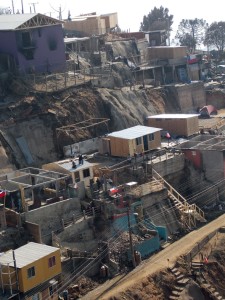
Emergency homes

On April 12, a raging wildfire enveloped the city of Valparaiso, Chile. Narrow, hillside roads and the lack of water or fire hydrants made controlling and extinguishing the fire very difficult. Fifteen people died as a result of the fire, which consumed 1,090 hectares (approximately 2,692 acres) and destroyed 2,900 homes, leaving approximately 12,500 people displaced.

Valparaiso is the Chilean city with the greatest number of low-income neighborhoods, with 22 percent of the city’s population living well below the national poverty line. Many people are worried about being evicted from their area and forced to move to other zones of Valparaiso.

Working with the Educación Popular en Salud Foundation (EPES), Lutheran Disaster Response is assisting those impacted by the fire by providing housing assistance and psychosocial support for women and children.

Rebuilding Homes

Currently, many residents who lost their homes are now living on their former property in tents or unstable structures built from tin and boards rescued from the fire. These dwellings are not waterproofed and provide no insulation from the winter cold and rains that are now occurring in the region. Lutheran Disaster Response, along with our partner, EPES will provide resources to 300 families to help them improve the conditions of shelter and winterization in their emergency houses.

Hope and Healing

The psychosocial support is grounded in a community participation strategy. Sessions will take place at a community center where 45 women and 300 children will be able to talk in a safe environment to diminish psychosocial injury and motivate family support and participation.

In the immediate aftermath of the fire, thousands of volunteers from around the country responded to the emergency. Few of those volunteers who worked in the initial weeks are present today, but families still need assistance. Lutheran Disaster Response is committed to providing long-term assistance to people whose lives have been disrupted by disaster. Thanks to your generosity, Lutheran Disaster Response is able to walk with our brothers and sisters in Valparaiso as they continue on their journey of recovery and rebuilding.

If you would like to help support the church’s work in Valparaiso, please visit the Lutheran Disaster Response giving page.

Share

Women’s Literacy in Liberia

Ryan P. Cumming

It’s a sad fact of history that women’s bodies become “battlefields” in situations of armed conflict.  Rape, trafficking, maiming and death are among the immediate threats women face when war breaks out.  But the long-term effects of conflict can be severe, too, especially when women face sexual violence during war.  This is true of the women of Bong and Lofa Counties in Liberia, many of whom were victims of rape during the civil war in their country.  The obstacles they face providing for themselves and their children are serious, especially when coupled with the insufficient education they can access in Liberia.

Recently, the Liberian government has tried to make strides in improving the quality of and access to education, especially for women and girls.  Still, though, less than half of the adult population is literate.  Recognizing the importance of literacy, the Lutheran Church in Liberia (LCL) in 2014 has started the “Young and Adult Women Basic Bilingual Literacy Project,” intended to help vulnerable women gain the skills they need to feed themselves and their children.

Remember the old saying, “Knowledge is power”?  That is certainly true of the women associated with this project, some of whom “were born either before or during the heat of our civil war [and] most of whom are single mothers and solely depend on selling petite market [items] to support their children.”  Despite their experiences during the long conflict – many of their children were born as a result of rape, according to the LCL – the women are “breadwinners” and vital members of their communities.  Yet, their inability to read, write and count large numbers means that they are often on “the losing end” of transactions in the marketplace.  Literacy means not only the ability to read and write – it can mean the difference between sustainable and unsustainable livelihood for themselves and their communities.

To support them in their efforts, the LCL will work with rural women in Liberia to teach them basic math and reading, skills that the LCL believes will not only benefit the women themselves but “have great potential to lift their communities from neglect.”  Because of the skills, creativity and industry of women in these communities, the support offered by LCL’s program will have wide-reaching effects.

In addition to teaching nearly 300 women to read and write, the project will also create hundreds of educational resources, train teachers, and establish learning centers in the community.  Moreover, the LCL will also teach women and girls basic skills in English, increasing their ability to participate in the marketplace and seek further education.

By listening to the needs – illiteracy, poverty, trauma – and the assets – strong women leaders, industriousness, support for education – in the communities in Liberia, the LCL will implement a program with great potential.  As companions of the LCL, the ELCA has been invited to be part of this great work through the support of a grant from ELCA World Hunger.  This year, Liberian women will be supported in their work by your gifts to ELCA World Hunger.  Together, our communities can move from vulnerability to possibility and from possibility to sustainability.  Thank you!


Ryan P. Cumming is the Program Director of Hunger Education for ELCA World Hunger.  You can reach him at Ryan.Cumming@ELCA.org.

Share

ELCA World Hunger Education and Networking Grants

Henry Martinez

Evangelical Lutheran Church in America

ELCA World Hunger Education and Networking Grants

2014


ELCA World Hunger Education and Networking grants are available to support local efforts to educate and mobilize ELCA congregations, groups, and/or synods.  This particular grant program supports engaging educational and networking opportunities focused on the root causes of and solutions to hunger.

In 2014 we are particularly interested in receiving education proposals that focus on increasing youth and young adult engagement; address racism, sexism and classism within domestic poverty; and increase awareness of the experience of domestic poverty.  Education funding can be used for events, educational programs or the development of shareable resources.   For networking proposals, congregation-based and synod-based hunger leader trainings will be prioritized.

We are looking for proposals submitted by a non-profit charitable organization classified as a 501(c)(3) public charity by the Internal Revenue Service, or operate under the fiscal sponsorship of a 501(c)(3) that must:

  1. Provide a short (2-3 paragraph) description of your congregation, group or organization and a narrative of the context in which the project, event or initiative will take place.  This should clearly show what your program, congregation or group is attempting to address and how the proposal relates to the current priorities for ELCA World Hunger Education and Networking.
  2. Summarize how the project, event, or initiative will:
    1. Educate and mobilize ELCA congregations, groups, and/or synods;
    2. Influence this church body toward better action and engagement against hunger and poverty; and
    3. Encourage sustainable participation in the anti-hunger work of ELCA World Hunger
  3. Provide a clear “goal statement” that summarizes the direction and focus of the program and defines the scope.
  4. For education proposals, please list the learning objectives and audience for the event, resource or initiative which the grant will support.
  5. List two or three specific, measurable objectives by which the success of your proposal implementation will be evaluated.
    1. At least one process objective: What activities will be completed in what specific time period?
    2. At least one outcome objective: What are the expected results—what change, by how much, where and when?
  6. Summarize the implementation strategies and methods and/or sustainability of your plan (identifying additional sources of funding if needed.)
  7. Demonstrate an ELCA connection with one letter of support by an ELCA pastor, bishop, or Lutheran agency/institution that explains how a relationship between the organization and ELCA World Hunger impacts/enhances each other’s work and furthers the objectives and guidelines of ELCA World Hunger.
  8. Include your organization’s name, address, contact person, email, phone number, and tax ID number with your proposal.
  9. The amount of funding you are seeking. Please include a budget for the event, project or initiative using the narrative budget format (example shown below):
Item Amount Explanation
Put the line item label here Put the line item cost here. Describe how you came to that amount (show your calculations, if relevant). You may also use this section to further explain why you need this cost covered, if you believe that is not clear from the proposal.

Proposals will be reviewed throughout the year. All proposals must be received by December 31, 2014 to be considered for funding.

If you have any questions please email hunger@elca.org.

Share

South Sudan: What It Means to Run for Safety

Megan Brandsrud

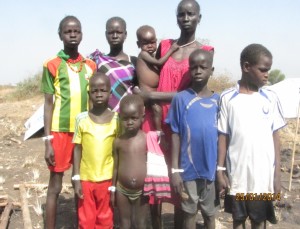
Nyagnet Req and children

Since mid-December 2013, the world’s newest nation, South Sudan, has been the setting of a political crisis turned violent. According to a May 16, 2014, report from the United Nations, more than 1.3 million people have been displaced as a result of the armed fighting, and more than 4 million people are facing acute food insecurity.

Despite an agreement to cease hostilities on Jan. 23, 2014, the violence continues. One of the most fought-over towns is Malakal, the capital of oil-producing northern Upper Nile state. Many people in Malakal have been forced to flee to escape being caught between the warring parties.

Nyagnet Req, the mother of seven children, is one of those people. This is her story.

On Jan. 13, 2014, Nyagnet went to a nearby river to get water for her household. This was part of her daily routine. However, when she was returning home on that day, she witnessed first-hand the disaster as it hit her town. The town had been taken over by heavy armed fighting. Gun shots were flying as parents were running to gather their children. Nyagnet says she only has blurred memories of how fast she ran to collect her children and escape.

“It was the worst day of my life,” Nyagnet says.

Nyagnet and her three sons and four daughters were traveling on foot. After days of walking, they reached the Ethiopian border town, Matar. Matar is one of the entry points in the western region of Ethiopia.

On Jan. 23, 2014, Nyagnet and her family were placed in Lietchor camp. The camp has modest temporary shelters and basic sanitation facilities. Food and clean water are Nyagnet’s primary concerns.

Since Nyagnet and her children had to flee so quickly, she lost contact with her husband, who was working for the government in road construction at the time the clashes occurred in their town. She has no knowledge of where he is, and she has no way to let him know where she is.

Nyagnet’s story is similar to the stories of the many who have had to flee their homes as a result of the conflict in South Sudan. Many families had to leave on a moment’s notice, with no time to grab belongings or supplies, and family separation is one of the most prevalent results of the conflict.

Providing Hope and Healing

Lutheran Disaster Response, in partnership with The Lutheran World Federation (LWF), is providing assistance to accommodate the 20,000 refugees at Lietchor camp. Boreholes are being drilled to construct a motorized water supply system, hygiene supplies are being distributed, and sanitation awareness programs are being implemented. In addition to these life-saving activities, we are working with LWF to provide agricultural livelihood restoration programs.

The months of conflict and the fear of returning home to nothing take a toll on families who have had to leave everything behind for their safety.  Lutheran Disaster Response has been present from the beginning, providing assistance within South Sudan and to refugees in Ethiopia, Uganda, Kenya and Chad. We will continue to be present and provide assistance where it is needed most, for as long as it is needed. Your gifts designated for the South Sudan Conflict Response will help assist those who have been directly impacted.

Who will separate us from the love of Christ? Will hardship, or distress, or persecution, or famine, or nakedness, or peril, or the sword? No, in all these things we are more than conquerors through him who loved us. Romans 8:35, 37

Share

Living Earth Reflections: Fear and Hope

Mary Minette, ELCA Director of Environmental Advocacy

​May 2014​

​”Why are you afraid, you of little faith?” – Matthew 8:26

Like the disciples in Matthew, we are only human and often fear the unknown, the disruptive, the strange. But as the disciples learned, faith in God can help to still our fears and generate hope even in the midst of disruption and storm. ​

Recently the Intergovernmental Panel on Climate Change (IPCC) released the first and second parts of their fifth assessment on the current state of scientific research regarding climate change. The first part of the report once again confirmed that the majority of that research supports the conclusion that global average temperatures are increasing as a result of human activity, primarily the burning of fossil fuels to generate energy, and that temperature increases are driving significant changes in earth’s climate.

The second section of the report, titled “Climate Change 2014: Impact, Adaptation and Vulnerability” confirms for the first time since the IPCC began releasing these assessments more than two decades ago that impacts of this human-caused climate change are now observable around the globe, and highlights the extreme vulnerability of low income people to these impacts both now and in the future. The IPCC report predicts with a high degree of certainty that climate change will have significant, negative impacts on global food security unless emissions of carbon dioxide and other greenhouse gases are cut dramatically. Rising temperatures and increased drought is already impacting staple crop yields in some regions, and those impacts will continue; the report also predicts declines in fish populations as ocean temperatures grow warmer — between 40 and 60 percent in tropical regions. It also outlines how freshwater resources are already under strain in many areas as glaciers retreat, endangering the water supplies that billions depend on for drinking, sanitation and growing crops.

Adding to this sense of urgency, on May 6 the White House released the third National Climate Assessment, a report summarizing contributions from scientists working for government agencies, academic institutions and non-profit organizations around the United States. The report outlined the current impacts that climate change is having around the country, ranging from coastal flooding to extreme drought.

These reports are pretty frightening, and they could lead us to the kind of hand-wringing fatalism engaged in by Christ’s disciples in the story told in Matthew: before Jesus wakes and calms the waters, they are loudly proclaiming their imminent death, having lost sight of the fact that they have the Son of God on the boat with them.

When something big and momentous (and scary) is about to happen in Scripture, God often sends a messenger to those who will be most affected. He sends an angel to Mary to tell her that she will bear the Son of God — and his first words to her are, “Do not be afraid.” Mary responds positively to this message, praising God and rejoicing in this gift. In contrast, when her kinsman Zechariah prays for a child, and God sends an angel to tell him, “Do not be afraid,” and that his wife, Elizabeth, will bear a child, he rejects the message and God strikes him mute until the event comes to pass. Zechariah, like the disciples, gives in to his fear.

So how should we respond to the big, scary news in the IPCC reports? Do we let our fear rule and throw up our hands, proclaiming that the end is near? Do we ignore the message (and the messengers) like Zechariah and fail to see that God offers us hope in the midst of troubles?

Or do we put our faith in God and live in the hope of the risen Christ, rejoicing in the abilities that we have been given to adapt and respond to this challenge? Instead of giving in to despair, can we welcome the opportunity to change our hearts and our ways, embracing what can be done to use less energy, to move to a fossil-free energy future and to help our most vulnerable neighbors adapt to weather extremes and other climate impacts?

Climate change is happening, but do not be afraid. God is with us.

​—-

Want to learn more about ELCA’s commitment to advocating for public policy that supports the care for creation?  

Visit our website

Like us on Facebook

Follow us on Twitter ​

Share

Index of the May 2014 Issue

Issue 34 of Administration Matters

Campaign for the ELCA
Always Being Made New: The Campaign for the ELCA, is the first-ever comprehensive campaign for our church, approved by the 2013 Churchwide Assembly in response to God’s call to love and serve our neighbors, to boldly respond to the needs of the world with a living, daring confidence in God’s grace. It seeks to raise $198 million in support of new and expanded churchwide ministries above and beyond those supported by regular weekly offerings. >more

Ethics Policy for Congregations
Adopting an ethics policy is the best practice to help clarify fiduciary duties and address conflicts of interest or appearance of conflicts. >more

Tips for web managers – copyright
Copyright and trademark laws apply to online publishing. In order to use someone else’s work on your website you must get permission from the author or creator of the work. >more

ELCA Group Ruling Tax Exemption
An ELCA IRS ruling certification letter can be used when you apply for bulk mailing permit, state sales tax exemption, to receive grant or matching funds, estate settlement or simply for proof of tax exempt status. >more

Information Security Awareness
Security breaches and stolen personal information are in the headlines too often these days. To prevent your congregation from losing members data, review this updated guide to information security. >more

Reducing risk – cell phones while driving
Congregations should consider creating a “no cell phone use while driving” policy for all employees and volunteers that is more expansive than what state and local laws may already require.  >more

Share

Lutheran Pastors Travel to D.C. to Advocate for the World’s Most Vulnerable

Tia Upchurch-Freelove, ELCA Advocacy Office

May 14, 2014

​Last week, faith leaders from across the country traveled to Washington, D.C., to speak out in support of f​​unding for life-saving humanitarian and poverty-focused development assistance (PFDA) programs.

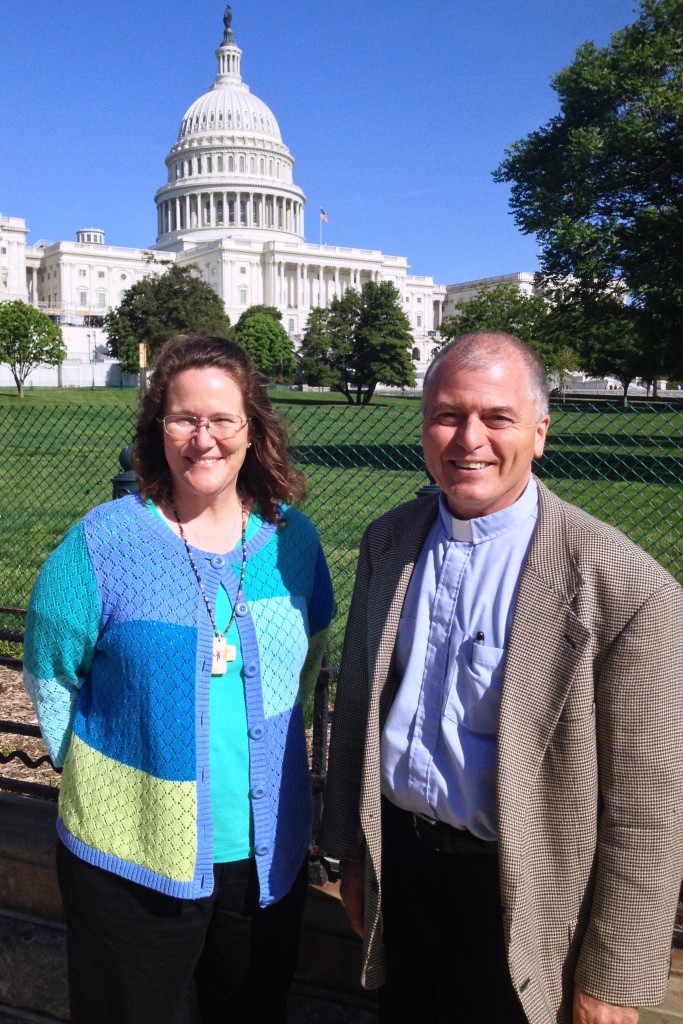
Two ELCA pastors, the Rev. Amy Truhe and the Rev. John Backus, joined these leaders on Capitol Hill to share their commitment to promoting the dignity of all people, including the world’s most vulnerable. The Rev. Amy Truhe serves as pastor for Scherer Memorial Lutheran Church in Chapman, Kan. The Rev. John Backus visited from Trinity Lutheran Church in Omaha, Neb., where he co-pastors with his wife, the Rev. Liz Backus.

I met with Pastor Truhe and Pastor Backus before their day on Capitol Hill to ask why they felt compelled to advocate for policies that provide support to those living in poverty and suffering from hunger.

Pastor Amy Truhe_Pastor John Backus

Pastor John Backus: My son is from Thailand and is 29 years old. When I adopted him he was between 3 and 5 years old. When I got him he was dying of malnutrition. It was a year of having enough to eat every day and having all the things he could ask for as a child growing up in rural Minnesota before he stopped hiding food in his room … before I could get him to stop stealing from his playmates. … That changed him and he is still repairing the damage done. Every child on the face of the planet that goes to bed hungry is a threat to the safety and security of those who have enough to eat.

Pastor Amy Truhe: We are so immensely gifted that we don’t understand what we have. My sister [who was adopted from Korea] was left in a box because her mother didn’t have enough and couldn’t take care of her child. How horrible for a mother to have to make that decision! I am here because I feel passionate about this.

Pastor Truhe went on to describe that even after working with children who live in the U.S. and have experienced extreme poverty here, it is still difficult to imagine living in a place where those who are hungry cannot even attempt to scrounge for food because there are no extras.

After the pastors met with congressional offices, I caught up with Pastor Backus to ask how his experience has helped shape or alter the way he views advocacy in the ELCA.

Pastor John Backus: I am glad that the ELCA is involved in advocacy for those who have less than they need. It is important, as we give aid to people and help them become more food-safe, that we ask [those in] power the question, “Why do hunger and need continue to exist on a planet of abundance?”

I will be telling other ELCA Nebraskans what a positive experience we had in D.C. … I will also encourage people to speak with their representative[s] and senator[s], [to tell] those folk of their concern for the world’s poor. 

We thank Pastor Backus and Pastor Truhe for their hard work and dedication to ELCA’s advocacy efforts.

​—

Do you feel inspired to help feed the hungry and fight poverty? Your gifts are urgently needed to support out church’s response to the root causes of hunger and poverty.

Visit ELCA World Hunger to donate today!

Share

Typhoon Haiyan: Recovery Work Continues Six Months Later

Megan Brandsrud

Typhoon Haiyan banner photo

Six months ago, Typhoon Haiyan (known locally as Yolanda) crashed into the Philippines. As one of the strongest storms in recorded history, it affected more than 14 million people and destroyed approximately 1 million homes. More than 6,200 people were reported dead as a result of the storm, and more than one thousand people still remain missing.

Working with Lutheran World Relief, Lutheran Disaster Response was active on the ground in the Philippines days after Typhoon Haiyan made landfall. A lot of recovery work has been done in the past six months. Projects have involved shelter repair, cash-for-work programs, non-food item distributions, livelihood rehabilitation, and water and sanitation intervention programs.

Here is a breakdown of some of the recovery projects in process:

Shelter: Working with Habitat for Humanity Philippines, 1,457 households have received shelter repair kits, which have impacted 7,285 people. Repair kits include things such as plywood, coco lumber, iron roofing sheets, nails, hammers and saws. These kits allow people to return home.

Cash-for-Work: More than 18,000 people have participated in cash-for-work debris removal programs. This means that people are able to contribute to their community by taking part in clean-up efforts, and they can receive money to be able to make prioritized spending decisions that are right for their family. Cash-for-work programs are beneficial because even though millions of people were impacted by the same disaster, they were impacted in different ways and have different needs as they recover.

Water: The availability of clean drinking water was a major concern tackled after the storm, and 240 community water filtration units have been installed in child-friendly places, such as schools.

Delia Moreno is a grandmother to three children. She and her grandchildren were in her home in Maya barangay of northern Cebu when Typhoon Haiyan was approaching. They quickly ran to a neighbor’s sturdier home for shelter.

“We ran for our lives,” Delia said. “I prayed that I would receive God’s graces and survive the storm.”

They all survived the storm, but Delia’s house did not. When they emerged from her neighbor’s home, they saw that all that remained of Delia’s home was a pile of debris.

However, on Nov. 23, just two weeks after Typhoon Haiyan destroyed her home, Delia received a shelter repair kit and with the help of her nephew, she rebuilt her home.

“I am so happy,” she said.

There have been great strides in recovery in the six months since Typhoon Haiyan hit the Philippines, but there is still a long way to go. Thanks to your generosity, Lutheran Disaster Response is able to work with our brothers and sisters in the Philippines as they continue to rebuild and recover. To help provide assistance to those who need it most, you can give a gift to the Lutheran Disaster Response – Pacific Typhoon fund. Donations from people like you allow the church to be present and active in this long journey to recovery.

The one who began a good work among you will bring it to completion by the day of Jesus Christ. -Philippians 1:6

Please visit the Lutheran Disaster Response Facebook page for more photos of Typhoon Haiyan recovery projects.

Share

“Our God Shows Up to Fight for Justice” – Reflections on Advocacy Efforts Throughout the World

Lauren Blatt, MDiv Student, Lutheran Theological Seminary – Pennsylvania

​May 12, 2014​

​​​

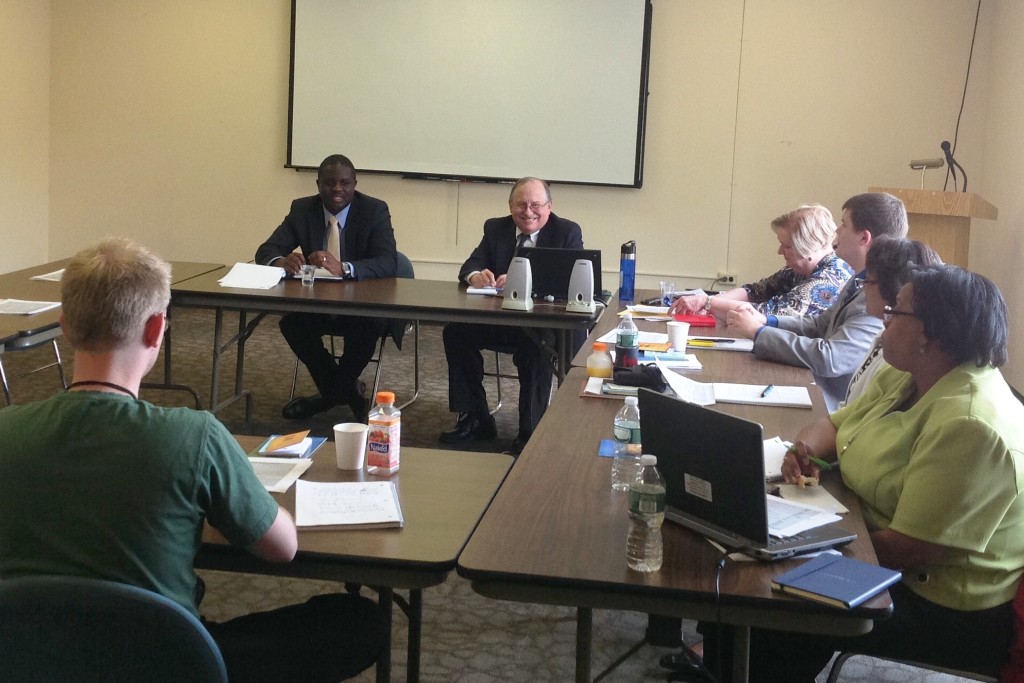
Last week, the Lutheran Office for World Community (NY) hosted the 2014 Nolde Seminar on Theology and Human Rights. The seminar explores questions about the dignity of human life, its relation to Christian and spiritual values, and the challenges facing the international community. ​This call to focus on international human rights was inspired by Dr. Frederick Nolde​ and his family. Dr. Nolde was Dean of the Lutheran Theological Seminary in Philadelphia and taught Christian Education from the 1940’s through the 1960’s. He helped influence the UN Charter in promoting global human rights, and wrote the Religious Freedom section in the United Nations’ Universal Declaration of Human Rights.  ​

Lauren Blatt, ​who is presently attending the Lutheran Theological Seminary in Philadelphia to achieve a Master’s of Divinity, gives us her insights into the 2014 Seminar below.​

​Finding God’s Work

The thing about God is that you can never be quite sure what God is up to… As people of faith, we look at the entire world through theological spectacles even when we don’t try. It’s not a conscious recollection of what God has done in our lives or a realization of what God is doing in our lives. This is just how we see the world and how we see God. That is not to say that we don’t get angry or throw our hands toward the heavens in exhaustion and wonder at times why God has yet to make things right. We expect quick answers, we expect our infinite and intimate God to topple the systems of oppression in our society, but that is not quite who our God is…Our God is a God who shows up in the suffering. Our God shows up in the last reasonable place we would ever think to look. Our God shows up in a stable, walking the dusty roads, and on a cross to die the death of a criminal.

What is more, our God shows up to fight for justice with us. Our God accompanies us as we consider the evils of our society. Our God opens our eyes and breaks our hearts when the least, the last and the lost experience great upsets—Suddenly we realize that WE ARE the least, the last, and the lost. We realize that we have nothing more than the marginalized, the downtrodden, or the heartbroken. We have what they have, namely Jesus the Christ.

​Over a three-day stint we met with members of the United Nations community. We met with people affiliated with faith-based organizations, and we met with individuals who worked on a strictly secular basis. We heard speakers from across the world and within various different disciples. We heard about apartheid in the Holy Land, the reconciliation efforts in South Africa, the global food crisis, and many other important topics. We were exhausted, not simply because we were jam packed with speakers, but because we were moved and propelled by the Holy Spirit to consider action. Our hearts were moved by God through the mouth of every speaker to seek justice and love mercy, all the while knowing that Christ walks with us in our times of great triumph and immeasurable pain.
Nolde_4_Ambassador Mashabane


We began to recognize the myth that our church is dying—that all churches are dying. We were moved to realize that our God is doing something amazing in this world, our God is doing something incredible in this world, our God is doing something in this world—it is so bright. God is not finished with this world, and our God loves us more than anything we could ever imagine. Our God is a God of abundance—abundant love, blessing, perseverance, and above all abundant accompaniment—our God will never leave us. ​

Living Through Christ

The author of the Gospel of Luke writes (referring to Jesus), “We had hoped that he was the one to redeem Israel…” There is nothing that gets to the heart of disappointment, the heart of what it meant to be human than to say, “We had hoped”. It refers to the disciples’ hope that Jesus was the one that they had waited for throughout history—the one who would finally take away the pain. The disciples knew what it was like to live in a world of sin and death. Even after Jesus is raised from the dead, it is clear that the disciples and the rest of the human populace still live in a world of sin and death—they still live in a field of crosses. Each and every one of us is still hanging on the cross because we have not yet been raised. A life lived for Christ, a life propelled by Christ, is a life that is lived cruciform. We live in relationship to God (vertically), but the only way that this relationship works is through the relationships that we have (horizontally) with our brothers and sisters on earth. It is through our love for our neighbors that we are able to love God. When we realize that Christ is in every person our hearts burn in the knowing, but our hearts also burn with justice—knowing that the grace that God has given us is one that demands a response. This response remains separate from our salvation, but it is a response that happens when the grace of God overflows from our cups.

The reality of the United Nations is one that we, as Christians, and as humans can be proud of… like Mother Theresa writes, “We have forgotten that we belong to one another”. We belong to each other. We are all one. We must take action against sin, death, and the devil—we must take action against injustice because every human has inalienable rights that reflect the human’s relationship to God. We are made in God’s image and because of this reality we are bearers of God. God resides in us, our faces reflect the face of God, and actions against humanity—crimes against humanity, against human dignity are against God. There is much work to be done in our world, and we recognize how easy it is to throw our hands in the air after pure exhaustion, but the reality is that our God calls us to action. To steal the Evangelical Lutheran Church in America’s phrase, “It’s God’s work, our hands”.

Jonathan, Trena, Joshua, Theresa, Jessica, Daniel, and I were honored to spend time with representatives to the United Nations and our brothers and sisters in Christ.

Want to learn more about ELCA’s commitment to advocating for public policy that creates opportunities to overcome poverty, promotes peace and justice, and supports the care for creation?

Visit our website

Like us on Facebook

Follow us on Twitter

Share

10 Facts on Women and Hunger

Henry Martinez

1.    In developing regions, the proportion of people living on less than USD $1.25 a day fell from 47 per cent in 1990 to 22 per cent in 2010. Extreme poverty is also falling in every region.1

2.   Hunger and poverty remain stubbornly ‘feminized’ – globally, 70 percent of people living in absolute poverty are female.2

3.   Surveys in a wide range of countries have shown that 85 to 90 percent of the time spent on household food preparation is spent by women.3

4.  Women are much more likely to earn poverty-level wages than men. In 2011, 32 percent of women earned poverty-level wages or less, while 24.3 percent of men earned the same.4

5. Globally, malnourished mothers are more likely to give birth to underweight babies. Underweight babies are 20 percent more likely to die before the age of five.5

6. Women’s labor force participation in Latin America and the Caribbean region has risen 35 percent since 1990 (a more dramatic rate than any other region). It is estimated that between 2000 and 2010 extreme poverty in the region would have been 30 percent higher if not for women’s participation in the labor force.6

7. Women make up the majority (66 percent) of sub-minimum wage workers (earning $2.13 an hour) in tipped restaurant occupations, compared to 48 percent of the non-tipped restaurant workforce (earning $7.25 an hour).7

8. Higher education opportunities for women and girls are crucial for battling poverty. The gross enrolment rate for girls at lower secondary level increased from 69 to 81 percent between 1999 and 2010, and from 43 to 58 percent at the upper secondary level in the same period.8

9. Researchers estimate that rural women produce half the world’s food and, in developing countries, between 60% and 80% of food crops.9

10. The Food and Agriculture Organization estimates that if women had the same agricultural access to resources and markets as men yield gaps would be closed by 20-30%, reducing the number of undernourished people by 100-150 million.10


Sources:

http://www.unwomen.org/en/news/in-focus/mdg-momentum#MDG1. The Millennium Development Goals Report 2013, 7. Access: http://www.un.org/millenniumgoals/pdf/report-2013/mdg-report-2013-english.pdf.

2 Bread for the World Hunger Report (2014), 160.

3 http://www.wfp.org/our-work/preventing-hunger/focus-women/women-hunger-facts

4 Lawrence Mishel, Josh Bivens, Elise Gould, Heidi Shierholz, “The State of Working America,” 12th Ed. (Cornell University Press, Noevember 2012), 193.

5 “Progress for Children: A World Fit for Children Statistical Review,” UNICEF, (December 2007), p.7.http://www.unicef.org/progressforchildren/2007n6/files/Progress_for_Children_-_No._6.pdf

6 “Gender at Work: A Companion to the World Development Report on Jobs,” the World Bank Group (2013), p. 8.

7 “Tipped Over the Edge: Gender Inequality in the Restaurant Industry,” Restaurant Opportunities Centers United, 2012 report, 9.

8 “From Access to Equality,” United Nations Educational, Scientific, and Cultural Organization Report (2012), p.22.

9 FAO Focus on Women and Food Security, prepared by the Women in Development Service, FAO Women and Population Division, FAO, Access: http://www.fao.org/sd/fsdirect/fbdirect/fsp001.htm.

10 “The State of Food and Agriculture 2010-2011,” Food and Agriculture Organization report,http://www.fao.org/docrep/013/i2050e/i2050e00.htm.

Share