Skip to content
ELCA Blogs

Faith Lens

April 19, 2026 – When Easter Hope Isn’t all Shiny and Pastel

Prepare

The Road to Emmaus story is chock-full of theological imagery and imagination. We meet disciples and Jesus on the road and yet something is keeping the disciples from recognizing Christ. There’s a lot that could be explored as to why the disciples don’t recognize Jesus throughout their entire conversation, especially in light of other resurrection stories we have about Christ where folks recognize him immediately. Moreover, it is theologically significant that his identity is revealed through the Eucharist. It is as they break bread that Christ is recognized for who he is. The meal is the disciples “touching of the wounds” moment that Thomas was so desperate for. The meal is where Jesus is the most recognizable version of himself.

The gospel of Luke, more than the other gospels, emphasizes roads and journeys for both Christ and people of faith. It is fitting, therefore, that we meet Christ on the road as the disciples’ doubts, questions, and pain swirl around them. Their movement in the passage reflects where the disciples are in their processing. They are moving and progressing forward as they are vulnerable with each other and this stranger. When they cry out that they had hoped Jesus really was the messiah, they reveal their underlying fear: it now appears he was not. It isn’t until right before Christ is revealed to them that they find a place to stop and sit with their grief. Once he is revealed, the disciples are on the road again, this time to redeem the story that was told as they left. 

Opening Exercise

Are you currently hoping for anything in particular? What does it feel like to hope for something with true hope (something you cannot work towards on your own, but something you have to trust God, or someone else, to come through for you?). 

Read the Text:

Luke 24:13-35

When Easter Hope Isn’t all Shiny and Pastel

A few years ago I was talking with a friend about her husband’s cancer diagnosis. In this conversation I could feel the
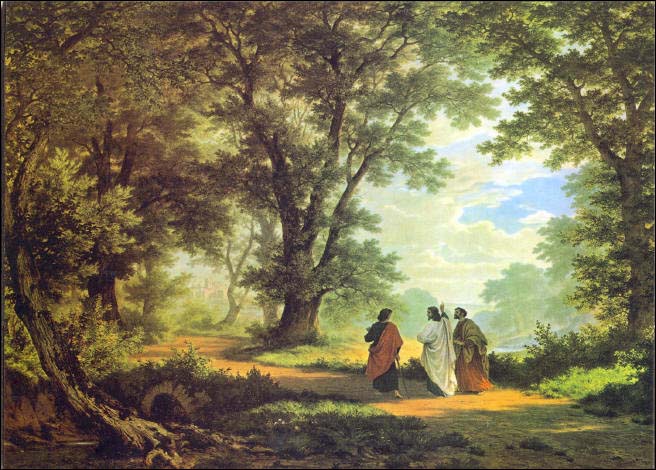
The Road to Emmaus (Gang nach Emmaus), 1877, by Robert Zünd. Public domain, via Wikimedia Commons.

sadness and frustration starting to get me down so I said something along the lines of “but we’re hopeful the next treatment will work!” I am ever the person to add sugar to a terrible situation. Luckily, my friend was willing to be honest and vulnerable with me. She said, “honestly, I’m feeling kind of burned by hope. I’d rather not.” I was stunned…Isn’t hope a good thing? 

But she shared that they’d been hoping. That they had hoped the tumor wasn’t cancer at all and then it was. They had hoped the cancer wouldn’t progress and then it did. They had hoped chemo would work and then it didn’t. She, like the disciples on the road in our story, was tired of hope.

When you think about it, hope sets us up to be burned a time or two because, when we start hoping, our whole demeanor changes. We go from a place of accepting our circumstance to dreaming about what things could be like if God, or someone more powerful than we are, stepped up. It’s the dreaming that makes hope dangerous. The disciples who met Jesus on the road had been hoping that Jesus was going to redeem Israel. When it looks like that hasn’t and won’t happen, they are down worse than they were before they met Jesus. They are more upset than when they had no hope.

Easter Hope

What really gets the disciples is that they assume this is the end of the story. They have left the other disciples, wallowing as they walk back towards their lives before hope. But that isn’t how Jesus works. They stop having hope because they tied their hope to very specific outcomes. They hoped that Jesus would redeem them in an earthly battle. They hoped Jesus would never die. They hoped in far smaller ways than our God works. 

When Jesus is revealed in the meal, what the disciples start to see is that their hope made Jesus way too small. They didn’t need to hope he wouldn’t die, because he overcame death. They didn’t need to hope that Jesus would win some earthly battle leaving some new people to be corrupted by power while others struggled. Christ brings the Kingdom of God in which there is abundance for everyone and nobody is lesser than anyone else. This story shows us the danger of hope in our world, not because we might be disappointed (though that’s always a bummer), but because if we hope with too much specificity we might miss who God is altogether. 

When we hope, we hope in a God who is doing far bigger things than our imaginations can handle. The same God who has kept my friend’s husband alive and well for far longer now than any doctor expected.

Reflection Questions

  • What do you think the disciples had hoped would happen instead of the cross?
  • When have you missed, or almost missed, something really good because you were hoping for something else?
  • How can we hope while being faithful to how gigantic our God is? How do we make sure our hopes aren’t putting God in a box?

Closing Activity 

Have students get into pairs and share their hopes. Invite them to gently “correct” each other until their hope is Christ sized, not limited to our own imaginations.

Here’s an example:

  • I hope my friend gets better.
  • I hope my friend is no longer in pain or the hospital.
  • I hope my friend is able to live a rich and happy life with/without their illness.

Once each student has a God-sized hope, share them with the group.

Closing Prayer

Prayer of Good Courage:

O God, you have called your servants
to ventures of which we cannot see the ending,
by paths as yet untrodden, through perils unknown.
Give us faith to go out with good courage,
not knowing where we go,
but only that your hand is leading us
and your love supporting us,
through Jesus Christ our Lord.  Amen.

Bio

Lindsay Batesmith is the pastor of Rejoice Lutheran Church in Erie, CO. She is consistently in awe of the power of vulnerability to connect us to each other and invite the Holy Spirit to transform lives. When not at church or her favorite coffee shop, Lindsay is usually playing with her dog, Echo, or watching the Great British Bakeoff with her wife, Tillie.

April 5, 2026 – The Interruption of Easter

Prepare

The gloom and despair of Matthew 26-27 hangs over the beginning of chapter 28. Those who had followed Jesus, who had been welcomed by his grace, had lost everything. All of their hopes had been cruelly nailed to the cross with violent and stunning finality. Many of those close to him, fearing for their own lives and darkened by unspeakable despair, hid in a room. Three women who had followed him, however, forced themselves to bring honor to Jesus one last time, heading out early in the morning to anoint his broken, scarred, dead body for burial.

Jesus had interrupted their lives with the call to follow him. It was an interruption that took them places they never dared dream possible.

But now, his execution put paid to all of that.

Until…

Opening Exercise:

When you hear the word, “Easter,” what memories/feelings/images/stories does it conjure up for you?

Text Read Aloud:

Matthew 28:1-10

A Bike Crash and the Empty Tomb

On March 11, 2019, I was finishing up a 20-mile bike ride. I’d been riding the bike paths of Glendale, Peoria, and Phoenix, AZ for over 13 years. To that point I had cycled over 40,000 miles! Starting out the day with an early morning ride was one of the best parts of my day. In fact, it still is!

But that day, about two miles from my house, riding around a corner I had ridden dozens of times, my front tire slipped on some loose gravel and I fell. Hard. My right shoulder and head did battle against the cement path. Thanks to my helmet, my head won. My shoulder, however, lost. Badly.

I wasn’t in pain, but the first thing I noticed, after getting up off of the ground, was that my right shoulder was several inches higher than it should be.

I had blown up all of the ligaments that held my shoulder together. Two weeks later I was in surgery.

That split second interrupted my life for several months. Being right-handed and now in a harness, it interrupted my eating. My teeth brushing. My sleep­­; I slept in an easy chair for 12 months! My ability to type/text. My bathing habits. My ability to show up and lead worship. My ability to drive and hug my grandkids.

Interruptions are a part of life. Moments that can reset the paths of our lives. Some of those interruptions impact us positively: falling in love; graduating high school; starting a job; gaining new friends; moving to a new city. Others can set us back and negatively impact our lives: cancer; the loss of a loved one; divorce; an injury.

Sometimes those interruptions break us.

Easter’s Interruption

Matthew’s Gospel recounts an interruption that not only changed the trajectory of two women’s lives, but one that continues to reverberate to this day; an interruption that changes everything.

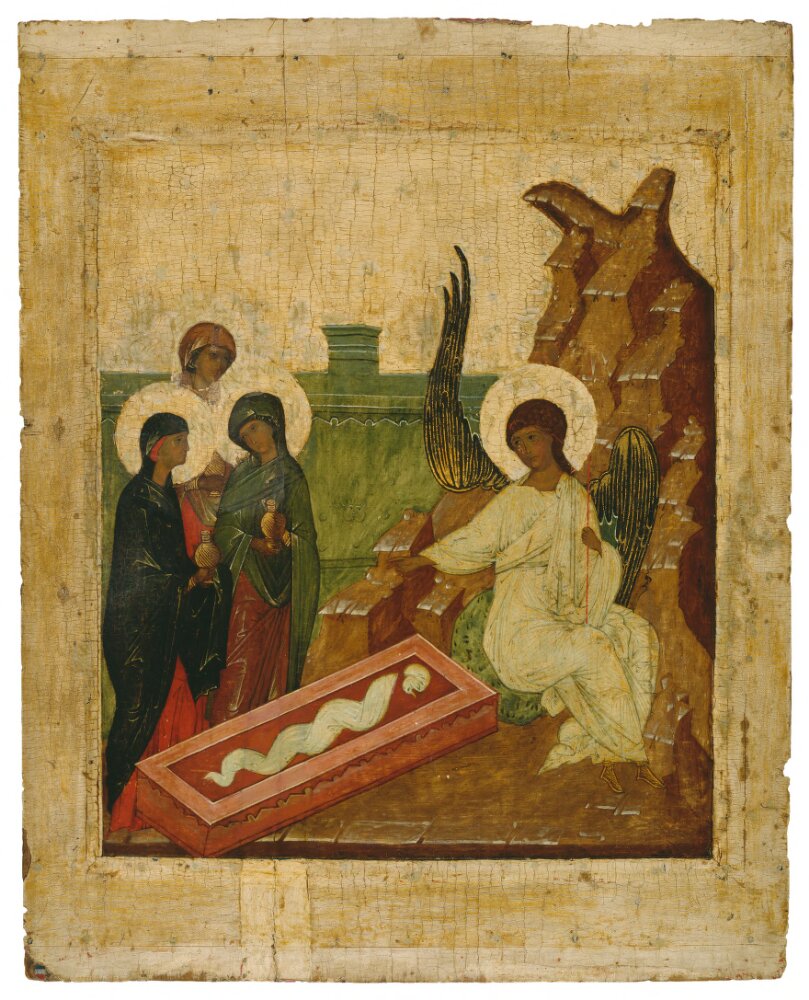
The Women at the Tomb, Novgorod School icon, 15th century. Public domain image via Wikimedia Commons.

2000 years ago God interrupted human history when God’s grace exploded out of a tomb in Jerusalem, interrupting:

  • Death with life
  • Sin with forgiveness
  • Despair with hope
  • Anxiety with peace
  • Grief with the presence of God

For three years, Jesus made his way throughout Israel interrupting people with the call to follow him; to live as loved and forgiven people; to live as loving and forgiving people. It was a call that changed the trajectory of the lives of all who followed him.

Easter’s Interruption

That mission of interrupting people’s lives with God’s grace, however, was seemingly interrupted itself—and finished—when Jesus was crucified.

But God’s grace interrupted that interruption by raising Jesus from the dead. In the process, God interrupted all those interruptions that rob us of life.

Easter, the interruption of God’s grace, changes the orientation of our lives. It roots our lives in God’s love for us. It holds us steady through all the ups and downs and all the interruptions thrown at us in this life.

And that grace, that unconditional love that God has for you and for me, is the one thing in life we can always count on. It’s the one thing that no interruption can ever interrupt.

Today, Jesus, the crucified and risen Savior comes to interrupt your life with grace. He says to you:

  • You are mine
  • You’re my child
  • I love you

No matter what life throws your way, I will always be there for you. I will always have your back.

So follow me as I interrupt your life with my grace!

Reflection Questions:

  • How do you think the women felt when the Angel of the Lord interrupted their visit to the tomb?
  • Think back to one or two positive and negative interruptions in your life. How did they affect you?
  • Why or how does Jesus’ resurrection change everything?
  • How has the call of Jesus interrupted your life?

Closing Activity:

As a group, or as individuals, think about one practical way that you might interrupt the life or lives of someone with a tangible expression of God’s love for them.

Final Blessing:

Choose someone to pray this blessing over the group:

I pray that, according to the riches of his glory, he may grant that you may be strengthened in your inner being with power through his Spirit and that Christ may dwell in your hearts through faith, as you are being rooted and grounded in love. I pray that you may have the power to comprehend, with all the saints, what is the breadth and length and height and depth and to know the love of Christ that surpasses knowledge, so that you may be filled with all the fullness of God. (Ephesians 3:16-19, NRSVue)

Bio

Tim Wright served as an ELCA pastor for 41 years. He and his wife, Jan, have been married since 1979. They have two adult children, five grandchildren, and two dachshunds. They live in Glendale, AZ. You can access Tim’s Reckless Grace Substack at https://recklessgrace.substack.com/ and his Deep-Grace Diving Podcast at https://open.spotify.com/show/4WPRRpqMtUzyPeqcqbqrgv

He is also the author of the middle school series: The Adventures of Toby Baxter. https://www.timwrightbooks.com/

April 20, 2014–Quakes of Fear and Joy

Contributed by Bryan Jaster, Winchester, VA


Warm-up Question

Have you ever been in an earthquake?  Where were you and what happened?

Quakes of Fear and Joy

On April 1st, 2014, an 8.2 magnitude earthquake off the coast shook Chile.  The next day a 7.6 magnitude struck the region.  Landslides, power outages, collapsed buildings, and people fleeing homes resulted.   Tsunami warnings sprang up and first responders were on high alert.

Almost one million people were evacuated.  About 300 prisoners escaped from a prison in Iquique, a northern port city in Chile.  Traffic clogged the many of northern Chile’s streets.  Fear spread as people remembered an 8.8 magnitude quake on February 27, 2010, which killed 500 people and triggered a building toppling tsunami.

In the hours after, a surprising, different story sprang up.  Well planned and executed evacuations saved countless lives.  Most homes and skyscrapers survived unscathed due to well followed building codes developed in response to past earthquakes.  Most of the escaped inmates turned themselves in a week after the quakes.  People have returned home thankful for life.  While the quakes struck fear, the community is now moved by joy and thanksgiving for new life.


Discussion Questions

  • If you had been in the earthquake in Chile, how do you think you would have acted?  Are you surprised the prisoners returned to jail?
  • Should Chile be afraid of future earthquakes?  What have they learned?
  • When has your fear turned into joy?

Scripture Texts (NRSV) for Sunday, April 20, 2014 (Resurrection of our Lord, Easter Sunday)

Acts 10:34-43

Colossians 3:1-4

Matthew 28:1-10

(Text links are to Oremus Bible Browser. Oremus Bible Browser is not affiliated with or supported by the Evangelical Lutheran Church in America. You can find the calendar of readings for Year C at Lectionary Readings.)

For lectionary humor and insight, check the weekly comic Agnus Day.


Gospel Reflection

Easter2014editToday is Easter.  There are flowers, bunnies, chocolate, fancy clothes and joyous songs.  Families gather; crowds worship; good food is eaten and familiar stories are told.

Let’s look more closely at the Easter story from Matthew.  It begins with an earthquake and in fear.

Fear:  The One who they thought might be the messiah may be yet another failure and is gone.

Fear:  When the angel rolled away the stone.  Read again:  “the guards shook and became like dead men.”

Fear:  It was beating in the hearts of the two women named Mary who rushed from the tomb to tell the disciples.

Fear:  When the risen Jesus appeared to the disciples.

And yet, in the Easter story with earthquakes there is joy.  

Joy:  When the women receive the message that indeed Jesus is no longer dead, but risen.

Joy:  The angel beckons the women to tell the disciples he is alive and you will see him in Galilee. They run to tell this news.

Joy: Jesus’ presence and greeting moves the disciples to worship.

Joy:  Jesus gives the disciples a new mission to go and tell.

Easter has quakes of fear and joy present together.  As much as we see the happy, bright side of Easter when we gather today, remember this: The risen Jesus brings both quakes of holy fear and joy into the world.  On this first day of a new week, hear the news that Jesus comes into the world’s quakes, inviting you to witness to resurrection in the middle of both fear and joy. 

Discussion Questions

  • Why do you think the soldiers were afraid of the angel?  Why were the two women named Mary afraid?   Why were the disciples afraid?  Would you have responded as they did?  Why or why not?
  • When has your life been shaken?  How did you get through it?   Why were you afraid?  Did you find joy?
  • As you celebrate Easter, what message do you tell to others?  What does the risen Jesus want you to do?

Activity Suggestions

  • Think of a way you as a group can tell and show the Good News of Christ’s resurrection in your home or in your community.  Do it.
  • Make a plan to visit someone whose life has been filled with fear.  Bring that person food, balloons, cards, candy, tell jokes, and do whatever might bring joy.  Consider a mini parade.
  • Travel to a neighboring town.  Listen and look for ways that Jesus is alive in that community.

Closing Prayer

God of the empty tomb, help us to see you in all of life’s fears and joys.  As earthquakes come, may our fears be transformed into the joy of knowing you.  Help us to go and tell the news that you are alive in our homes, streets, schools and world.  Thank you for the death and resurrection of your Son today.  Amen.

April 22, 2012–It’s a Miracle!

Contributed by John Wertz, Blacksburg, VA


Warm-up Question

Can you think of something that you would describe as a miracle?

 It’s a Miracle!

On Good Friday, a Navy fighter jet lifted off from a base in Virginia Beach, Virginia.  The jet suffered a severe mechanical.  The pilots tried to return to the base, but it quickly became apparent that they were in trouble.  After a short flight, the jet crashed into an apartment complex and destroyed over 40 units.  Amazingly, no one was killed.

According to witnesses and experts, several factors combined to prevent a larger tragedy.  The pilots managed to dump fuel which helped prevent a larger fire.  They waited until the last possible moment to eject from the plane so they could try and guide the plane as long as possible.  The plane hit an empty courtyard and because the accident occurred in the middle of the day, most people were not home at the time of the crash.  After the accident, people on the ground were able to pull the pilots away from the flames to prevent them from suffering further injury.  A total of seven people were hurt, but all of them were out of the hospital within two days.

The response from leaders in the area was clear.  According to the Associate Press article “Virginia Beach Mayor Will Sessoms took to Twitter on Saturday to celebrate the fact no lives were lost, calling it a “Good Friday miracle.” Adm. John C. Harvey, commander of U.S. Fleet Forces, said he was “quite surprised, to be honest”, that no one had died, calling it an “amazing miracle.”  Gov. Bob McDonnell told The Virginian-Pilot newspaper that the lack of loss of human life was “an act of divine providence.”


Discussion Questions

  • The leaders in the area clearly viewed the fact that no one was killed as a miracle.  Do you agree?  Why or why not?
  • How would you define a miracle?

Scripture Texts (NRSV) for Sunday, April 22, 2012 (Third Sunday of Easter)

 Acts 3:12-19

1 John 3:1-7

Luke 24:36b-48

(Text links are to Oremus Bible Browser. Oremus Bible Browser is not affiliated with or supported by the Evangelical Lutheran Church in America. You can find the calendar of readings for Year C at Lectionary Readings.)

For lectionary humor and insight, check the weekly comic Agnus Day.


Gospel Reflection

Mary Magdalene, Joanna, Mary the mother of James and the other women returned and announced the good news.  The tomb was empty.  Jesus had risen from the dead.  Peter ran to see the empty tomb for himself, but he didn’t see the angels or risen Lord.  The disciples on the road to Emmaus returned and shared their encounter with Jesus, but hearing about something miraculous is not the same as experiencing it yourself.  So when Jesus appeared to the disciples, it should be no surprise that the disciples were startled and terrified—or that they initially believed that Jesus is a ghost.

The disciples are trying to make sense of this miraculous event.  Trying to understand how the horrible death they witnessed on Friday night could be overcome.  Trying to understand how God could accomplish something so miraculous.  Encountering Jesus’ ghost would be a little easier to believe, but after touching and seeing his wounds and sharing a meal with him, the disciples are convinced that Jesus has risen from the dead.  It’s a miracle!  Christ’s presence moves them from fear to acceptance, from confusion to clarity.

Miracles, by definition, are occurrences that defy a rational explanation, but for the disciples, the miracle of the Resurrection offered clarity and brought understanding.  Jesus’ resurrection makes it clear that God’s power is greater than the power of death.  Jesus’ resurrection makes it clear that God, through Jesus, is on a mission to love, bless and forgive the whole world.  Jesus’ resurrection makes it clear that as “witnesses of these things”(Lk 24:48), the disciples are called to go and share this miraculous good news with the world.

In this Easter season, we, like the disciples, hear the amazing, miraculous news of the Resurrection.  Like them, we may have moments of doubt and uncertainty.  This truly is an amazing story and although you and I may not be able to touch Jesus’ wounds or watch him eat a piece of fish in person, we can still encounter the risen Jesus today.  We encounter Jesus through the story of what God has done and is doing for God’s people.  We encounter Jesus as we experience God’s presence through the bread and wine of communion and as we are surrounded by the community of God’s people.  We encounter Jesus as we hear God’s Word through the story of the scriptures.  As we, like the disciples, encounter Jesus we can believe the miracle of the tomb empty, receive forgiveness of sin, and rejoice in the hope that thanks to the resurrection we have the promise of eternal life with God.

Discussion Questions

  •  How do you think you would have reacted if you had been in the room with the disciples?
  • What is the first question you would have asked Jesus?  How do you think he would have responded?
  • How can you be a witness to the resurrection in the world today?

Activity Suggestions

Jesus calls us to be witnesses to the good news of the resurrection.  Try one of the following activities this week or develop one that fits your particular community.

  • Create favorite scripture passage posters and place them around the church.
  • Look in the “Contact” list in your phone and text one person who doesn’t have a church home to invite them to worship or a church event
  • Write a handwritten note to someone in the congregation or community who is not able to come to worship
  • Give time to a service project as a way of sharing God’s love.

Closing Prayer

Loving God, we give you thanks for the empty tomb and the risen Jesus.  Fill us with the joy of your love, help us to know your presence in our lives, and inspire us to be your witnesses, sharing the story of the resurrection and your unbreakable love with those around us.  Amen.

April 8, 2012–Open Ended Resurrection

Contributed by Dennis Sepper, University Pastor, Pacific Lutheran University, Tacoma Washington

Warm-up Question

Have you ever experienced something for which there was no explanation?  What happened?  How did it make you feel?

It’s a Mystery…

In the past months two mysteries have made the national news and were all noted on the internet.  The first mystery happened in Le Roy, New York.  Twelve female students from Le Roy Junior Senior High (that’s not a mistake, both Junior High and Senior High must me in the same building or on the same grounds) began experiencing uncontrollable twitching movements and verbal outbursts.  The condition then spread to some adults too.  While the twitching was indeed real no one could explain what was happening…but they sure tried.  The school was checked for mold and chemicals but nothing was found.  Some psychologists stated that it must be stress that is causing the problem.  But in the end no one could explain what was causing the condition.  It remains a mystery.

The second is currently going on is Clintonville, Wisconsin where the residents were awakened by loud sounding booms that rattled their windows.  The event took place in neighborhoods all over town for about four days straight.  No one could figure out what was causing the booms and the city hired a company to explore what might be happening.  Again, people were quick to come up with possible explanations:  pipes were bursting underground or perhaps there were very small earthquakes under the city.  But in the end no one has yet explained what is causing the booms.  It remains a mystery.

Discussion Questions

  • If you identified a mystery in your life thinking about the warm up question, did you or others try to explain what caused your experience?  Were the explanations satisfying or did it remain a mystery?
  • Why do think it is that when we are confronted with a mystery the first response is to try to explain it away?

Scripture Texts (NRSV) for Sunday, April 8, 2012 (Resurrection of our Lord)

Acts 10:34-43

1 Corinthians 15:1-11

Mark 16:1-8
(Text links are to Oremus Bible Browser. Oremus Bible Browser is not affiliated with or supported by the Evangelical Lutheran Church in America. You can find the calendar of readings for Year C at Lectionary Readings.)
For lectionary humor and insight, check the weekly comic Agnus Day.

Gospel Reflection

It is interesting to note that in all four Gospels it is the women who go to the tomb of Jesus and learn of the resurrection first, not the disciples.  In our text today the women are going to the tomb of Jesus to place spices in the tomb to try to overcome the smell of death.  However, they encounter a “young man” in the tomb who tells them that Jesus has risen.  The young man then instructs the women to tell Peter and the disciples that the risen Jesus will meet them Galilee.  Who is this young man?  No one knows for sure, perhaps an angel though Mark doesn’t tell us that.  It remains a mystery.

What happens next?  The women run out of the tomb and go immediately to the disciples to tell them that Jesus has been raised from the dead, right?   No, Mark tells us that “terror and amazement had seized them; and they said nothing to anyone, for they were afraid.”  When confronted with the mystery of the resurrection of Jesus the women react with amazement, terror, perhaps some joy, maybe doubt.  In other words the women react to the mystery the same way we react to a mystery.

And that leads to another fact.  If you look at the end of the Gospel of Mark in a Bible you might see that there are three endings to the Gospel.  One is the ending at verse 8 (our text) and then there is a short ending and long ending that were added by someone in the first or second century who couldn’t accept the mystery but had to have Jesus appear to someone in order to validate the resurrection.

I must say that I like the ending of Mark.  It is a strong proclamation of the fact that the resurrection is a mystery that cannot be explained (remember no one had risen from the dead before and no one has risen from the dead since Jesus!).  The resurrection of Jesus is a mystery to be entered into by faith.  Also, the ending of Mark’s Gospel begs the questions of where do we encounter the Risen Christ today?  To quote one theologian, “the risen Jesus is simply still ‘out there somewhere.’”

Discussion Questions

  • What do you think about the ending of Mark’s Gospel?  What do think Mark is trying to say to us by this ending?
  • How do you feel about the reaction of the women?  They went out expecting the status quo…a dead body, but encountered an empty tomb.  How would you react?
  • How does the risen Christ come to us today?  (Hint to those who are Lutheran that Word and Sacrament should be among your answers!)

Activity Suggestions

There will be some in your church or faith community who will not be able to attend Easter services.  Have your group purchase some Easter cards and send Easter blessings and the Good News that Christ is Risen to the shut-ins, those who are hospitalized or in the military, those in prison or treatment centers and others who you know cannot be there for the Easter celebration.

Closing Prayer

Risen Christ, we give you thanks that by your resurrection the power of sin, death and evil has been defeat and that out of sheer mercy and love you grant that victory to us.  We thank you also that the risen Christ is present to all generations to strengthen us and grant us the courage to serve you and our neighbor.  May our Easter worship and celebrations be worthy of the incredibly good news:  Christ is risen!  Christ is risen indeed!  Amen.

“Our Lord has written the promise of the resurrection, not in books alone, but in every leaf in spring-time.” ~Martin Luther